Pan American Health Organization · 2021
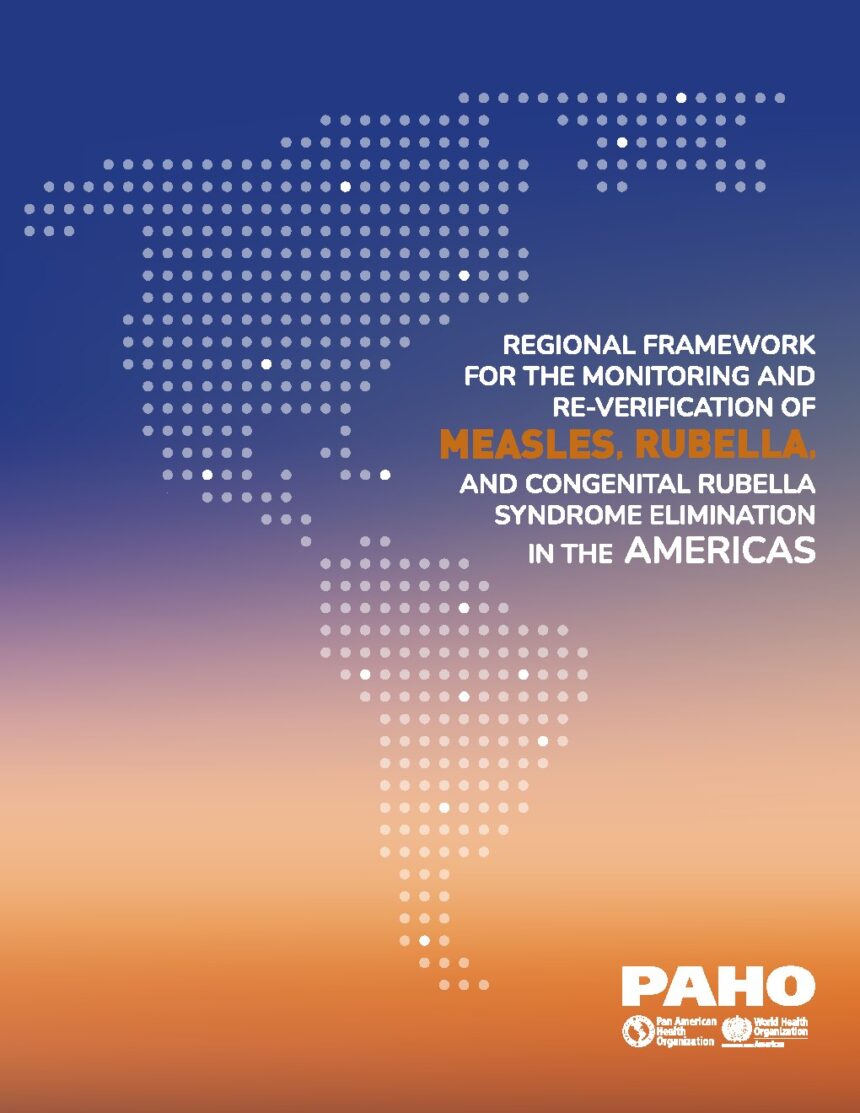
Standardised procedures for PAHO Member States to monitor sustainability and re-verify elimination status of measles and rubella.
- Issuer
- Pan American Health Organization
- Edition
- 2021
- Audience
- National Immunization Programmes, Surveillance Directorates, National Reference Laboratories, National Sustainability Committees, public health officials in PAHO Member States
- Evidence
- Expert consensus based on regional experience and lessons learned from elimination maintenance
- Reviewed
- 19 Oct 2026 · GMJ
What this guideline says
GMJ summary
This framework establishes standardised procedures for Pan American Health Organization (PAHO) Member States to monitor and re-verify measles, rubella, and congenital rubella syndrome (CRS) elimination in the post-elimination era. Following the Americas’ declaration as measles-free in 2016 and rubella-free in 2015, Venezuela (Bolivarian Republic of) and Brazil lost their elimination status in 2018 and 2019, respectively, necessitating new guidance for re-verification.
The framework requires countries to document evidence across six core components: epidemiology; quality of surveillance; molecular epidemiology and laboratory activities; vaccinated population cohorts; sustainability of elimination; and correlation of evidence. Countries that have reestablished endemic transmission must demonstrate absence of virus circulation for at least 12 months following rash onset of the last confirmed case, in the presence of well-performing surveillance systems.
An independent Measles and Rubella Elimination Regional Monitoring and Re-Verification Commission (MRE-RVC) reviews country evidence and provides re-verification. National Sustainability Committees in each country are responsible for approving annual reports and monitoring elimination sustainability. The framework emphasises that rapid outbreak response, homogeneous vaccination coverage ≥95% at all administrative levels, and sensitive surveillance detecting ≥2 suspected cases per 100,000 population are essential to maintain elimination.
Key points
For clinicians — doses and thresholds as stated in the guideline
- Countries must maintain ≥2 suspected measles-rubella cases per 100,000 population annually at national level for adequate surveillance sensitivity
- Vaccination coverage ≥95% with two doses of MMR vaccine must be maintained homogeneously at national, subnational and municipal levels
- Re-verification of elimination requires interruption of endemic virus transmission for ≥12 months following rash onset of last confirmed case
- ≥80% of suspected cases must have household visit within 48 hours of reporting and blood specimen collected within 30 days of rash onset
- ≥80% of outbreaks must have genotype information available to confirm interruption of transmission chains
- Surveillance systems must achieve ≥80% performance on all quality indicators including adequate investigation (8 of 11 data points), contact tracing for 30 days, and laboratory confirmation in proficient laboratories
- For CRS surveillance: ≥1 suspected case per 10,000 live births should be detected, with ≥80% having adequate laboratory confirmation
- Dropout rates between MMR1 and MMR2, and between DPT1/Penta1 and MMR1, must be maintained at minimum threshold of 5%
Measles and rubella surveillance indicators
Table extracted from the guideline
| Criteria | Indicator | Minimum threshold |
|---|---|---|
| Reporting Rate | Annual rate of suspected measles and rubella cases at the national level | ≥2 per 100,000 population |
| Reporting Rate | Annual rate of suspected measles and rubella cases at the subnational level | ≥2 per 100,000 population (or ≥1 case if population <100,000) |
| Suspected Cases Adequate Investigation | Percentage suspected cases with household visit within 48 hours following reporting | ≥80% |
| Suspected Cases Adequate Investigation | Percentage suspected cases with 8 of 11 data points completed | ≥80% |
| Confirmed Cases | Percentage confirmed cases with contact tracing for 30 days | ≥80% |
| Laboratory Confirmation (adequate specimens) | Percentage suspected cases with blood specimen collected within 30 days of rash onset | ≥80% |
| Laboratory Confirmation (adequate specimens) | Percentage suspected cases with respiratory specimen collected within 7 days of rash onset (up to 14 days) | ≥80% |
| Laboratory Confirmation (adequate testing) | Percentage suspected cases with adequate blood specimens tested in a proficient laboratory | ≥80% |
| Viral Detection | Percentage outbreaks with genotype information available | ≥80% |
Source: Pan American Health Organization, Regional Framework for the Monitoring and Re-Verification of Measles, Rubella, and Congenital Rubella Syndrome Elimination in the Americas. Reproduced in summary form.
What changed in this edition
Versus the previous edition
- Endemic countries must now document absence of measles or rubella virus transmission for more than one year (previously varied) to meet re-verification criteria
- Establishment of new Measles and Rubella Elimination Regional Monitoring and Re-Verification Commission (MRE-RVC) in 2019, replacing the former International Expert Committee (IEC)
- Introduction of standardised template for country reports with two parts: one for all countries monitoring sustainability and one specifically for countries applying for re-verification
- Development of measles and rubella country profile as stand-alone document to facilitate data analysis, updated annually
- Updated operational case definitions including new category of 'reestablishment of endemic transmission' defined as continuous chain of transmission ≥12 months in defined geographical area
From the guideline
Verbatim
“It is not enough to maintain high and homogeneous vaccination coverage with two doses of vaccine or to detect suspected cases through a passive surveillance system: these strategies should always be accompanied by a rapid response with appropriate interventions.”
Editor’s perspective
Why this matters for Georgia and the region
Prof. Giorgi Pkhakadze, MD, MPH, PhD
Editor-in-Chief, Georgian Medical Journal · Chair, Public Health Institute of Georgia · WHO consultant, health and migration
As Chair of the Public Health Institute of Georgia and WHO consultant on health and migration, I recognise this framework's critical relevance for the South Caucasus, particularly given population mobility between Georgia, Armenia, Azerbaijan and neighbouring endemic areas. The framework's emphasis on 'drop-by-drop' transmission in high-density urban areas with apparently adequate coverage is a phenomenon we must monitor in Tbilisi and other cities, especially among mobile and migrant populations. I would stress to Georgian clinicians the 48-hour window for household investigation of suspected cases and the requirement for ≥80% laboratory confirmation in proficient laboratories—our national reference laboratory must maintain this standard. The framework's experience during COVID-19, showing 73% decline in suspected case notification, mirrors challenges we faced in Georgia; our National Immunisation Programme must now implement active case-finding in health facilities and communities to verify we have not missed circulating virus during the pandemic disruption, particularly in areas with delayed routine immunisation.
ORCID 0000-0001-7609-4515 · Perspective written for the GMJ Guidelines Library, 19 Oct 2026
Applicability
Georgia and the South Caucasus
For Georgia and the South Caucasus region, this framework provides a model for elimination monitoring applicable beyond the Americas. Georgia’s immunisation programme would need to ensure homogeneous MMR coverage ≥95% across all municipalities, not just national averages, as the framework demonstrates that pockets of susceptibility in high-density areas can sustain ‘drop-by-drop’ transmission even when national coverage appears adequate. The emphasis on active case-finding in silent municipalities, integration of private sector laboratories into national surveillance networks, and rapid response teams trained for outbreak control within 48 hours are directly applicable to Georgian contexts. The framework’s experience with maintaining elimination during the COVID-19 pandemic (73% decrease in suspected case notification in 2020) and strategies for closing immunity gaps created by pandemic disruptions offer practical lessons for post-pandemic recovery of routine surveillance and immunisation services in the Caucasus region.
Questions this guideline answers
Quick answers
What surveillance rate is required to demonstrate adequate sensitivity for measles and rubella elimination?
Countries must detect and report at least 2 suspected measles-rubella cases per 100,000 population annually at both national and subnational levels. For administrative units with population less than 100,000, at least 1 suspected case should be notified annually. This threshold ensures the surveillance system is sensitive enough to detect imported and import-related cases in the post-elimination era.
How long must a country demonstrate absence of virus transmission to regain elimination status?
Countries that have reestablished endemic transmission must document absence of measles or rubella virus circulation for at least 12 months following the date of rash onset of the last confirmed case, in the presence of well-performing surveillance that meets all quality indicators at ≥80%. This must be supported by both epidemiological evidence and molecular surveillance showing absence of the endemic genotype and lineage.
What proportion of suspected cases must have adequate laboratory investigation?
At least 80% of suspected cases must have blood specimens collected within 30 days of rash onset and tested in a proficient (PAHO/WHO-accredited or equivalent) laboratory. Additionally, ≥80% of suspected cases should have respiratory specimens collected within 7 days of rash onset (up to 14 days) or urine specimens within 7 days (up to 10 days) for virologic testing.
What vaccination coverage is required at the municipal level to sustain elimination?
Homogeneous vaccination coverage ≥95% with two doses of MMR vaccine must be maintained at national, subnational, and municipal levels. The framework emphasises that achieving high national averages is insufficient; measles virus can exploit small pockets of susceptible individuals in municipalities with lower coverage, even in countries reporting overall coverage of 95% or higher.
Related on GMJ
Interconnected resources
Dictionary of Public Health
GMJ News coverage
Quality & accreditation
- ASF PHC — Standard 4 — Acute & Same-Day Care · Primary Health Clinic
- ASF PHC — Standard 7 — Governance & Staffing · Primary Health Clinic
- ASF Hospital — Standard 5 — Safety & Emergency Preparedness
- ASF Hospital — Standard 11 — Critical Care
- ASF Medical Transport — Standard 6 — Emergency Response During Transport
Other guidelines on this topic
- Protocol for Enhanced Isolate-Level Antimicrobial Resistance Surveillance in the Americas. Primary Phase: Bloodstream Infections
- Recommendations on Regulatory Processes and Aspects related to the Introduction of Vaccines during the COVID-19 Pandemic and Other Emergencies
- Guide for the preparation of a risk communication strategy for COVID-19 vaccines
- Guidelines for Prophylaxis and Management of Patients with Mild and Moderate COVID-19 in Latin America and the Caribbean
- Crisis Communication related to vaccine safety: Technical guidance
- Issuer
- Pan American Health Organization
- Type
- Procedures, manuals, guidelines
- Edition
- 2021
- Replaces
- Plan of Action for the Documentation and Verification of Measles, Rubella, and Congenital Rubella Syndrome Elimination in the Region of the Americas, 2011
- Status
- Current
- Published
- 2021-01-01
- Languages
- English
- Scope
- Regional (Americas)
- Audience
- National Immunization Programmes, Surveillance Directorates, National Reference Laboratories, National Sustainability Committees, public health officials in PAHO Member States
- Licence
- CC BY-NC-SA 3.0 IGO
- ISBN
- 978-92-75-12405-5 (print versi
- Evidence
- Expert consensus based on regional experience and lessons learned from elimination maintenance
- Record history
- Created 19 Oct 2026 · updated 19 Oct 2026 · next check Apr 2027
Pan American Health Organization. Regional Framework for the Monitoring and Re-Verification of Measles, Rubella, and Congenital Rubella Syndrome Elimination in the Americas. Washington, D.C.: PAHO; 2021. 58 p. (ISBN: 978-92-75-12405-5).GMJ Guidelines Library records are original summaries written by the GMJ editorial team from the issuer’s published document and reviewed by a physician. They do not replace the full guideline. The document is the copyright of its issuer and is linked, not hosted. Spotted an error or a newer edition? Tell the Guidelines Desk.
Was this article helpful?