Pan American Health Organization · 2020
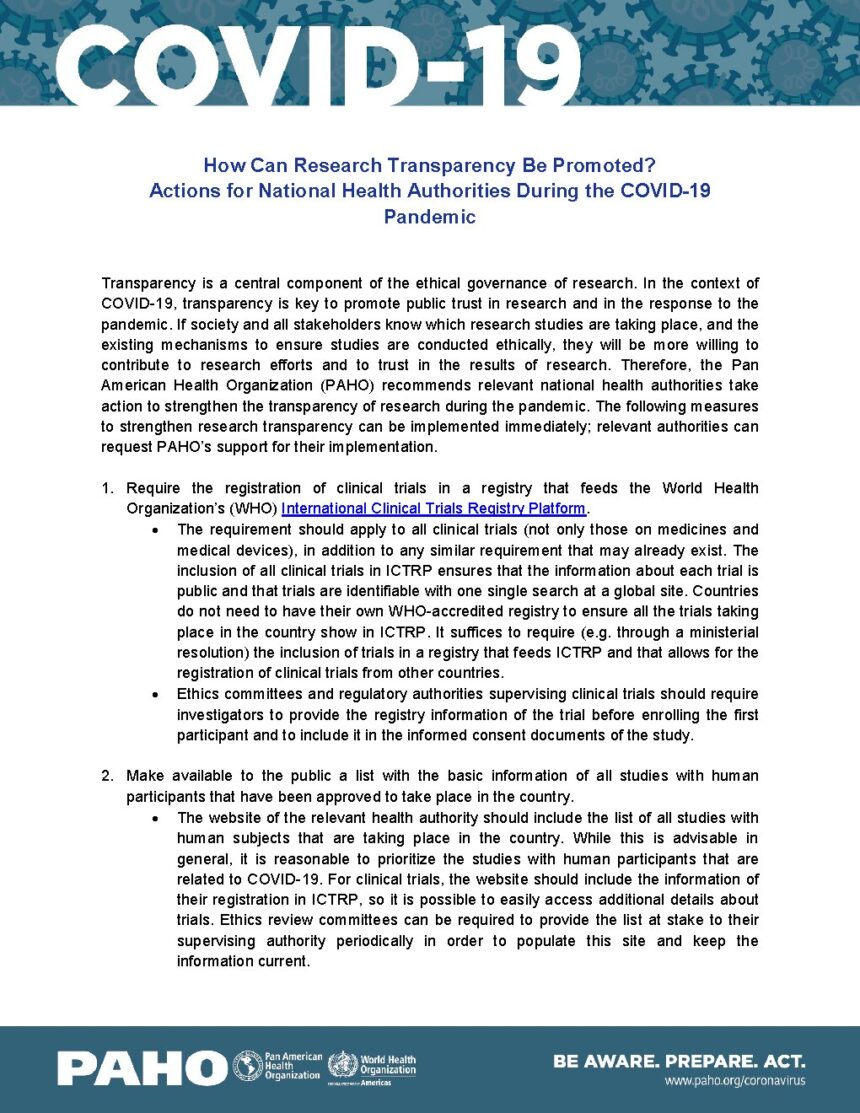
Guidance for national health authorities on strengthening transparency of COVID-19 research to promote public trust.
- Issuer
- Pan American Health Organization
- Edition
- 2020
- Audience
- National health authorities, ethics committees, regulatory authorities
- Evidence
- Expert consensus
- Reviewed
- 19 Oct 2026 · GMJ
What this guideline says
GMJ summary
This PAHO guidance document outlines four key actions that national health authorities should implement to strengthen transparency of research during the COVID-19 pandemic. The central premise is that transparency promotes public trust in research and the pandemic response; when society knows which studies are taking place and the mechanisms ensuring ethical conduct, people are more willing to contribute to research efforts and trust results.
The four recommended actions are: requiring clinical trial registration in a WHO-accredited registry; making public a list of all approved human subjects research; informing society about research conduct and ethical safeguards; and requiring community engagement plans for COVID-19 studies. These measures can be implemented immediately with PAHO support.
Key points
For clinicians — doses and thresholds as stated in the guideline
- Require registration of all clinical trials (not only medicines and medical devices) in a registry that feeds the WHO International Clinical Trials Registry Platform (ICTRP)
- Ethics committees and regulatory authorities should require investigators to provide registry information before enrolling the first participant and include it in informed consent documents
- Publish on the relevant health authority's website a list of all studies with human participants approved in the country, prioritising COVID-19-related studies
- Ethics review committees should provide updated lists to supervising authorities periodically to keep public information current
- Use multiple communication channels (social media, websites, public announcements) to inform the public about research importance, methods and participant safeguards
- Require COVID-19 studies to include a community engagement plan approved by ethics committees and authorities, following international ethical standards
- Community engagement should start as soon as possible using pandemic-appropriate strategies (social media, virtual communications) and continue throughout the study
- Research teams should make continuously updated trial information available to the public through a website in a transparent manner
From the guideline
Verbatim
“If society and all stakeholders know which research studies are taking place, and the existing mechanisms to ensure studies are conducted ethically, they will be more willing to contribute to research efforts and to trust in the results of research.”
Editor’s perspective
Why this matters for Georgia and the region
Prof. Giorgi Pkhakadze, MD, MPH, PhD
Editor-in-Chief, Georgian Medical Journal · Chair, Public Health Institute of Georgia · WHO consultant, health and migration
As Georgia continues to build its research capacity and regulatory infrastructure, these PAHO recommendations offer a pragmatic pathway to strengthen research governance without requiring extensive new infrastructure. The emphasis on transparency is particularly relevant for the South Caucasus region, where public trust in health institutions remains critical for pandemic preparedness and response. I would stress to Georgian colleagues the importance of requiring trial registration before first participant enrolment and including registry information in informed consent documents, as these are low-cost interventions with high impact on transparency. The main implementation challenge will be ensuring that ethics review committees have the administrative capacity to periodically report approved studies to supervising authorities, which may require additional resources and training in our context.
ORCID 0000-0001-7609-4515 · Perspective written for the GMJ Guidelines Library, 19 Oct 2026
Applicability
Georgia and the South Caucasus
For Georgia and the South Caucasus, these recommendations provide a framework for strengthening research governance during health emergencies. National programmes would need to consider existing regulatory mechanisms for clinical trial oversight, the capacity of ethics review committees to monitor and report on approved studies, and the availability of communication infrastructure to engage communities through digital platforms. Countries in the region without WHO-accredited trial registries can implement the requirement by mandating use of existing ICTRP-feeding registries that accept international registrations, requiring only ministerial resolution rather than establishing new national infrastructure.
Questions this guideline answers
Quick answers
Does a country need its own WHO-accredited registry to comply with these recommendations?
No. Countries can require (e.g. through ministerial resolution) that trials register in any WHO-accredited registry that feeds ICTRP and allows registration of trials from other countries.
Should all research with human participants be made public or only clinical trials?
The guidance recommends making public a list of all studies with human participants approved in the country, though it is reasonable to prioritise COVID-19-related studies initially.
When should clinical trials be registered?
Ethics committees and regulatory authorities should require investigators to provide registry information before enrolling the first participant.
What community engagement strategies are appropriate during a pandemic?
Community engagement should use strategies adequate for the pandemic context, such as social media and virtual communications, and should start as soon as possible and continue throughout the study.
Related on GMJ
Interconnected resources
Dictionary of Public Health
GMJ News coverage
- UK flu and COVID-19 surveillance data to May 2027 shows continued monitoring amid seasonal trendsOct 2026
- Community Health Workers Boost COVID-19 Testing Among Formerly Incarcerated PeopleAug 2026
- PLOS Medicine Strengthens Code Sharing Requirements to Boost Research TransparencyJun 2026
- NEJM Retracts Landmark Avacopan Vasculitis Trial After Data Integrity ConcernsSep 2026
Quality & accreditation
Other guidelines on this topic
- COVID-19 Recommended Interventions in Mental Health and Psychosocial Support (MHPSS) during the Pandemic
- Ongoing Living Update of Potential COVID-19 Therapeutics: summary of rapid systematic reviews
- Reorganization and Progressive Expansion of Health Services for the Response to the COVID-19 Pandemic
- Influenza at the Human-Animal Interface: PAHO Recommendations to Strengthen Intersectoral Work for Surveillance, Early Detection, and Investigation
- Administrative Controls to Guarantee Implementation of Infection Prevention and Control Measures in the Context of COVID-19
- Issuer
- Pan American Health Organization
- Type
- Procedures, manuals, guidelines
- Status
- Current
- Published
- 2020-01-01
- Audience
- National health authorities, ethics committees, regulatory authorities
- Licence
- CC BY-NC-SA 3.0 IGO
- Evidence
- Expert consensus
- Record history
- Created 19 Oct 2026 · updated 19 Oct 2026 · next check Apr 2027
Pan American Health Organization. How Can Research Transparency Be Promoted? Actions for National Health Authorities During the COVID-19 Pandemic. Washington, D.C.: PAHO; 2020. PAHO/HSS/BIO/COVID-19/20-0034.GMJ Guidelines Library records are original summaries written by the GMJ editorial team from the issuer’s published document and reviewed by a physician. They do not replace the full guideline. The document is the copyright of its issuer and is linked, not hosted. Spotted an error or a newer edition? Tell the Guidelines Desk.
Was this article helpful?