Pan American Health Organization · Interim recommendations, 18 June 2020
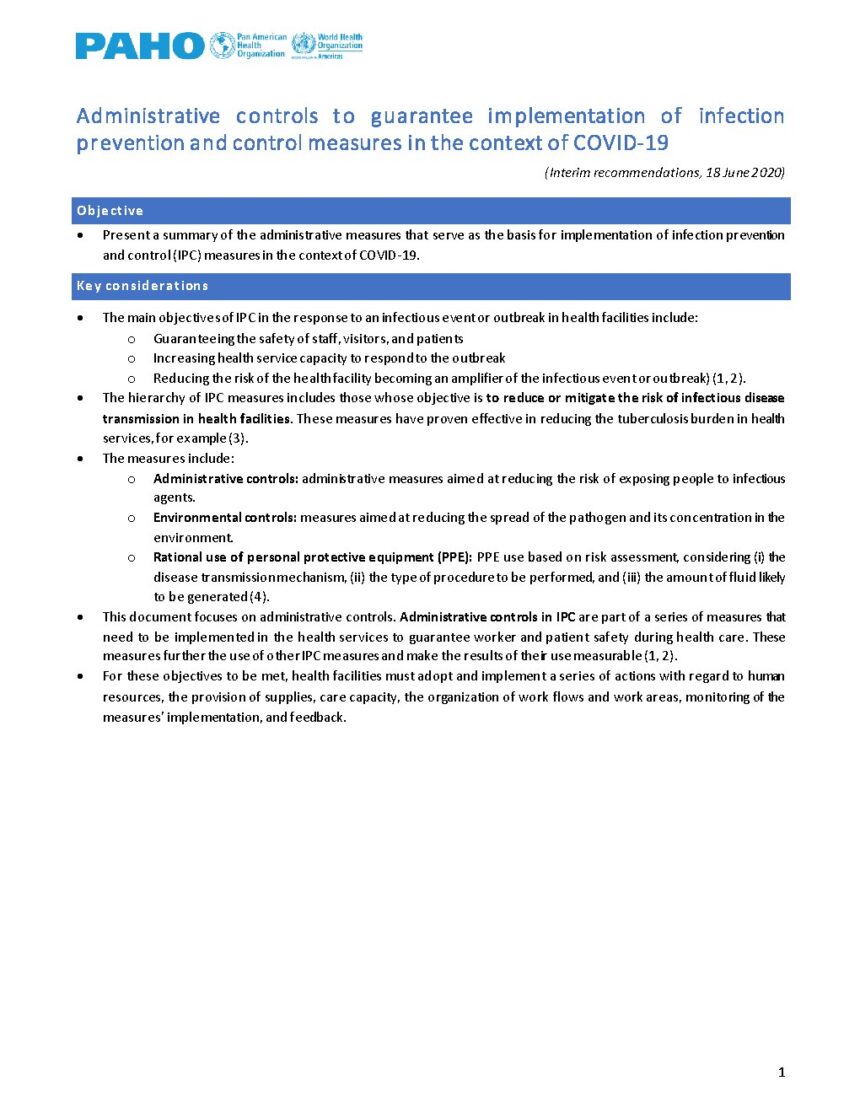
Interim recommendations on administrative measures for implementing IPC in health facilities during COVID-19 response.
- Issuer
- Pan American Health Organization
- Edition
- Interim recommendations, 18 June 2020
- Audience
- Health facility managers, IPC teams, clinical staff, public health professionals
- Evidence
- Expert consensus based on WHO IPC core components and COVID-19 experience
- Reviewed
- 19 Oct 2026 · GMJ
What this guideline says
GMJ summary
This interim guidance from the Pan American Health Organization presents administrative controls—the first tier in the hierarchy of infection prevention and control (IPC) measures—necessary to reduce COVID-19 transmission in health facilities. Administrative controls include human resource planning, triage processes, environmental management, and monitoring systems that enable effective implementation of other IPC measures.
The document specifies staffing ratios, workflow organisation, and surveillance requirements. It recommends one full-time IPC professional per 100–250 beds (with higher ratios for COVID-19 areas), dedicated clinical teams for confirmed cases, active surveillance of health workers for acute respiratory infection, and well-equipped triage stations at facility entrances. The guidance emphasises maintaining at least 1 metre patient separation, ensuring adequate PPE supply, and establishing monitoring indicators across outcome, process, organisational, and structural domains.
The core message is that administrative controls form the foundation of a successful IPC programme: without proper planning of human resources, environmental standards, and monitoring systems, other infection control measures such as PPE use and environmental controls cannot be effectively implemented or sustained.
Key points
For clinicians — doses and thresholds as stated in the guideline
- Assign one full-time IPC professional (nurse or physician) for every 100–250 beds, with higher ratios for areas caring for suspected or confirmed COVID-19 cases
- Establish a well-equipped triage station with trained staff at the health facility entrance using screening questionnaires based on current case definitions
- Assign dedicated teams of health workers exclusively to care for suspected or confirmed COVID-19 cases to reduce transmission risk
- Maintain at least 1 metre separation between all patients and do not exceed standard bed occupancy capacity
- Conduct active surveillance for acute respiratory infection among health workers, maintain rosters of all workers and their shifts, and record all unprotected occupational exposures
- Ensure availability of hand hygiene products at points of care and working sinks with supplies at entrances to care and drug preparation areas
- Guarantee safe drinking water availability for at least 8 hours per day
- Monitor adherence to IPC standards through regular audits with outcome indicators (health professional and patient COVID-19 infections), process indicators (isolation procedure compliance), organisational indicators (presence of IPC team), and structural indicators (ventilation, bed spacing)
Management Indicators for COVID-19 Infection Prevention and Control
Table extracted from the guideline
| Indicator type | Indicator | Frequency | Objective | Key calculation |
|---|---|---|---|---|
| Outcome | Number of health professionals with COVID-19 infection acquired in health facility | Weekly | 100% of cases identified and investigated | Health professionals with COVID-19/total health professionals per day |
| Outcome | Number of patients infected with COVID-19 during their stay | Weekly | 100% of cases identified and investigated | Patients acquiring COVID-19/total admissions for other causes |
| Process | % isolation procedures based on national/local recommendations | Daily | 100% compliance | Patients in isolation with contact/droplet precautions/total patients in isolation |
| Organisational | Existence of COVID-19 infection prevention and control team or focal point | Annual | Present | Official document regulating IPC team |
| Structural | 1 metre separation between beds of COVID-19 patients | Daily | 100% of beds with 1 metre separation | Areas with 1 metre separation/total areas observed |
Source: Pan American Health Organization, Administrative Controls to Guarantee Implementation of Infection Prevention and Control Measures in the Context of COVID-19. Reproduced in summary form.
From the guideline
Verbatim
“The WHO recommendation on the ratio of IPC professionals required to handle the workload in an acute care health facility is one full-time IPC professional (nurse or physician) for every 100-250 beds or fraction thereof, depending on the demand.”
Editor’s perspective
Why this matters for Georgia and the region
Prof. Giorgi Pkhakadze, MD, MPH, PhD
Editor-in-Chief, Georgian Medical Journal · Chair, Public Health Institute of Georgia · WHO consultant, health and migration
As we review health system preparedness across the South Caucasus, this PAHO document provides essential operational specifics often missing from high-level IPC guidance. The recommendation of one IPC professional per 100–250 beds offers a concrete benchmark against which Georgian facilities can assess current capacity—my observation is that many regional hospitals fall short of this standard. The emphasis on active surveillance of health workers is particularly relevant given the occupational exposure risks documented during COVID-19 waves in Tbilisi and regional centres. The most challenging element for implementation in Georgia will be sustaining dedicated COVID-19 clinical teams in smaller facilities where staff shortages already limit service delivery; this will require creative rostering solutions and potentially regional coordination of IPC expertise rather than facility-by-facility staffing.
ORCID 0000-0001-7609-4515 · Perspective written for the GMJ Guidelines Library, 19 Oct 2026
Applicability
Georgia and the South Caucasus
This guidance remains highly relevant for Georgia and the South Caucasus as the region continues to strengthen health system resilience against respiratory pathogen threats. National IPC programmes in Georgia, Armenia, and Azerbaijan would need to assess current staffing ratios against the 1:100–250 beds benchmark, particularly in regional facilities where IPC capacity may be limited. The emphasis on active surveillance of health workers and maintaining rosters aligns with occupational health priorities across the region. Implementation would require national adaptation of monitoring indicators to local epidemiological contexts and consideration of resource constraints in smaller district hospitals where dedicated IPC teams and separate isolation areas may be challenging to establish without additional investment.
Questions this guideline answers
Quick answers
What is the recommended ratio of IPC professionals to beds?
One full-time IPC professional (nurse or physician) for every 100–250 beds or fraction thereof, with higher ratios recommended for areas devoted to care of suspected or confirmed COVID-19 cases given disease severity and the importance of strict compliance with IPC recommendations.
What distance should be maintained between patients?
At least 1 metre of separation must be guaranteed between all patients. Spatial separation and adequate ventilation help reduce the spread of many pathogens in health care settings. Health facilities should not exceed standard bed occupancy capacity.
What surveillance is required for health workers?
Facilities must conduct active surveillance for cases of acute respiratory infection potentially caused by SARS-CoV-2 among health workers, maintain rosters of all workers with their duties and shifts, provide thermometers and log books for temperature recording, follow up on unexplained absences, and keep records of any unprotected occupational exposures.
What are the key components of a triage system for COVID-19?
A well-equipped triage station with trained support staff must be set up at the health facility entrance. Staff should use screening questionnaires based on current case definitions, display signs with COVID-19 information in public areas, prioritise care of symptomatic patients, and create a separate waiting area.
Related on GMJ
Interconnected resources
Dictionary of Public Health
GMJ News coverage
- UK flu and COVID-19 surveillance data to May 2027 shows continued monitoring amid seasonal trendsOct 2026
- Community Health Workers Boost COVID-19 Testing Among Formerly Incarcerated PeopleAug 2026
- 655 Million Without Electricity Face Growing Health Crisis, WHO WarnsOct 2026
- Heat stress risk from PPE requires urgent clinical vigilance, UK health officials warnOct 2026
Quality & accreditation
- ASF Hospital — Standard 20 — Supporting the Care Workforce
- ASF Laboratory — Standard 3 — Personnel & Competence
- ASF Hospital — Standard 5 — Safety & Emergency Preparedness
- ASF Medical Transport — Standard 5 — Infection Prevention & Control
- ASF Laboratory — Standard 7 — Examination: Process & Safety
- ASF Hospital — Standard 11 — Critical Care
- ASF Medical Transport — Standard 6 — Emergency Response During Transport
Other guidelines on this topic
- Recommendations for Reorganization and Expansion of Hospital Services in Response to COVID-19. Technical Working Document, version 5
- Emergency Use of Unproven Interventions Outside of Research: Ethics Guidance for the COVID-19 Pandemic
- Measures to ensure the continuity of the response to malaria in the Americas during the COVID-19 pandemic
- Checklist for the Management of Human Resources for Health in Response to COVID-19
- Caribbean Shelter Guide: COVID-19 Considerations
- Issuer
- Pan American Health Organization
- Type
- Procedures, manuals, guidelines
- Edition
- Interim recommendations, 18 June 2020
- Status
- Current
- Published
- 2020-01-01
- Scope
- Administrative controls for infection prevention and control in health facilities responding to COVID-19
- Audience
- Health facility managers, IPC teams, clinical staff, public health professionals
- Licence
- CC BY-NC-SA 3.0 IGO
- Evidence
- Expert consensus based on WHO IPC core components and COVID-19 experience
- Record history
- Created 19 Oct 2026 · updated 19 Oct 2026 · next check Apr 2027
Pan American Health Organization. Administrative controls to guarantee implementation of infection prevention and control measures in the context of COVID-19: interim recommendations, 18 June 2020. Washington, D.C.: PAHO; 2020. Licence: CC BY-NC-SA 3.0 IGO.GMJ Guidelines Library records are original summaries written by the GMJ editorial team from the issuer’s published document and reviewed by a physician. They do not replace the full guideline. The document is the copyright of its issuer and is linked, not hosted. Spotted an error or a newer edition? Tell the Guidelines Desk.
Was this article helpful?