Pan American Health Organization · Interim recommendations, 1 February 2021
Interim recommendations for IPC experts and health workers on containment of multidrug-resistant C. auris in healthcare settings.
- Issuer
- Pan American Health Organization
- Edition
- Interim recommendations, 1 February 2021
- Audience
- Infection prevention and control experts at national and facility levels; health workers from all levels of care
- Evidence
- Expert consensus
- Reviewed
- 19 Oct 2026 · GMJ
What this guideline says
GMJ summary
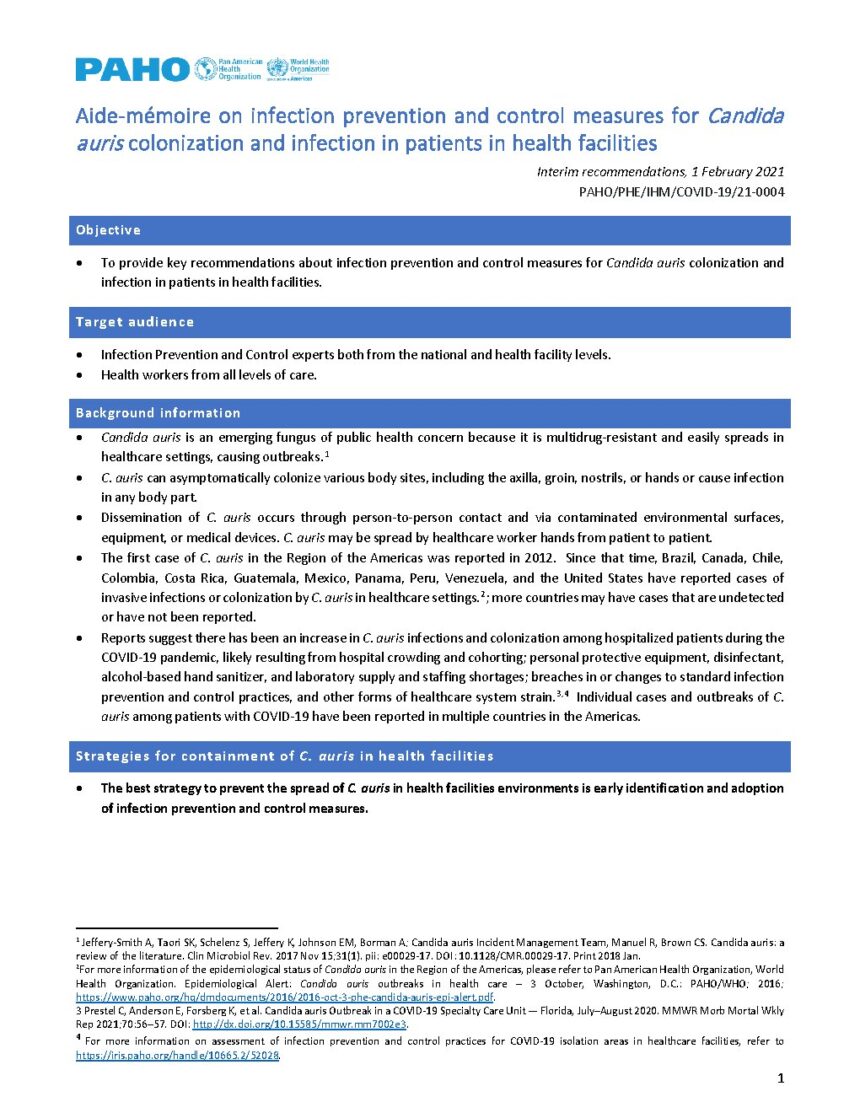
This aide-mémoire provides key infection prevention and control (IPC) recommendations for managing Candida auris, an emerging multidrug-resistant fungus of public health concern that easily spreads in healthcare settings. C. auris can asymptomatically colonize body sites including the axilla, groin, nostrils and hands, or cause infection in any body part. Transmission occurs through person-to-person contact, contaminated environmental surfaces, equipment and medical devices, particularly via healthcare worker hands.
The document emphasises early identification through investigation of newly infected or colonized patients and screening of healthcare contacts. Core IPC measures include strict adherence to standard and contact precautions, hand hygiene, use of personal protective equipment (gloves and gowns), environmental cleaning with disinfectants effective against C. auris (such as 0.1% sodium hypochlorite for non-metal equipment), and good communication between laboratory, IPC teams and facility administration. Patients should ideally be placed in single rooms or cohorted, and remain on contact precautions for their entire stay as colonization persists for long periods.
The document notes an increase in C. auris infections during the COVID-19 pandemic, likely resulting from hospital crowding, supply shortages and breaches in standard IPC practices. Establishment of a C. auris task force including administration, nursing, environmental cleaning, medical care and laboratory personnel is recommended when the pathogen is first identified or during outbreaks.
Key points
For clinicians — doses and thresholds as stated in the guideline
- Use standard and contact precautions for all patients with C. auris infection or colonization throughout their entire stay, as patients remain colonized for long periods
- Place infected or colonized patients in single rooms ideally; if not possible, cohort patients with the same pathogen
- Use gloves and gowns before entering patient care areas; remove before exiting; change PPE and perform hand hygiene between contacts with patients in the same room
- Clean and disinfect patient areas at least daily using disinfectants effective against C. auris or C. difficile spores, such as 0.1% sodium hypochlorite solution for non-metal equipment
- Conduct colonization screening by swabbing the groin and armpit (other sites such as nose or fingers/toes can also be colonized) on wards identifying new infected or colonized cases
- Perform hand hygiene before and after contact with the patient or environment, and before and after doffing PPE, using handwashing with water and soap or alcohol-based handrub
- Dedicate equipment (sphygmomanometers, stethoscopes, thermometers) exclusively to patients with C. auris or cohort areas where possible
- No decolonization methods are recommended; high concentrations of chlorhexidine are required to kill C. auris and transmission has occurred in facilities using chlorhexidine bathing
From the guideline
Verbatim
“The best strategy to prevent the spread of C. auris in health facilities environments is early identification and adoption of infection prevention and control measures.”
Editor’s perspective
Why this matters for Georgia and the region
Prof. Giorgi Pkhakadze, MD, MPH, PhD
Editor-in-Chief, Georgian Medical Journal · Chair, Public Health Institute of Georgia · WHO consultant, health and migration
As Georgia continues strengthening its healthcare quality and infection control systems, this PAHO guidance on Candida auris arrives at a critical moment. Our hospitals faced significant strain during the COVID-19 pandemic—precisely the conditions this document identifies as risk factors for C. auris emergence and spread. I would stress to Georgian clinicians the need for good communication between laboratories and IPC teams with automatic alerts, as this requires minimal investment but can prevent costly outbreaks. The realistic caveat is that many Georgian facilities currently lack mycology capacity for species-level Candida identification beyond sterile sites, and procurement of appropriate disinfectants effective against fungal spores may require revision of existing supply contracts that rely on quaternary ammonium compounds.
ORCID 0000-0001-7609-4515 · Perspective written for the GMJ Guidelines Library, 19 Oct 2026
Applicability
Georgia and the South Caucasus
This guidance is highly relevant for Georgia and the South Caucasus region given the global spread of C. auris and reported increases during the COVID-19 pandemic. Georgian healthcare facilities would need to assess their current mycology laboratory capacity for identifying Candida species beyond just sterile sites, ensure adequate supplies of appropriate disinfectants (0.1% sodium hypochlorite) rather than ineffective quaternary ammonium compounds, and establish communication pathways between laboratories and IPC teams with automatic alerts for new cases. National programmes should consider surveillance for C. auris in tertiary centres and ICUs, particularly those that experienced strain during COVID-19, and develop facility-level task forces with adequate resources for environmental cleaning, PPE and potential unit closures during outbreaks. The recommendation to inform authorities during inter-institutional transfers is particularly important for the region’s referral patterns between facilities in Georgia, Armenia and Azerbaijan.
Questions this guideline answers
Quick answers
How long should patients with C. auris remain on contact precautions?
Patients should remain on contact precautions for their entire hospital stay because they remain colonized for a long time. Rescreening patients with previous colonization is not recommended.
Which disinfectants are effective against C. auris?
Some common healthcare disinfectants, especially some quaternary ammonium compounds, are not effective. Use hospital disinfectants approved against C. auris or C. difficile spores, such as 0.1% sodium hypochlorite solution for non-metal equipment, following manufacturers' directions for appropriate contact time.
Which body sites should be screened for C. auris colonization?
Colonization screening should be conducted by swabbing the groin and armpit, but other sites such as nose or fingers/toes can also be colonized. If concerned about C. auris in the facility, consider species identification of Candida from all body sites, not just sterile sites, including urine, wounds and respiratory specimens.
Is decolonization recommended for patients with C. auris?
No, there are no recommended decolonization methods. High concentrations of chlorhexidine are required to kill C. auris and there has been transmission and outbreaks in facilities using chlorhexidine bathing.
Related on GMJ
Interconnected resources
Dictionary of Public Health
GMJ News coverage
Quality & accreditation
- ASF Laboratory — Standard 1 — Governance & Document Control
- ASF Laboratory — Standard 6 — Pre-Examination: Specimen Pathway
- ASF Laboratory — Standard 7 — Examination: Process & Safety
- ASF Laboratory — Standard 8 — Post-Examination: Reporting & Critical Values
- ASF Hospital — Standard 5 — Safety & Emergency Preparedness
- ASF Medical Transport — Standard 5 — Infection Prevention & Control
- ASF Hospital — Standard 11 — Critical Care
- ASF Medical Transport — Standard 6 — Emergency Response During Transport
Other guidelines on this topic
- Regional Framework for the Monitoring and Re-Verification of Measles, Rubella, and Congenital Rubella Syndrome Elimination in the Americas
- Recommendations for Heating, Ventilation, and Air Conditioning in Healthcare Facilities
- Protocol for Enhanced Isolate-Level Antimicrobial Resistance Surveillance in the Americas. Primary Phase: Bloodstream Infections
- Guidelines for Care of Critically Ill Adult Patients with COVID-19 in the Americas, Summary, version 3
- Guide for the preparation of a risk communication strategy for COVID-19 vaccines
- Issuer
- Pan American Health Organization
- Type
- Procedures, manuals, guidelines
- Edition
- Interim recommendations, 1 February 2021
- Status
- Current
- Published
- 2021-01-01
- Scope
- Healthcare facilities managing patients with C. auris colonization or infection
- Audience
- Infection prevention and control experts at national and facility levels; health workers from all levels of care
- Licence
- CC BY-NC-SA 3.0 IGO
- Evidence
- Expert consensus
- Record history
- Created 19 Oct 2026 · updated 19 Oct 2026 · next check Apr 2027
Pan American Health Organization. Aide-mémoire on infection prevention and control measures for Candida auris colonization and infection in patients in health facilities: interim recommendations, 1 February 2021. Washington, D.C.: PAHO; 2021. (PAHO/PHE/IHM/COVID-19/21-0004). Licence: CC BY-NC-SA 3.0 IGO.GMJ Guidelines Library records are original summaries written by the GMJ editorial team from the issuer’s published document and reviewed by a physician. They do not replace the full guideline. The document is the copyright of its issuer and is linked, not hosted. Spotted an error or a newer edition? Tell the Guidelines Desk.
Was this article helpful?