Pan American Health Organization · 2021
HVAC and natural ventilation standards for healthcare facilities to prevent pathogen transmission during COVID-19 and aerosol-generating procedures.
- Issuer
- Pan American Health Organization
- Edition
- 2021
- Audience
- Hospital administrators, infection prevention and control teams, HVAC engineers, facility managers
- Evidence
- Expert consensus based on WHO infection prevention guidance
- Reviewed
- 19 Oct 2026 · GMJ
What this guideline says
GMJ summary
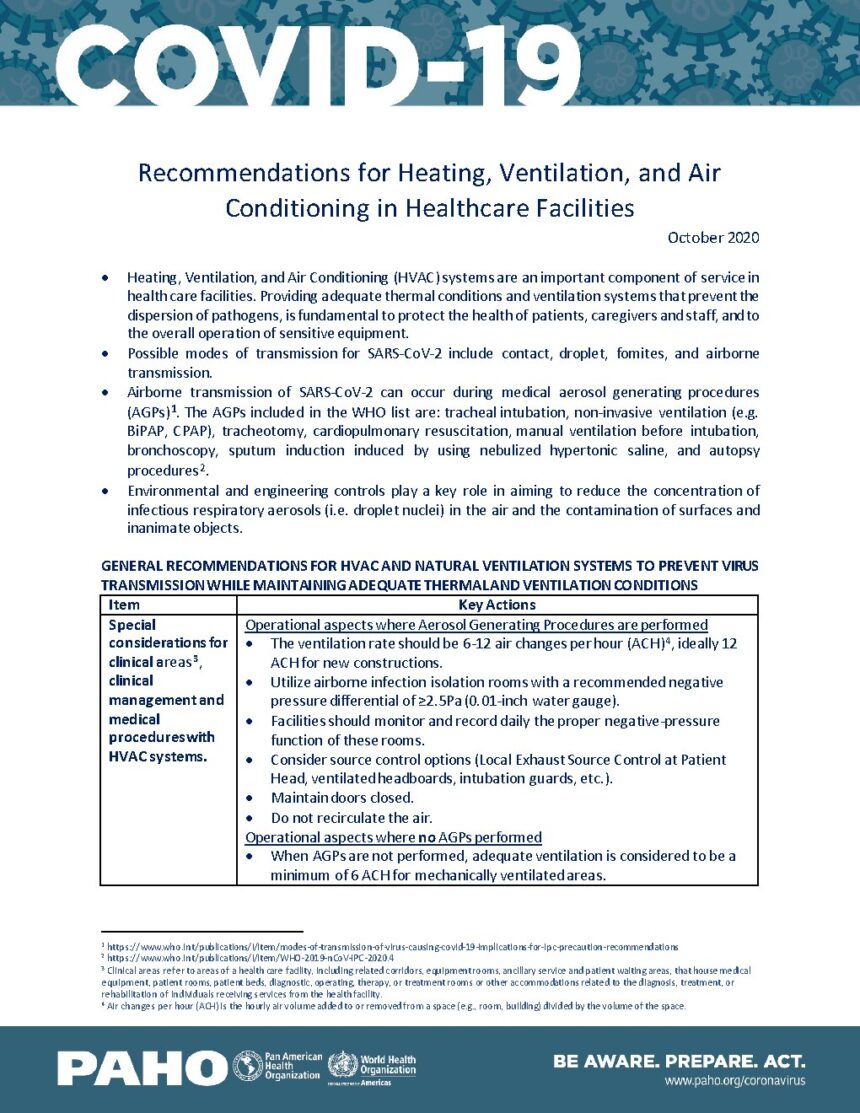
These recommendations from the Pan American Health Organization provide comprehensive guidance on heating, ventilation, and air conditioning (HVAC) systems in healthcare facilities to prevent transmission of SARS-CoV-2 and other pathogens. The document addresses both mechanically ventilated and naturally ventilated settings, recognising that airborne transmission can occur during aerosol-generating procedures (AGPs) such as intubation, bronchoscopy, non-invasive ventilation, and cardiopulmonary resuscitation.
The guidance establishes distinct ventilation requirements for areas where AGPs are performed (6–12 air changes per hour with negative pressure of ≥2.5Pa) versus areas without AGPs (minimum 6 ACH for mechanical ventilation, 60 litres/second per patient for natural ventilation). Key engineering controls include HEPA filtration for special-care areas, MERV-13 or higher filters for patient treatment areas, no air recirculation in isolation rooms, maintaining negative pressure, and source control options. For naturally ventilated facilities, the document recommends 160 L/s per patient in areas with AGPs and emphasises establishing barriers and separation of risk areas.
The recommendations extend to non-clinical areas, maintenance protocols (including filter disinfection with 10% sodium hypochlorite for at least 5 minutes), and operational parameters such as maintaining relative humidity at 40–60% and temperature at 21°C–24°C (70°F–75°F). The guidance emphasises that HVAC systems should remain operational continuously and be connected to emergency power supplies.
Key points
For clinicians — doses and thresholds as stated in the guideline
- For areas performing aerosol-generating procedures: ventilation rate of 6–12 air changes per hour (ACH), ideally 12 ACH for new constructions, with negative pressure differential of ≥2.5Pa
- For areas without AGPs: minimum 6 ACH for mechanically ventilated areas, or 60 litres/second per patient for naturally ventilated areas
- For naturally ventilated areas with AGPs: use hybrid (mixed-mode) model to achieve 160 L/s per patient
- HEPA filtration required for special-care areas; MERV-13 or higher filters for patient treatment areas; no air recirculation in isolation rooms
- Maintain relative humidity between 40–60% and temperature between 21°C–24°C (70°F–75°F) in non-clinical areas
- Beds in shared rooms must be placed at least 1 metre apart when single rooms unavailable
- Minimum separation distance of 10m (30 feet) between exhaust outlets and outdoor air intakes
- Filters should be disinfected with 10% sodium hypochlorite solution for at least 5 minutes before removal and disposal
Ventilation Requirements by Clinical Area and Procedure Type
Table extracted from the guideline
| Setting | AGPs Performed | No AGPs Performed | Additional Requirements |
|---|---|---|---|
| Mechanical ventilation | 6–12 ACH (ideally 12 for new construction) | Minimum 6 ACH | Negative pressure ≥2.5Pa; no recirculation |
| Natural ventilation | 160 L/s per patient (hybrid/mixed-mode model) | 60 L/s per patient | Closed doors in risk areas; barriers to prevent airflow |
| Shared rooms (any ventilation) | N/A | Beds ≥1 metre apart | Isolation curtains; no recirculation |
Source: Pan American Health Organization, Recommendations for Heating, Ventilation, and Air Conditioning in Healthcare Facilities. Reproduced in summary form.
From the guideline
Verbatim
“The ventilation rate should be 6-12 air changes per hour (ACH), ideally 12 ACH for new constructions.”
Editor’s perspective
Why this matters for Georgia and the region
Prof. Giorgi Pkhakadze, MD, MPH, PhD
Editor-in-Chief, Georgian Medical Journal · Chair, Public Health Institute of Georgia · WHO consultant, health and migration
As Georgia strengthens its healthcare infrastructure following the COVID-19 pandemic, these PAHO ventilation standards provide essential engineering benchmarks that complement our infection prevention protocols. The distinction between mechanically and naturally ventilated settings is particularly relevant for Georgian facilities, where many regional hospitals rely on natural ventilation, and the specific threshold of 160 L/s per patient for areas performing aerosol-generating procedures gives our facility planners concrete targets for hybrid ventilation upgrades. I would stress to Georgian clinicians and hospital administrators the requirement for negative pressure monitoring and daily recording in isolation rooms—a practice not yet universal in our facilities—and the prohibition on recirculating air in COVID-19 areas, which some older Soviet-era HVAC systems may do by default. The primary implementation challenge for Georgia will be the requirement for continuous HVAC operation connected to emergency power supplies, as many facilities face energy cost constraints and unreliable power in rural areas, necessitating prioritised investment in backup generators for critical isolation and intensive care units performing intubations and other high-risk aerosol procedures.
ORCID 0000-0001-7609-4515 · Perspective written for the GMJ Guidelines Library, 19 Oct 2026
Applicability
Georgia and the South Caucasus
For Georgia and the South Caucasus, these recommendations are immediately applicable as the region continues to strengthen infection prevention and control capacity in healthcare facilities. Many Georgian healthcare facilities operate with natural or hybrid ventilation systems, particularly in rural areas and older infrastructure, making the natural ventilation thresholds (60–160 L/s per patient) especially relevant. National programmes would need to conduct facility-by-class assessments of current ventilation capacity, prioritise upgrades for isolation wards and intensive care units treating respiratory infections including tuberculosis (endemic in the region), and develop maintenance protocols adapted to local HVAC provider capacity. The guidance on maintaining continuous operation and emergency power connections is critical for Georgia given seasonal energy supply variations, whilst the temperature range of 21°C–24°C may require adjustment considerations for the hot Caucasus summers and cold winters affecting facility energy management.
Questions this guideline answers
Quick answers
What ventilation rate is required for rooms where intubation or bronchoscopy is performed?
Mechanically ventilated rooms performing aerosol-generating procedures require 6–12 air changes per hour (ACH), ideally 12 ACH for new constructions, with negative pressure of at least 2.5Pa. Naturally ventilated areas should achieve 160 L/s per patient using a hybrid (mixed-mode) ventilation model.
Can we recirculate air in COVID-19 isolation rooms?
No. Air from airborne infection isolation rooms should be exhausted directly to the outside or filtered through a HEPA filter. Do not recirculate air in rooms with suspected, probable, or confirmed COVID-19 patients or where aerosol-generating procedures are performed.
What filter ratings are recommended for patient care areas?
HEPA filtration is recommended for special-care areas where aerosol-generating procedures occur. For general patient treatment areas, prefer filters with MERV (Minimum Efficiency Reporting Value) ratings of 13 or higher. For non-clinical areas, MERV-13 or higher is also preferred.
How should we maintain and dispose of filters during the pandemic?
Use personal protective equipment during maintenance. Disinfect filters with 10% sodium hypochlorite solution or another appropriate disinfectant approved for SARS-CoV-2, allowing it to act for at least 5 minutes before removal. Filters can then be bagged and disposed of in regular waste. Start maintenance in areas of least contamination and move to COVID-19 ICUs last.
Related on GMJ
Interconnected resources
Dictionary of Public Health
GMJ News coverage
- UK flu and COVID-19 surveillance data to May 2027 shows continued monitoring amid seasonal trendsOct 2026
- Community Health Workers Boost COVID-19 Testing Among Formerly Incarcerated PeopleAug 2026
- Influenza dominates African respiratory surveillance; SARS-CoV-2 remains lowMay 2026
- Malaria Prophylaxis for East African Safari Travellers: Evidence-Based PreventionOct 2026
Quality & accreditation
- ASF Hospital — Standard 18 — Sustainable Care
- ASF Hospital — Standard 7 — Governance & Management
- ASF Hospital — Standard 5 — Safety & Emergency Preparedness
- ASF Hospital — Standard 4 — Care & Treatment
- ASF Medical Transport — Standard 5 — Infection Prevention & Control
- ASF Laboratory — Standard 7 — Examination: Process & Safety
Other guidelines on this topic
- Guidelines for Care of Critically Ill Adult Patients with COVID-19 in the Americas, Summary, version 3
- Guideline for Preventive Chemotherapy for the Control of Taenia solium Taeniasis
- Smart Hospitals Toolkit. Second edition
- Recommendations for the adoption and procurement of pressure swing adsorption oxygen generator plants
- Good Practices in the Rational and Effective Use of Oxygen
- Issuer
- Pan American Health Organization
- Type
- Procedures, manuals, guidelines
- Status
- Current
- Published
- 2021-01-01
- Scope
- Healthcare facilities with mechanical HVAC systems or natural ventilation
- Audience
- Hospital administrators, infection prevention and control teams, HVAC engineers, facility managers
- Licence
- CC BY-NC-SA 3.0 IGO
- Evidence
- Expert consensus based on WHO infection prevention guidance
- Record history
- Created 19 Oct 2026 · updated 19 Oct 2026 · next check Apr 2027
Pan American Health Organization. Recommendations for Heating, Ventilation, and Air Conditioning in Healthcare Facilities. Washington, D.C.: PAHO; 2021. (PAHO/CDE/CE/COVID-19/21-0003).GMJ Guidelines Library records are original summaries written by the GMJ editorial team from the issuer’s published document and reviewed by a physician. They do not replace the full guideline. The document is the copyright of its issuer and is linked, not hosted. Spotted an error or a newer edition? Tell the Guidelines Desk.
Was this article helpful?