Pan American Health Organization · 2020
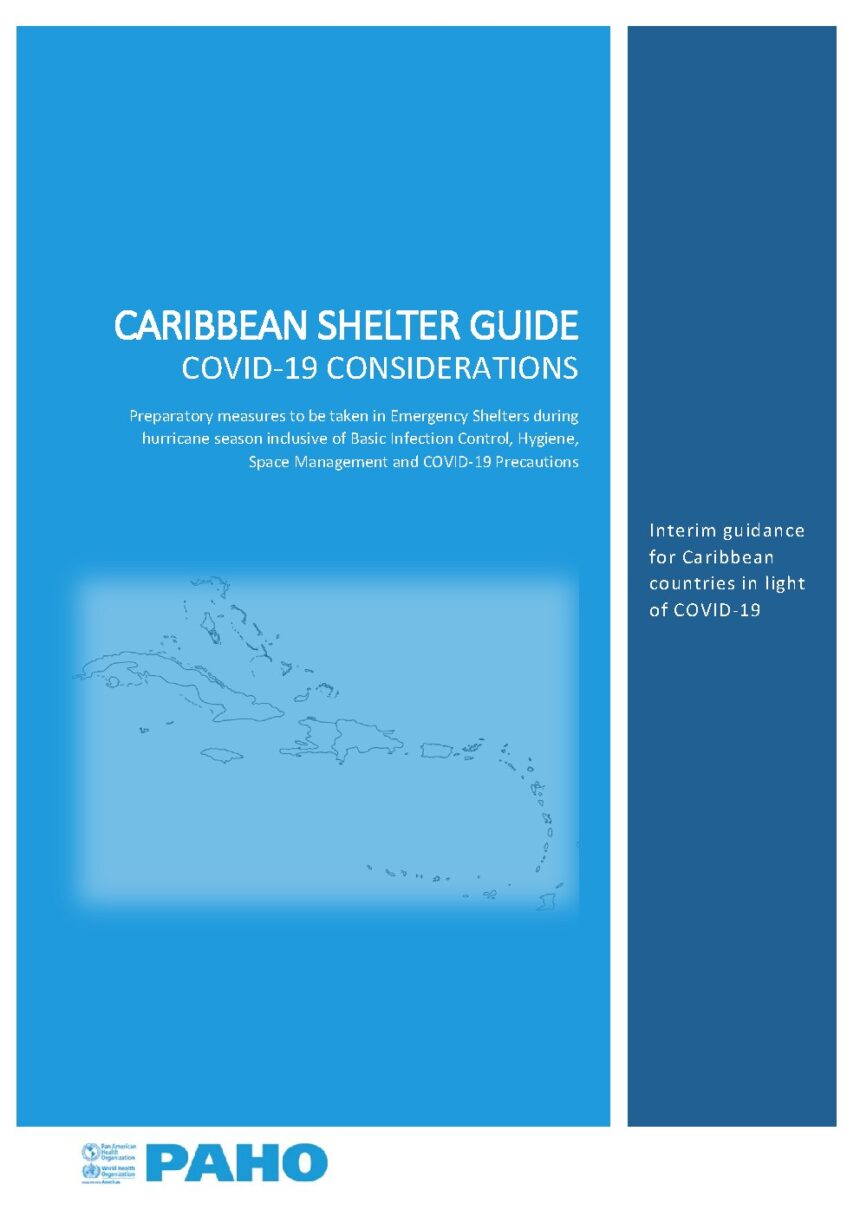
Interim guidance on operating emergency shelters during hurricane season with COVID-19 infection prevention and control measures.
- Issuer
- Pan American Health Organization
- Edition
- 2020
- Audience
- Shelter managers, emergency response personnel, civil protection authorities, public health officials
- Evidence
- Expert consensus adapted from international standards (The Sphere Handbook, FEMA, Australian Red Cross)
- Reviewed
- 19 Oct 2026 · GMJ
What this guideline says
GMJ summary
This interim guidance provides operational standards for managing emergency shelters in Caribbean countries during hurricane season under COVID-19 pandemic conditions. The document addresses the challenge that COVID-19 physical distancing requirements substantially reduce shelter capacity in community centres, schools, and churches typically used for emergency housing.
The guide establishes specific spatial requirements, hygiene standards, infection control protocols, and COVID-19 precautions for four key domains: shelter and space management, infection control and prevention, hygiene standards, and COVID-19-specific precautions. It provides practical recommendations adapted from international standards (The Sphere Handbook, FEMA, Australian Red Cross) while acknowledging that ideal requirements are not always feasible in resource-limited settings.
The guidance includes detailed specifications for physical distancing (4.5 feet for immediate sheltering, 6 feet for temporary sheltering), ventilation (minimum 15 cubic feet of air exchange per minute per person), sanitation ratios, cleaning intervals, disinfection protocols, and procedures for screening, isolating, and referring suspected COVID-19 cases to testing centres.
Key points
For clinicians — doses and thresholds as stated in the guideline
- Immediate sheltering (up to 18 hours): maintain 4.5 feet physical distance between persons not from the same family
- Temporary sheltering (longer than 18 hours): maintain 6 feet physical distance; wheelchair-bound individuals require 7 feet
- Suspected COVID-19 patients: isolate with 6 feet or as close to 40 square feet distance as possible until transfer to testing facility
- Ventilation: minimum 15 cubic feet of air exchange per minute per person, or 20-30 cubic metres per person per hour
- Sanitation ratios: 1 toilet per 20 females, 1 per 40 males, 1 urinal per 40 men, 1 shower per 30 people, 1 handwashing station per 30 people
- High-traffic surfaces: clean every 6 hours with 70% alcohol solution for common surfaces; use 0.1% chlorine solution for floors
- Bathrooms: clean and disinfect at least once daily with 0.1% chlorine solution, then 0.5% sodium hypochlorite for 10 minutes
- Temperature screening: daily epidemiologic surveillance at check-in and every 24 hours for staff; refer suspected cases immediately to nearest COVID-19 testing centre
Shelter and Space Management Requirements
Table extracted from the guideline
| Type | Description |
|---|---|
| Immediate Sheltering (up to 18 hours) | 4.5 ft physical distance from other persons (does not apply to family members); wheelchair-bound individuals 7 ft |
| Temporary sheltering (longer than 18 hours) | 6 ft physical distance from other persons; wheelchair-bound individuals 7 ft (does not apply to family members) |
| Patient with respiratory illness (suspected COVID-19, not yet tested) | 6 ft or as close to 40 sq. ft. as possible until placed in temporary isolation room/area |
| Recreation/Commons area | 4.5 ft physical distance per person or family; create shift system if indoors to limit numbers |
| Ventilation (indoor air quality) | Minimum 15 cubic feet of air exchange per minute per person, or 20-30 cubic metres per person per hour |
| Temperature inside shelter | Between 20-25°C if AC units are available |
| Single cot sleeping arrangements | 2-2.5 ft between head and sides of cot; 1.5-2 ft between aisles; alternating head-to-toe arrangement |
| Bunk cot sleeping arrangements | Same distance between head and sides; 65-95 cm vertical spacing between cots; 2-3 ft between aisles |
Source: Pan American Health Organization, Caribbean Shelter Guide: COVID-19 Considerations. Reproduced in summary form.
From the guideline
Verbatim
“The novel coronavirus disease (COVID-19) distancing requirements subsequently reduced the number of persons a shelter can accommodate during the hurricane season.”
Editor’s perspective
Why this matters for Georgia and the region
Prof. Giorgi Pkhakadze, MD, MPH, PhD
Editor-in-Chief, Georgian Medical Journal · Chair, Public Health Institute of Georgia · WHO consultant, health and migration
As someone who has worked extensively on emergency preparedness in Georgia, I recognise that this Caribbean guidance addresses a challenge we face whenever large-scale displacement occurs—how to maintain infection prevention in crowded temporary facilities. The specific spatial metrics and hygiene ratios provide objective benchmarks that Georgian civil protection authorities can adapt to our shelter infrastructure, which like the Caribbean predominantly relies on schools and community centres. I would particularly stress to local emergency management coordinators the ventilation standards—15 cubic feet of air exchange per minute per person—as Georgian shelters in cold seasons often prioritise heating over air circulation, creating ideal conditions for respiratory pathogen transmission. The realistic caveat is that achieving 6-foot distancing in our existing shelter inventory would require identifying and pre-approving substantially more facilities, which demands coordination across municipal, regional, and national levels that takes time to establish before the next emergency occurs.
ORCID 0000-0001-7609-4515 · Perspective written for the GMJ Guidelines Library, 19 Oct 2026
Applicability
Georgia and the South Caucasus
Georgia and neighbouring South Caucasus countries face different natural hazard profiles than Caribbean hurricanes—primarily earthquakes, floods, and landslides—but the infection prevention and control principles for congregate emergency shelters remain directly applicable. The spatial, ventilation, and hygiene standards established in this guide provide actionable benchmarks for Georgian emergency preparedness planners developing COVID-19 protocols for temporary displacement facilities. National and municipal civil protection authorities would need to adapt specific spatial requirements to available shelter infrastructure (often schools and community centres, similar to the Caribbean context) and consider cold-climate heating requirements alongside ventilation needs. The surveillance forms, disinfection protocols, and PPE sequencing guidance are universally applicable and could be integrated into Georgia’s existing emergency response frameworks and translated for use by local emergency management teams and community health workers.
Questions this guideline answers
Quick answers
How much space is required per person in an emergency shelter during COVID-19?
For immediate sheltering (up to 18 hours), maintain 4.5 feet physical distance. For temporary sheltering (longer than 18 hours), maintain 6 feet distance. Wheelchair-bound individuals require 7 feet. These distances do not apply between members of the same family. Suspected COVID-19 cases require 6 feet or as close to 40 square feet as possible in isolation.
What are the minimum ventilation requirements for shelters?
Shelters require a minimum of 15 cubic feet of air exchange per minute per person, or 20-30 cubic metres of airflow per person per hour. Natural ventilation is the best method. Split AC units do not refresh air, so individuals with respiratory illness should be placed in rooms with natural ventilation. Central AC should have open-air refreshing vents.
How frequently should shelter surfaces be cleaned and disinfected?
High-traffic areas and surfaces should be cleaned every 6 hours. Common and high-touch surfaces (door handles, light switches, handrails, tabletops) should be cleaned at least twice daily with 70% alcohol solution. Floors should be cleaned daily with 0.1% chlorine solution. Bathrooms must be cleaned at least once daily with 0.1% chlorine solution followed by 0.5% sodium hypochlorite left for 10 minutes.
What is the protocol for suspected COVID-19 cases in shelters?
Suspected cases should be identified through daily epidemiologic surveillance screening at check-in. Isolate immediately in a predetermined temporary isolation room with 6 feet distance, preferably with natural ventilation. Limit staff access to medical personnel with full PPE (gowns, gloves, mask, goggles). Perform hand hygiene before entering and exiting. Refer to the nearest COVID-19 testing centre as soon as possible. Conduct contact tracing of all exposed individuals.
Related on GMJ
Interconnected resources
Dictionary of Public Health
GMJ News coverage
- UK flu and COVID-19 surveillance data to May 2027 shows continued monitoring amid seasonal trendsOct 2026
- Community Health Workers Boost COVID-19 Testing Among Formerly Incarcerated PeopleAug 2026
- PEN-Plus Expands Severe Disease Care Across Africa: Third International Conference Charts ProgressOct 2026
- African Health Leaders Unite on Noncommunicable Diseases: New Commitments for SDG Targets by 2030Sep 2026
Quality & accreditation
- ASF Hospital — Standard 5 — Safety & Emergency Preparedness
- ASF Medical Transport — Standard 5 — Infection Prevention & Control
- ASF Laboratory — Standard 7 — Examination: Process & Safety
- ASF Hospital — Standard 11 — Critical Care
- ASF Medical Transport — Standard 6 — Emergency Response During Transport
Other guidelines on this topic
- Recommendations to expand access to hand washing and its proper use
- Recommendations for Ventilation in Nonmedical Facilities
- Aide-mémoire on infection prevention and control measures for Candida auris colonization and infection in patients in health facilities
- Regional Framework for the Monitoring and Re-Verification of Measles, Rubella, and Congenital Rubella Syndrome Elimination in the Americas
- Recommendations for Heating, Ventilation, and Air Conditioning in Healthcare Facilities
- Issuer
- Pan American Health Organization
- Type
- Procedures, manuals, guidelines
- Edition
- 2020
- Status
- Current
- Published
- 2020-01-01
- Languages
- English
- Scope
- Emergency shelter operations during concurrent natural hazard and COVID-19 pandemic
- Audience
- Shelter managers, emergency response personnel, civil protection authorities, public health officials
- Licence
- CC BY-NC-SA 3.0 IGO
- Evidence
- Expert consensus adapted from international standards (The Sphere Handbook, FEMA, Australian Red Cross)
- Record history
- Created 19 Oct 2026 · updated 19 Oct 2026 · next check Apr 2027
Pan American Health Organization. Caribbean Shelter Guide: COVID-19 Considerations. Washington, D.C.: PAHO; 2020. (PAHO/PHE/CPI/COVID-19-20-0020). Available from: https://iris.paho.org/handle/10665.2/52170GMJ Guidelines Library records are original summaries written by the GMJ editorial team from the issuer’s published document and reviewed by a physician. They do not replace the full guideline. The document is the copyright of its issuer and is linked, not hosted. Spotted an error or a newer edition? Tell the Guidelines Desk.
Was this article helpful?