Pan American Health Organization · 2021
COVID-19 infection control guidance for office, retail, manufacturing and public facilities through enhanced ventilation and filtration.
- Issuer
- Pan American Health Organization
- Edition
- 2021
- Audience
- Facility managers, HVAC providers, maintenance teams, public health authorities
- Evidence
- Expert consensus
- Reviewed
- 19 Oct 2026 · GMJ
What this guideline says
GMJ summary
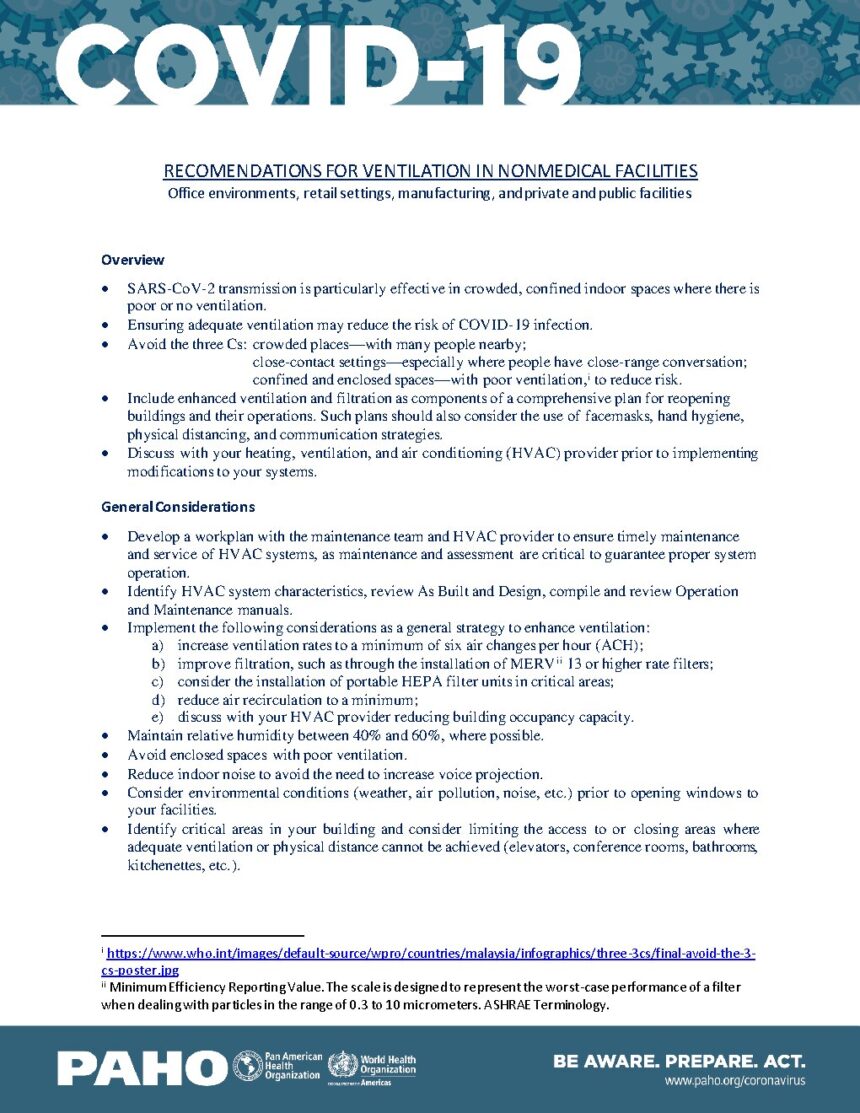
This guidance document addresses SARS-CoV-2 transmission risk reduction in nonmedical settings including offices, retail establishments, manufacturing facilities, and public buildings. The document emphasises that SARS-CoV-2 transmission is particularly effective in crowded, confined indoor spaces with poor or no ventilation, and provides actionable recommendations to mitigate this risk through enhanced ventilation strategies.
The core strategy includes increasing ventilation rates to a minimum of six air changes per hour (ACH), improving filtration through MERV 13 or higher filters, reducing air recirculation, and maintaining relative humidity between 40% and 60%. The guidance recommends pre- and post-occupancy flushing with maximum outside air flow for two hours or achieving six air changes of outside air, and maintaining CO₂ levels below 800 ppm in enclosed settings.
The document positions enhanced ventilation and filtration as components of a comprehensive plan that must also include facemasks, hand hygiene, physical distancing, and communication strategies. Special attention is given to enclosed settings, cleaning procedures, and the protection of vulnerable populations through portable HEPA filtration devices and UV-C light air purifiers where appropriate.
Key points
For clinicians — doses and thresholds as stated in the guideline
- Increase ventilation rates to a minimum of six air changes per hour (ACH) in all occupied spaces
- Install MERV 13 or higher rate filters to improve air filtration; consider portable HEPA filter units in critical areas
- Maintain relative humidity between 40% and 60% where possible
- Maintain CO₂ levels below 800 ppm in enclosed settings using continuous monitoring
- Provide flushing with maximum outside air flow for two hours pre- and post-occupancy, or achieve six air changes of outside air
- Reduce air recirculation to a minimum and avoid using split air conditioning systems unless outside air can be provided
- Run garage exhaust and toilet exhaust fans two hours before occupancy and continuously during occupied hours
- Provide cleaning and maintenance teams with N95 respirators, eye protection, coveralls and disposable gloves; treat HVAC filters as contaminated waste
From the guideline
Verbatim
“SARS-CoV-2 transmission is particularly effective in crowded, confined indoor spaces where there is poor or no ventilation.”
Editor’s perspective
Why this matters for Georgia and the region
Prof. Giorgi Pkhakadze, MD, MPH, PhD
Editor-in-Chief, Georgian Medical Journal · Chair, Public Health Institute of Georgia · WHO consultant, health and migration
As we continue to manage COVID-19 alongside other respiratory infections in Georgia, this PAHO guidance offers immediately actionable engineering controls for our public buildings, workplaces and commercial facilities. The specified thresholds—six air changes per hour, CO₂ below 800 ppm, and MERV 13 filtration—provide objective targets that facility managers can measure and verify, moving beyond general advice to implement and audit concrete improvements. I would particularly stress to Georgian public health colleagues the value of portable HEPA filtration and CO₂ monitoring as interim solutions for older buildings where full HVAC upgrades are not immediately feasible, a situation common across our region. The realistic caveat is that many Soviet-era buildings in Georgia rely on natural ventilation or minimal mechanical systems; achieving these standards will require capital investment, technical capacity building for maintenance personnel, and balancing ventilation with energy costs during our cold winters, making phased implementation and prioritisation of high-occupancy facilities essential.
ORCID 0000-0001-7609-4515 · Perspective written for the GMJ Guidelines Library, 19 Oct 2026
Applicability
Georgia and the South Caucasus
For Georgia and the South Caucasus, this guidance is directly applicable to public buildings, offices, and commercial facilities as COVID-19 continues to circulate. Many buildings in the region rely on natural ventilation or older HVAC systems that may not meet the recommended six air changes per hour standard. National and regional programmes would need to conduct building assessments to identify ventilation capacity, prioritise upgrades in high-occupancy public facilities (government offices, educational institutions, transport hubs), and develop workforce training for maintenance teams on proper HVAC operation and filter handling. The guidance on CO₂ monitoring and portable HEPA filtration offers practical, scalable solutions for facilities where full HVAC upgrades are not immediately feasible. Winter heating practices that reduce outside air intake to conserve energy would need to be balanced against ventilation requirements, making the humidity and CO₂ threshold recommendations particularly relevant for the region’s climate.
Questions this guideline answers
Quick answers
What is the minimum recommended air change rate for nonmedical facilities?
A minimum of six air changes per hour (ACH) is recommended for occupied spaces to reduce COVID-19 transmission risk.
What CO₂ level indicates adequate ventilation in enclosed spaces?
CO₂ levels should be maintained below 800 ppm. Continuous CO₂ monitoring can be used to assess ventilation efficiency in conference rooms, offices and similar enclosed settings.
How long should buildings be flushed with outside air before occupancy?
HVAC systems should provide flushing with maximum outside air flow for two hours before and after occupancy, or achieve six air changes of outside air in the space. For naturally ventilated buildings, open windows for a minimum of two hours before reoccupation when weather and air quality permit.
What personal protective equipment is recommended for maintenance staff working on HVAC systems?
Cleaning and maintenance teams should be provided with N95 respirators, eye protection, coveralls and disposable gloves. HVAC filters should be treated as contaminated waste.
Related on GMJ
Interconnected resources
Dictionary of Public Health
GMJ News coverage
Quality & accreditation
Other guidelines on this topic
- Aide-mémoire on infection prevention and control measures for Candida auris colonization and infection in patients in health facilities
- Recommendations for Heating, Ventilation, and Air Conditioning in Healthcare Facilities
- Guidelines for Care of Critically Ill Adult Patients with COVID-19 in the Americas, Summary, version 3
- Guideline for Preventive Chemotherapy for the Control of Taenia solium Taeniasis
- Smart Hospitals Toolkit. Second edition
- Issuer
- Pan American Health Organization
- Type
- Procedures, manuals, guidelines
- Status
- Current
- Published
- 2021-01-01
- Scope
- Office environments, retail settings, manufacturing facilities, and private and public nonmedical facilities
- Audience
- Facility managers, HVAC providers, maintenance teams, public health authorities
- Licence
- CC BY-NC-SA 3.0 IGO
- Evidence
- Expert consensus
- Record history
- Created 19 Oct 2026 · updated 19 Oct 2026 · next check Apr 2027
Pan American Health Organization. Recommendations for Ventilation in Nonmedical Facilities. Washington, DC: PAHO; 2021. (PAHO/CDE/CE/COVID-19/21-0016). Available from: https://iris.paho.org/handle/10665.2/54641GMJ Guidelines Library records are original summaries written by the GMJ editorial team from the issuer’s published document and reviewed by a physician. They do not replace the full guideline. The document is the copyright of its issuer and is linked, not hosted. Spotted an error or a newer edition? Tell the Guidelines Desk.
Was this article helpful?