Pan American Health Organization · 2020
A comprehensive checklist for health authorities and facility managers to plan, mobilise and protect health workforce during COVID-19 pandemic response.
- Issuer
- Pan American Health Organization
- Edition
- 2020
- Audience
- PAHO/WHO health systems advisors, incident command members, national health authorities including human resources directors and managers, directors of health services and networks
- Evidence
- Expert consensus checklist
- Reviewed
- 19 Oct 2026 · GMJ
What this guideline says
GMJ summary
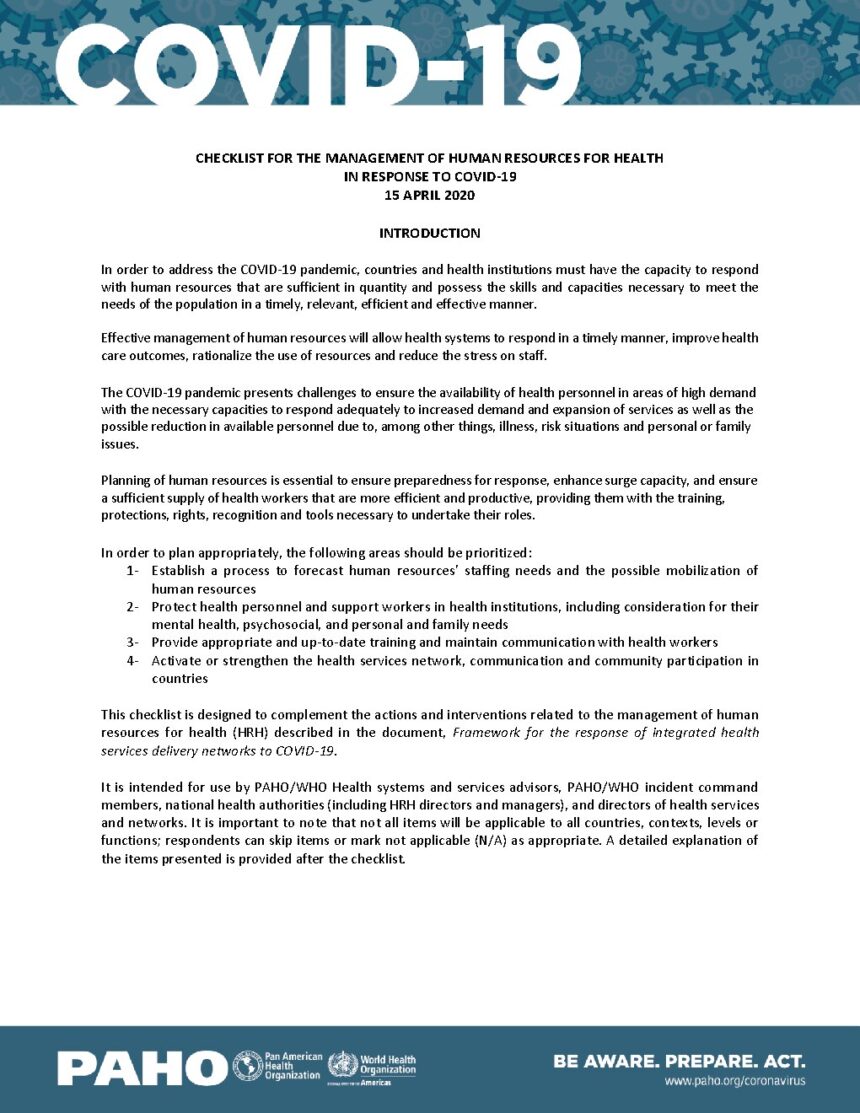
This checklist provides a systematic framework for managing human resources for health during the COVID-19 pandemic. It addresses four priority areas: forecasting and mobilising health workforce; protecting health personnel including mental health support; providing appropriate training and communication; and activating health services networks and community participation.
The document presents detailed checklists covering workforce mapping, recruitment strategies (including private sector deployment, activation of medical reserve corps, early licensing of graduates, and retired health worker mobilisation), reorganisation and task-shifting, contractual and legal considerations, communication mechanisms, training requirements, occupational safety measures including personal protective equipment (PPE), and mental health and psychosocial support for health workers.
Intended for use by health systems advisors, national health authorities, human resources directors, and health services managers, the checklist is designed to complement the broader framework for integrated health services delivery networks responding to COVID-19, with the flexibility to adapt items to specific country contexts and levels of care.
Key points
For clinicians — doses and thresholds as stated in the guideline
- Map essential health worker needs and availability by level of care, establishing centralised rosters or databases of all available health workforce
- Recruit additional surge capacity through temporary private-to-public sector deployment, activation of medical reserve corps, early licensing of medical and nursing graduates, and mobilisation of retired health workers
- Implement task-shifting by training paediatric intensivists and emergency physicians for adult care, reorienting specialists to manage critical COVID-19 treatments (intubation, ventilation, respiratory therapy), and redistributing non-frontline professionals to first-level care
- Ensure all health workforce receive appropriate COVID-19 training and are up-to-date in basic life support according to WHO Basic Emergency Care standards
- Secure and allocate PPE to frontline health workforce in hospitals and communities based on exposure risk, ensuring proper training in rational use and disposal
- Reassign health workers in high-risk categories for COVID-19 complications to tasks and settings that reduce exposure risk
- Establish dedicated hotlines for psychological support to health workers, review work schedules for flexibility, monitor for stress and burnout, and provide childcare and family care support options
- Implement protocols for management and monitoring of suspected and confirmed COVID-19 cases among health workers, with blame-free reporting environments and clear criteria for when workers must self-isolate
Safety and Protection of Health Workers
Table extracted from the guideline
| Measure | Implementation status |
|---|---|
| Preventive and protective measures, including administrative controls, taken to minimize occupational safety and health (OSH) risks | Yes / No / In progress / N/A |
| Information, instruction and training on OSH provided | Yes / No / In progress / N/A |
| Secure and allocate PPE to health workforce providing frontline services (in hospitals and communities), considering risk of exposure | Yes / No / In progress / N/A |
| Health workforce is properly trained in the rational use and disposal of PPE | Yes / No / In progress / N/A |
| Appropriate work hours and enforced rest periods ensured and space made available for the same | Yes / No / In progress / N/A |
| Optional accommodation arrangements for hospital-based health workers to reduce time spent travelling to/from home and protect health workers' families from indirect exposure available | Yes / No / In progress / N/A |
| Health workers in high-risk categories for COVID-19 complications are reassigned to tasks/settings that reduce risk of exposure | Yes / No / In progress / N/A |
| Partnering more experienced with inexperienced colleagues is included in plan | Yes / No / In progress / N/A |
| WHO document on Rights, roles and responsibilities of health workers has been made available to all health workers | Yes / No / In progress / N/A |
| Protocols for the management and monitoring of suspected and confirmed cases among the human resources involved in the COVID-19 response has been activated | Yes / No / In progress / N/A |
| Mechanisms for reporting of incidents and symptoms by health workers are in place | Yes / No / In progress / N/A |
| All health workers are aware of how to identify and report any symptoms | Yes / No / In progress / N/A |
| Health workers understand when they must self-isolate | Yes / No / In progress / N/A |
| Protocols established to assure safe return to work of health workers following quarantine or sick leave | Yes / No / In progress / N/A |
Source: Pan American Health Organization, Checklist for the Management of Human Resources for Health in Response to COVID-19. Reproduced in summary form.
From the guideline
Verbatim
“Effective management of human resources will allow health systems to respond in a timely manner, improve health care outcomes, rationalize the use of resources and reduce the stress on staff.”
Editor’s perspective
Why this matters for Georgia and the region
Prof. Giorgi Pkhakadze, MD, MPH, PhD
Editor-in-Chief, Georgian Medical Journal · Chair, Public Health Institute of Georgia · WHO consultant, health and migration
As Georgia confronted COVID-19 with a health workforce already challenged by emigration and regional maldistribution, this PAHO checklist offers a systematic approach that Georgian health authorities can adapt to local context. The task-shifting recommendations are particularly valuable for our setting, where concentrating specialist expertise in Tbilisi has long limited surge capacity in regional centres. I would stress to Georgian colleagues the importance of formalising legal and contractual frameworks for temporary licensing and scope-of-practice expansion before the next emergency, as ad hoc arrangements during crisis create unnecessary delays and liability concerns. The critical implementation caveat for Georgia is that mental health and psychosocial support infrastructure for health workers remains underdeveloped; establishing the recommended dedicated hotlines and buddy systems will require investment in trained personnel and sustainable financing beyond emergency periods.
ORCID 0000-0001-7609-4515 · Perspective written for the GMJ Guidelines Library, 19 Oct 2026
Applicability
Georgia and the South Caucasus
For Georgia and the South Caucasus, this checklist addresses critical health workforce challenges during pandemic response, particularly relevant given regional constraints in health workforce density and distribution. Georgian health authorities would need to consider existing human resources databases and professional registries, legal frameworks for temporary licensing and task-shifting, agreements with private sector healthcare providers, and mechanisms for mobilising the Georgian diaspora of health professionals. The mental health and psychosocial support recommendations are particularly pertinent given documented burnout among healthcare workers in the region. National programmes should assess existing contractual mechanisms, liability and insurance frameworks, and capacity for rapid training deployment through platforms such as the National Center for Disease Control and Public Health’s training programmes.
Questions this guideline answers
Quick answers
How can countries rapidly expand health workforce capacity during COVID-19?
Strategies include temporary deployment of private sector professionals to public facilities, activation of medical reserve corps and military health providers, early licensing of medical and nursing graduates, mobilisation of retired health workers, and training non-health sector workers and volunteers for support functions such as administration, data collection, and infection prevention and control.
What task-shifting measures can be implemented for critical care?
Paediatric intensivists and emergency care physicians can be trained to manage adults under supervision of adult intensive care physicians; specialists such as internists, anaesthesiologists, and surgeons can be reoriented to manage specific treatments for critical COVID-19 patients including intubation, ventilation, and respiratory therapy; and non-frontline specialists can be redistributed to first-level care for non-COVID-19 patients.
What protection measures are essential for frontline health workers?
Essential measures include securing and allocating PPE based on exposure risk, proper training in rational use and disposal of PPE, enforcing appropriate work hours and rest periods, providing optional accommodation to reduce travel and protect families, reassigning high-risk workers to lower-exposure settings, implementing protocols for monitoring suspected cases among staff, and establishing blame-free reporting mechanisms for incidents and symptoms.
What mental health and psychosocial support should be provided to health workers?
Support should include establishing dedicated psychological support hotlines, reviewing work schedules for flexibility and distributed workload, encouraging and monitoring breaks, monitoring for stress and burnout, providing childcare and family care support options, implementing buddy systems for peer support and safety reinforcement, facilitating access to mental health services, and providing psychological first aid training for volunteers supporting high-stress areas.
Related on GMJ
Interconnected resources
Dictionary of Public Health
GMJ News coverage
- UK flu and COVID-19 surveillance data to May 2027 shows continued monitoring amid seasonal trendsOct 2026
- Community Health Workers Boost COVID-19 Testing Among Formerly Incarcerated PeopleAug 2026
- Why Women Doctors Drop Out: A Systematic Review Reveals Critical Gaps in Medical TrainingOct 2026
- PEN-Plus Expands Severe Disease Care Across Africa: Third International Conference Charts ProgressOct 2026
Quality & accreditation
- ASF Hospital — Standard 20 — Supporting the Care Workforce
- ASF Laboratory — Standard 3 — Personnel & Competence
- ASF Hospital — Standard 7 — Governance & Management
- ASF Hospital — Standard 5 — Safety & Emergency Preparedness
- ASF Hospital — Standard 4 — Care & Treatment
- ASF Hospital — Standard 11 — Critical Care
- ASF Medical Transport — Standard 6 — Emergency Response During Transport
Other guidelines on this topic
- Caribbean Shelter Guide: COVID-19 Considerations
- Aide-mémoire on infection prevention and control measures for Candida auris colonization and infection in patients in health facilities
- Regional Framework for the Monitoring and Re-Verification of Measles, Rubella, and Congenital Rubella Syndrome Elimination in the Americas
- Protocol for Enhanced Isolate-Level Antimicrobial Resistance Surveillance in the Americas. Primary Phase: Bloodstream Infections
- Guide for the preparation of a risk communication strategy for COVID-19 vaccines
- Issuer
- Pan American Health Organization
- Type
- Procedures, manuals, guidelines
- Status
- Current
- Published
- 2020-01-01
- Audience
- PAHO/WHO health systems advisors, incident command members, national health authorities including human resources directors and managers, directors of health services and networks
- Licence
- CC BY-NC-SA 3.0 IGO
- Evidence
- Expert consensus checklist
- Record history
- Created 19 Oct 2026 · updated 19 Oct 2026 · next check Apr 2027
Pan American Health Organization. Checklist for the Management of Human Resources for Health in Response to COVID-19, 15 April 2020. Washington, D.C.: PAHO; 2020. Reference Number: PAHO/HSS/HR/COVID-19/20-0013.GMJ Guidelines Library records are original summaries written by the GMJ editorial team from the issuer’s published document and reviewed by a physician. They do not replace the full guideline. The document is the copyright of its issuer and is linked, not hosted. Spotted an error or a newer edition? Tell the Guidelines Desk.
Was this article helpful?