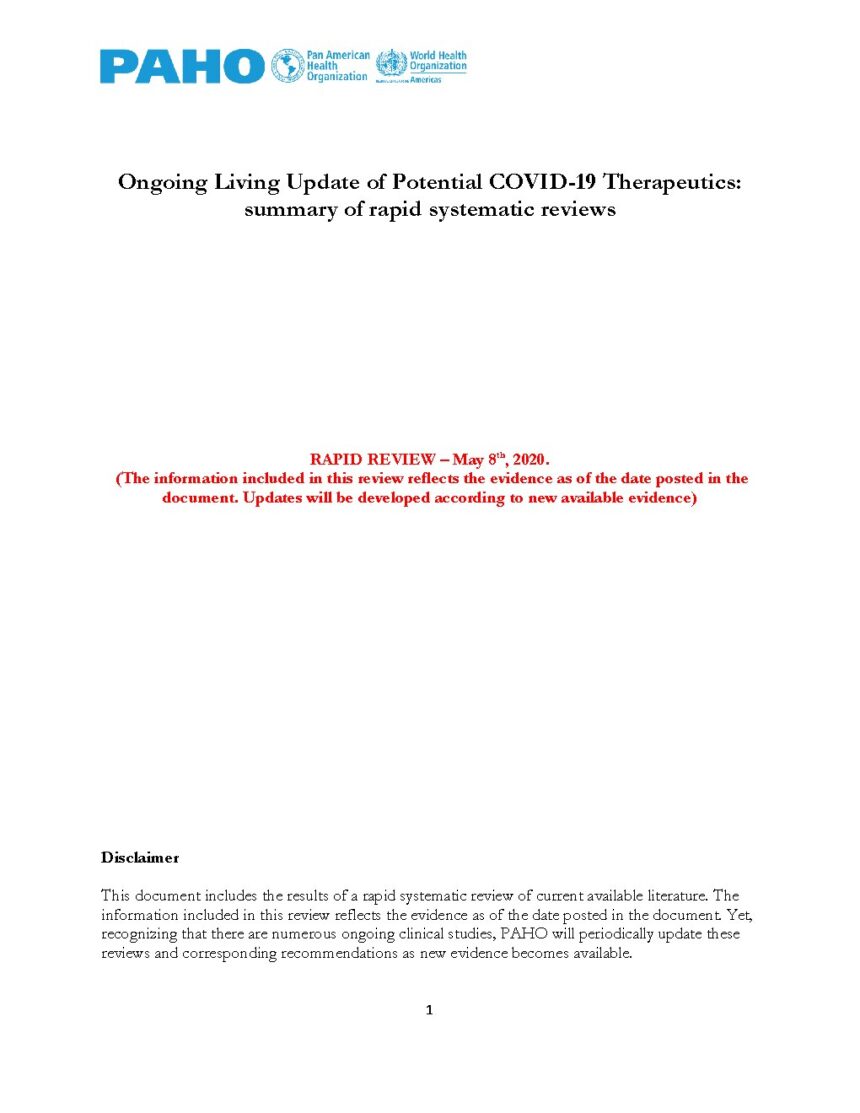
Pan American Health Organization · Rapid Review, 8 May 2020
Rapid systematic review of emerging evidence on COVID-19 drug candidates for clinicians and public-health professionals.
- Issuer
- Pan American Health Organization
- Edition
- Rapid Review, 8 May 2020
- Audience
- Clinicians and public-health professionals
- Evidence
- GRADE-rated rapid systematic review; mostly very low certainty evidence from small RCTs and observational studies
- Reviewed
- 19 Oct 2026 · GMJ
What this guideline says
GMJ summary
This rapid systematic review, published 8 May 2020 by PAHO during the early COVID-19 pandemic, synthesises evidence on 18 candidate therapeutics including chloroquine/hydroxychloroquine, lopinavir/ritonavir, remdesivir, corticosteroids, convalescent plasma, interferons, tocilizumab, favipiravir, ivermectin, and others. The review found insufficient evidence to draw conclusions on benefits and harms for most agents; most data came from small, non-randomised, confounded observational studies with very low certainty of evidence.
Hydroxychloroquine/chloroquine demonstrated no clear benefit in multiple small RCTs and observational studies, with concerning cardiovascular adverse events (QT prolongation, arrhythmias) especially when combined with azithromycin. Lopinavir/ritonavir showed no significant clinical benefit in randomised trials. Remdesivir data were inconclusive with high mortality in underpowered trials. Corticosteroids showed mixed results; one meta-analysis of ARDS patients (not COVID-19 specific) suggested reduced mortality and mechanical ventilation duration with moderate certainty evidence. Convalescent plasma case-series suggested possible benefit but lacked control groups.
The review emphasises that nearly all data were hypothesis-generating only, calling urgently for well-designed randomised controlled trials. GRADE certainty ratings were overwhelmingly ‘very low’ due to high risk of bias, small sample sizes, confounding, and poor reporting. The document served as a living update to inform prescribers of rapidly evolving evidence and guide clinical trial prioritisation during the pandemic emergency.
Key points
For clinicians — doses and thresholds as stated in the guideline
- Hydroxychloroquine 400 mg twice daily day 1, then 400 mg daily: no significant benefit versus standard care in multiple small RCTs; adverse events in 30% versus 8.8% controls (Tang trial); QT prolongation >500 ms in 11–25% of patients when combined with azithromycin.
- Chloroquine high-dose (600 mg twice daily for 10 days, total 12 g): 17% lethality, 25% QTc >500 ms; higher lethality trend versus low-dose (total 2.7 g over 5 days); high-dose regimen should not be recommended.
- Lopinavir/ritonavir 400/100 mg twice daily for 14 days: no significant difference in time to clinical improvement (median 16.0 days both arms), day-28 mortality 19.2% versus 25.0% controls (not significant), open-label RCT n=199.
- Remdesivir 200 mg IV day 1, then 100 mg daily days 2–10: no significant difference in time to clinical improvement (HR 1.23, 95% CI 0.87–1.75); 22 deaths in treatment group versus 10 in placebo (underpowered trial, 50% power).
- Corticosteroids (methylprednisolone, dexamethasone, hydrocortisone) in ARDS (not COVID-19 specific): meta-analysis of 7 RCTs showed reduced all-cause mortality (RR 0.75, 95% CI 0.59–0.95, moderate certainty) and reduced mechanical ventilation duration (mean difference −4.93 days, low certainty).
- Convalescent plasma: case-series (n=5–10 patients) showed neutralising antibody titre increases to 1:640, viral clearance within 3–12 days, no severe adverse events, but no randomised control groups.
- Tocilizumab (IL-6 inhibitor) median dose 900 mg (range 700–1,200 mg): case-series n=21 showed 90.5% discharge rate, 75% reduced oxygen support, but non-randomised with very low certainty evidence.
- Ivermectin 150 mcg/kg once: observational registry data suggested lower mortality (7.3% versus 21.3% in mechanically ventilated patients, HR 0.20) but high risk of bias, non-randomised, hypothesis-generating only.
GRADE certainty hydroxychloroquine/chloroquine adverse events (all combined)
Table extracted from the guideline
| Study design | Risk of bias | Imprecision | HCQ/CQ events | Control events | Relative Risk (95% CI) | Certainty | Importance |
|---|---|---|---|---|---|---|---|
| 4 randomised trials | Serious | Serious | 32/126 (25.4%) | 10/133 (7.5%) | 2.86 (1.51 to 5.45) | ⨁⨁◯◯ LOW | CRITICAL |
Source: Pan American Health Organization, Ongoing Living Update of Potential COVID-19 Therapeutics: summary of rapid systematic reviews. Reproduced in summary form.
From the guideline
Verbatim
“It is absolutely imperative therefore that prescribers be given the most updated research evidence fast to inform if what was done was optimal or if it is not optimal or even harmful to patients.”
Editor’s perspective
Why this matters for Georgia and the region
Prof. Giorgi Pkhakadze, MD, MPH, PhD
Editor-in-Chief, Georgian Medical Journal · Chair, Public Health Institute of Georgia · WHO consultant, health and migration
As Georgia's COVID-19 response unfolded in 2020, this PAHO rapid review exemplified the tension between clinical urgency and evidence rigour that we faced daily. The finding that hydroxychloroquine conferred no benefit but real cardiovascular harm—particularly the 11–25% rate of dangerous QT prolongation when combined with azithromycin—was critical for Georgian clinicians, given our population's high burden of cardiovascular comorbidity. I would stress to colleagues the review's central lesson: very low certainty evidence demands clinical humility and participation in randomised trials, not widespread off-label use. The corticosteroid data, showing possible mortality reduction in ARDS, presaged the later RECOVERY trial findings that did establish benefit, illustrating why systematic evidence synthesis during rapidly evolving outbreaks must be iterative. One realistic caveat for Georgian practice: the infrastructure for daily GRADE-rated evidence updates and rapid guideline adaptation remains limited outside major referral centres, underscoring the need for strengthened knowledge translation mechanisms in our national public health system.
ORCID 0000-0001-7609-4515 · Perspective written for the GMJ Guidelines Library, 19 Oct 2026
Applicability
Georgia and the South Caucasus
This rapid review remains historically important for Georgia and the South Caucasus as a record of early pandemic evidence synthesis, though clinical recommendations have since evolved substantially. Georgian national COVID-19 treatment protocols would now be guided by more recent WHO living guidelines and large-scale RCTs (RECOVERY, SOLIDARITY). The review’s methodology—transparent GRADE assessment, explicit acknowledgment of very low certainty evidence, and caution against off-label use without trials—offers a model for evidence appraisal during future novel pathogen outbreaks. National programmes should note the cardiovascular safety concerns with hydroxychloroquine/azithromycin (especially relevant given high cardiovascular disease burden in Georgia) and the infrastructure requirements for convalescent plasma programmes. The emphasis on randomised trials over observational data remains critical for resource allocation and formulary decisions in Georgian hospitals.
Questions this guideline answers
Quick answers
What was the quality of evidence for hydroxychloroquine in COVID-19 as of May 2020?
Very low certainty. Multiple small RCTs showed no significant benefit in viral clearance, clinical recovery, or mortality. Adverse events occurred in 25–30% of hydroxychloroquine recipients versus 7.5% controls. When combined with azithromycin, 11–25% developed dangerous QT prolongation >500 ms, and increased cardiovascular mortality was observed (HR 2.19, 95% CI 1.22–3.94).
Did lopinavir/ritonavir show benefit for COVID-19?
No. The largest RCT (n=199) found no significant difference versus standard care in time to clinical improvement (median 16 days both arms), day-28 mortality (19.2% versus 25.0%), or ICU length of stay. Five patients (23.8%) in the lopinavir/ritonavir group had adverse events versus none in controls.
What did early corticosteroid evidence show?
Mixed results in COVID-19 observational studies (mostly very low certainty). However, a meta-analysis of 7 RCTs in ARDS patients (not COVID-19 specific) showed corticosteroids reduced mortality (RR 0.75, moderate certainty) and duration of mechanical ventilation (mean −4.93 days, low certainty), though with increased hyperglycaemia risk. COVID-19 observational data showed conflicting mortality signals.
What safety concerns were identified with hydroxychloroquine and azithromycin combination?
Significant QT interval prolongation: 11–15.9% of patients developed QTc >500 ms (high risk for torsades de pointes). One patient required emergent cardioversion for torsades. A large network cohort study found increased 30-day cardiovascular mortality (HR 2.19), chest pain/angina (HR 1.15), and heart failure (HR 1.22) with the combination versus hydroxychloroquine alone.
Related on GMJ
Interconnected resources
Dictionary of Public Health
Conditions A–Z
GMJ News coverage
- UK flu and COVID-19 surveillance data to May 2027 shows continued monitoring amid seasonal trendsOct 2026
- Community Health Workers Boost COVID-19 Testing Among Formerly Incarcerated PeopleAug 2026
- Cambridge researchers identify three distinct severe pneumonia subtypes, opening path to personalised treatmentSep 2026
- Machine Learning Model Predicts Child Pneumonia Hospitalisation Risk in Malawi Primary CareJun 2026
Quality & accreditation
Other guidelines on this topic
- Reorganization and Progressive Expansion of Health Services for the Response to the COVID-19 Pandemic
- Influenza at the Human-Animal Interface: PAHO Recommendations to Strengthen Intersectoral Work for Surveillance, Early Detection, and Investigation
- Administrative Controls to Guarantee Implementation of Infection Prevention and Control Measures in the Context of COVID-19
- Recommendations for Reorganization and Expansion of Hospital Services in Response to COVID-19. Technical Working Document, version 5
- Emergency Use of Unproven Interventions Outside of Research: Ethics Guidance for the COVID-19 Pandemic
- Issuer
- Pan American Health Organization
- Type
- Procedures, manuals, guidelines
- Edition
- Rapid Review, 8 May 2020
- Status
- Current
- Published
- 2020-01-01
- Languages
- English
- Scope
- 18 candidate COVID-19 therapeutics: meplazumab, ivermectin, siltuximab, danoprevir, tocilizumab, favipiravir, darunavir, nelfinavir, remdesivir, interferon-alpha, chloroquine/hydroxychloroquine, convalescent plasma, heparin, corticosteroids, IVIG, umifenovir (arbidol), lopinavir/ritonavir, α-lipoic acid
- Audience
- Clinicians and public-health professionals
- Licence
- CC BY-NC-SA 3.0 IGO
- Evidence
- GRADE-rated rapid systematic review; mostly very low certainty evidence from small RCTs and observational studies
- Next review
- Living update (series discontinued; superseded by WHO living guidelines)
- Record history
- Created 19 Oct 2026 · updated 19 Oct 2026 · next check Apr 2027
Pan American Health Organization. Ongoing Living Update of Potential COVID-19 Therapeutics: summary of rapid systematic reviews. Rapid Review, 8 May 2020. Washington, D.C.: PAHO; 2020. Licence: CC BY-NC-SA 3.0 IGO.GMJ Guidelines Library records are original summaries written by the GMJ editorial team from the issuer’s published document and reviewed by a physician. They do not replace the full guideline. The document is the copyright of its issuer and is linked, not hosted. Spotted an error or a newer edition? Tell the Guidelines Desk.
Was this article helpful?