Pan American Health Organization · 2020
Guidance for public health and veterinary authorities on surveillance, early detection, and investigation of zoonotic influenza with pandemic potential.
- Issuer
- Pan American Health Organization
- Edition
- 2020
- Audience
- Public health authorities, veterinary services, national influenza centers, surveillance officers
- Evidence
- Expert consensus based on WHO/PAHO/FAO/OIE collaboration and GISRS protocols
- Reviewed
- 19 Oct 2026 · GMJ
What this guideline says
GMJ summary
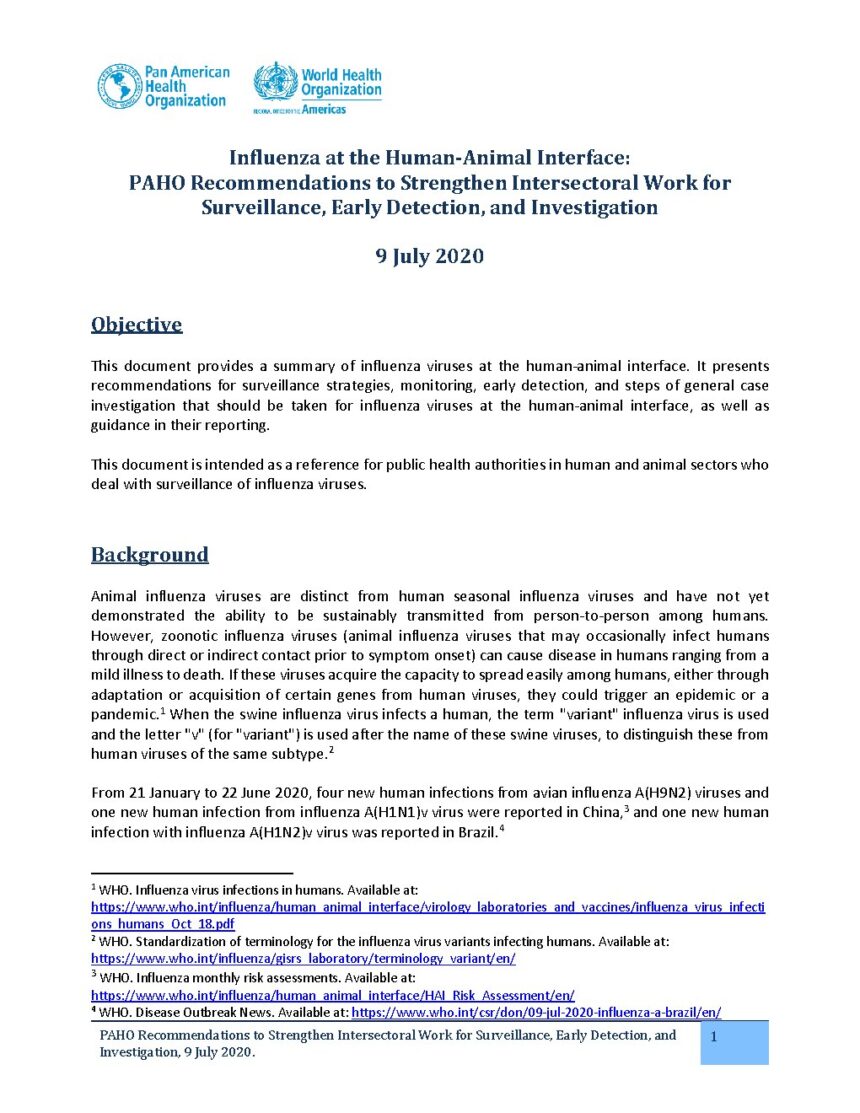
This PAHO document provides comprehensive recommendations for surveillance, early detection, and investigation of influenza viruses at the human-animal interface. Published during the COVID-19 pandemic (July 2020), it emphasises that animal influenza viruses—particularly avian and swine strains—can occasionally infect humans and potentially trigger epidemics or pandemics if they acquire sustained human-to-human transmission capability.
The guidance calls for strengthened intersectoral collaboration between human and animal health sectors through weekly information sharing, enhanced SARI (severe acute respiratory infection) and ILI (influenza-like illness) surveillance, and coordinated risk assessments. It details specific triggers for investigation, laboratory detection protocols including real-time RT-PCR interpretation for novel influenza viruses, and requirements for immediate reporting under the International Health Regulations (IHR) of any laboratory-confirmed human infection caused by an influenza A virus with pandemic potential.
The document covers both passive and active surveillance strategies in animal populations, emphasising that highly pathogenic avian influenza (HPAI) and low pathogenic avian influenza (LPAI) in poultry require mandatory OIE notification, whilst swine influenza surveillance should be enhanced despite not being on the OIE notifiable disease list due to its zoonotic potential.
Key points
For clinicians — doses and thresholds as stated in the guideline
- SARI case definition for investigation: acute respiratory infection with fever ≥38°C and cough, onset within last 10 days, requiring hospitalisation, when COVID-19 ruled out and associated with animal exposure, travel to affected countries, or part of an unexplained cluster
- Enhanced surveillance should continue for minimum of one month in locations where cases reside or animal outbreaks occur, with increased testing of SARI and ILI cases
- Real-time RT-PCR results showing InfA marker positive with no subtype markers, or pdmInfA with H3 markers, indicate potential novel or variant influenza viruses requiring immediate WHO notification
- All human infections with novel influenza subtypes are notifiable under IHR and must be reported immediately via two channels: IHR National Focal Point (ihr@paho.org) and GISRS network
- Clinical samples from suspected novel influenza cases must be sent to a WHO Collaborating Center within one week of detection for characterisation, without awaiting additional local testing
- Active surveillance in animals requires serological sampling complemented by molecular/virological monitoring, with capacity to detect H5, H7, and H9 avian subtypes plus A(H1N1), A(H1N2), and A(H3N2) swine influenza viruses
- Early warning triggers include: influenza strain not normally circulating in humans, increase in acute respiratory disease unrelated to COVID-19, or SARI not responding to standard treatment with animal exposure history
- National veterinary laboratories should perform both serological assays (AGID, ELISA) and molecular testing (RT-qPCR) for wide range of influenza strains in birds and swine
Interpretation of real-time RT-PCR results indicative of potential unusual influenza virus
Table extracted from the guideline
| InfA | InfB | pdmInfA | pdmH1 | H3 | RP | Interpretation |
|---|---|---|---|---|---|---|
| + | – | – | – | – | +/- | Influenza A – Unsubtyped POTENTIAL NOVEL INFLUENZA VIRUS |
| + | – | + | – | + | +/- | Influenza A POTENTIAL INFLUENZA A(H3N2)v |
| – | – | – | – | – | + | Negative |
| – | – | – | – | – | – | Inconclusive |
Source: Pan American Health Organization, Influenza at the Human-Animal Interface: PAHO Recommendations to Strengthen Intersectoral Work for Surveillance, Early Detection, and Investigation. Reproduced in summary form.
From the guideline
Verbatim
“PAHO reiterates that all human infections caused by a novel influenza subtype are notifiable under the International Health Regulations (IHR) and that States Parties to the IHR (2005) are required to immediately notify WHO of any laboratory-confirmed case of recent human infection caused by an influenza A virus with the potential to cause a pandemic.”
Editor’s perspective
Why this matters for Georgia and the region
Prof. Giorgi Pkhakadze, MD, MPH, PhD
Editor-in-Chief, Georgian Medical Journal · Chair, Public Health Institute of Georgia · WHO consultant, health and migration
As someone who has worked extensively on infectious disease surveillance in Georgia and the region, I find this PAHO guidance particularly timely for the South Caucasus. Our countries have made substantial progress in communicable disease surveillance—Georgia's National Centre for Disease Control coordinates both human and veterinary reporting—but the specific challenge of zoonotic influenza requires strengthened laboratory capacity and genuine One Health collaboration. The recommendation I would emphasise most strongly is the requirement for samples to reach WHO Collaborating Centers within one week of detecting unusual RT-PCR patterns, because this timeline demands pre-established courier arrangements and cannot wait for bureaucratic approvals. The realistic implementation challenge for Georgia, Armenia, and Azerbaijan will be sustaining active surveillance in animal populations: whilst our countries have reasonable passive notification systems for avian influenza, the recommended serological and molecular monitoring of swine herds will require dedicated funding and trained veterinary laboratory staff that most national programmes currently lack, particularly in rural areas where the risk is highest.
ORCID 0000-0001-7609-4515 · Perspective written for the GMJ Guidelines Library, 19 Oct 2026
Applicability
Georgia and the South Caucasus
For Georgia and the South Caucasus, this guidance is directly relevant given the region’s position at the intersection of migratory bird flyways, growing poultry and swine industries, and proximity to countries reporting zoonotic influenza events. Georgia’s National Centre for Disease Control and Public Health should ensure that national influenza centres maintain the recommended CDC RT-PCR protocols and establish clear communication channels between human and veterinary surveillance systems. The requirement for immediate IHR notification aligns with Georgia’s obligations as a WHO member state. National programmes will need to assess capacity for both passive surveillance (mandatory notification systems for veterinary services) and active surveillance (serological and molecular monitoring in animal populations), potentially requiring strengthened laboratory capacity and intersectoral coordination mechanisms. The recommendation for minimum one-month enhanced surveillance in affected areas requires pre-positioned resources and trained personnel in both urban centres and rural areas where animal contact is common.
Questions this guideline answers
Quick answers
What defines a SARI case requiring investigation for novel influenza?
A SARI case is an acute respiratory infection with fever ≥38°C and cough, onset within the last 10 days, requiring hospitalisation. After ruling out COVID-19, it requires investigation if: it doesn't respond to standard treatment, is associated with direct/indirect animal exposure, the patient travelled to countries with emerging viruses in the 14 days before symptom onset, occurred in a healthcare worker who treated a SARI patient with animal exposure, or is part of a cluster without conclusive laboratory results.
How quickly must novel influenza viruses be reported and to whom?
Confirmed human infection with a novel influenza virus must be reported immediately via two channels: the IHR National Focal Point (ihr@paho.org) and the Global Influenza Surveillance and Response System (GISRS). Clinical samples must be sent to a WHO Collaborating Center within one week of detection, without waiting for additional local testing. Even suspected cases should be reported immediately to GISRS with information shared with the IHR focal point.
What RT-PCR patterns indicate a potential novel influenza virus?
Using CDC kits, detection of the InfA marker with no amplification of any subtype markers (or only one of the influenza A(H1N1)pdm09 markers) indicates a potential novel influenza A virus. Detection of the pdmInfA marker together with the H3 marker indicates potential influenza A(H3N2)v virus. All curves must present standard typology with logarithmic phase and plateau crossing the threshold line within 38 cycles (Ct <38).
What surveillance capacity is required in veterinary laboratories?
National veterinary laboratories should detect a wide range of circulating strains using both serological assays (AGID and ELISA) and molecular testing (RT-qPCR). Capacity should include notifiable subtypes H5 and H7, but also H9 for avian influenza, plus A(H1N1), A(H1N2), and A(H3N2) for swine influenza. When national capacity is insufficient, countries must establish arrangements with regional animal reference laboratories including efficient courier services for timely sample shipment.
Related on GMJ
Interconnected resources
Dictionary of Public Health
GMJ News coverage
- Influenza surge in Southern Hemisphere prompts PAHO call for vaccination and health system readinessSep 2026
- Close Contact Alone May Not Drive Influenza Transmission, Controlled Study SuggestsJul 2026
- Australia Reports First High Pathogenicity H5N1 Case in Wild BirdAug 2026
- Europe reports 949 avian flu cases in birds across 30 countries in first half of 2026Aug 2026
Quality & accreditation
- ASF PHC — Standard 4 — Acute & Same-Day Care · Primary Health Clinic
- ASF PHC — Standard 7 — Governance & Staffing · Primary Health Clinic
- ASF Hospital — Standard 5 — Safety & Emergency Preparedness
- ASF Hospital — Standard 11 — Critical Care
- ASF Medical Transport — Standard 6 — Emergency Response During Transport
Other guidelines on this topic
- Administrative Controls to Guarantee Implementation of Infection Prevention and Control Measures in the Context of COVID-19
- Recommendations for Reorganization and Expansion of Hospital Services in Response to COVID-19. Technical Working Document, version 5
- Emergency Use of Unproven Interventions Outside of Research: Ethics Guidance for the COVID-19 Pandemic
- Measures to ensure the continuity of the response to malaria in the Americas during the COVID-19 pandemic
- Checklist for the Management of Human Resources for Health in Response to COVID-19
- Issuer
- Pan American Health Organization
- Type
- Procedures, manuals, guidelines
- Status
- Current
- Published
- 2020-01-01
- Scope
- Global, with focus on Americas
- Audience
- Public health authorities, veterinary services, national influenza centers, surveillance officers
- Licence
- CC BY-NC-SA 3.0 IGO
- Evidence
- Expert consensus based on WHO/PAHO/FAO/OIE collaboration and GISRS protocols
- Record history
- Created 19 Oct 2026 · updated 19 Oct 2026 · next check Apr 2027
Pan American Health Organization. Influenza at the Human-Animal Interface: PAHO Recommendations to Strengthen Intersectoral Work for Surveillance, Early Detection, and Investigation, 9 July 2020. Washington, D.C.: PAHO; 2020. (PAHO/PHE/IHM/20-041). Available from: https://iris.paho.org/handle/10665.2/52563GMJ Guidelines Library records are original summaries written by the GMJ editorial team from the issuer’s published document and reviewed by a physician. They do not replace the full guideline. The document is the copyright of its issuer and is linked, not hosted. Spotted an error or a newer edition? Tell the Guidelines Desk.
Was this article helpful?