Pan American Health Organization · June 2020
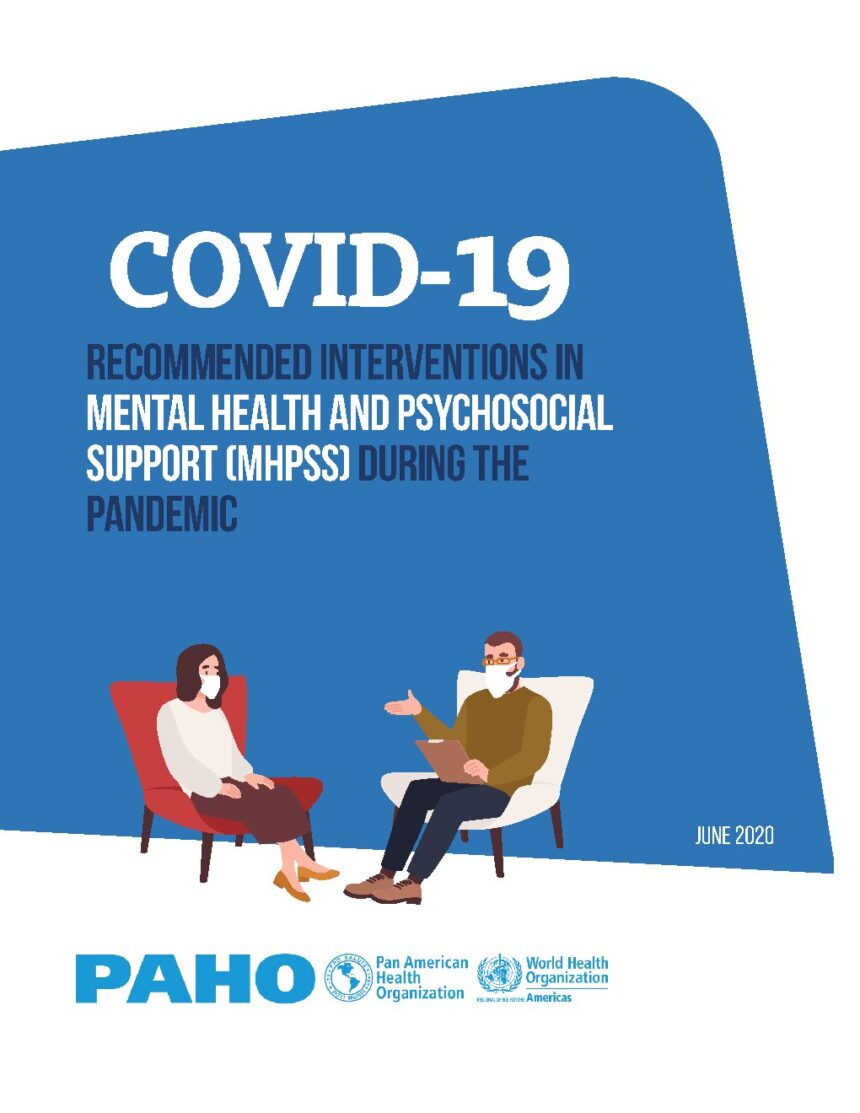
Four-level pyramid framework for delivering mental health and psychosocial support during COVID-19, from basic services to specialized care.
- Issuer
- Pan American Health Organization
- Edition
- June 2020
- Audience
- Health authorities, mental health professionals, primary care workers, community actors, first responders, social workers, educators, NGOs
- Evidence
- Expert consensus based on IASC guidelines and adapted WHO tools (PFA, mhGAP-HIG)
- Reviewed
- 19 Oct 2026 · GMJ
What this guideline says
GMJ summary
This PAHO guideline presents a comprehensive framework for mental health and psychosocial support (MHPSS) interventions during the COVID-19 pandemic, based on the Inter-Agency Standing Committee (IASC) intervention pyramid. The pyramid describes four levels of support ranging from social considerations and basic services for the general population, through community and family supports, focused non-specialized supports, to specialized mental health services for those with severe conditions.
The document emphasizes that the pandemic threatens both physical and mental health, with fear, socioeconomic impacts, isolation, and disruption of services creating widespread distress. While most reactions are normal responses to crisis, some people will develop more serious mental health problems requiring intervention. The framework aims to prevent escalation through timely interventions at lower complexity levels whilst ensuring specialized care for those who need it.
Key principles include intersectoral coordination, human rights approaches, adaptation to local contexts, continuity of treatment for pre-existing conditions, and special adaptation of interventions to remote delivery methods given physical distancing requirements. The guideline stresses that both community actors and professionals must work together across all pyramid levels to meet population needs.
Key points
For clinicians — doses and thresholds as stated in the guideline
- Implement four-level MHPSS pyramid: basic services/security for general population, community/family support for vulnerable groups, focused non-specialized support from primary care, and specialized mental health services for complex disorders
- Train first responders and primary care workers in psychological first aid (PFA) and mhGAP humanitarian intervention strategies for identification, care, and referral of people requiring mental health support
- Ensure essential psychotropic drugs (antidepressants, anti-anxiety drugs, antipsychotics, and anti-epileptic drugs) are available at first level of care for prescription by trained general practitioners
- Adapt MHPSS interventions to remote delivery (telephone, internet, applications, community radio) given physical distancing requirements and restricted mobility during pandemic
- Guarantee continuity of treatment for people with pre-existing mental, neurological, and substance use disorders, including longer-term prescriptions to avoid frequent facility visits
- Prioritize vulnerable groups across life course (older adults, children, adolescents), migrants, homeless persons, incarcerated persons, institutionalized persons, and those with chronic conditions
- Establish patient database or registry to monitor and ensure pharmacological and psychosocial treatments continue during disruptions
- Implement specialized mental health intervention strategies for front-line health care workers treating COVID-19 patients who require support
Four-Level MHPSS Intervention Pyramid for COVID-19
Table extracted from the guideline
| Level | Target Population | Key Interventions | Providers |
|---|---|---|---|
| Social considerations in basic services and security | General population | Risk communication; promote protection, safety, information; address basic needs and psychosocial issues | Local authorities, community health teams, first responders, civil society organizations, NGOs, journalists |
| Strengthening community and family supports | People with COVID-19 and families; vulnerable groups (children, elderly, disabled, migrants, homeless, minorities); people living alone | Adapted PFA from community actors; mutual support and community psychosocial strategies; information for vulnerable groups | Local authorities, first responders, community health teams, health promoters, social workers, community leaders, educators, civic organizations |
| Focused (person-to-person) non-specialized supports | People with mental health problems requiring first-level care; people in quarantine; children and adolescents in vulnerable conditions; victims of violence; family caregivers; front-line health teams; COVID-19 patients | Remote or in-person primary care based on mhGAP; adapted PFA by health professionals; essential psychotropic drugs at primary care | Primary care professionals, health workers treating COVID-19, MHPSS professionals (training and supervision) |
| Specialized services | People with mental, neurological, and substance use disorders; family members and caregivers requiring support; front-line health workers requiring care | Remote psychiatric, psychological, and counseling care; face-to-face emergency care; continued treatment of pre-existing conditions; essential psychotropic drugs with longer prescriptions | Psychiatrists, psychologists, mental health nurses, other mental health professionals |
Source: Pan American Health Organization, COVID-19 Recommended Interventions in Mental Health and Psychosocial Support (MHPSS) during the Pandemic. Reproduced in summary form.
From the guideline
Verbatim
“The COVID-19 pandemic is a major threat both to physical and mental health and to the well-being of entire societies that have been critically affected by this crisis, making it a priority that must be urgently addressed.”
Editor’s perspective
Why this matters for Georgia and the region
Prof. Giorgi Pkhakadze, MD, MPH, PhD
Editor-in-Chief, Georgian Medical Journal · Chair, Public Health Institute of Georgia · WHO consultant, health and migration
As someone who has worked extensively on health system strengthening in Georgia and the region, I recognise how the COVID-19 pandemic exposed critical gaps in our mental health infrastructure. This PAHO guideline provides a practical framework that Georgia can still apply to strengthen pandemic preparedness and routine mental health integration into primary care. The recommendation I would most emphasize to Georgian colleagues is ensuring essential psychotropic medications are available at the primary care level with trained family physicians able to prescribe them—this represents a fundamental shift from our current specialist-dependent model. The realistic implementation challenge is that whilst Georgia has made progress in some health areas, mental health services remain highly centralized in Tbilisi and regional centres, community-based care is underdeveloped, and telehealth infrastructure requires investment, meaning the pyramid's lower levels—which serve the majority of the population—will require sustained capacity-building and financing beyond emergency response periods.
ORCID 0000-0001-7609-4515 · Perspective written for the GMJ Guidelines Library, 19 Oct 2026
Applicability
Georgia and the South Caucasus
This guideline is directly applicable to Georgia and the South Caucasus region, which faced significant mental health challenges during the COVID-19 pandemic, including disruption of already limited mental health services, economic hardship, and social isolation in contexts where extended family and community support are culturally important. National programmes should consider adapting the four-level pyramid to existing primary health care infrastructure, ensuring that essential psychotropic medicines are available at primary care level (currently most mental health prescribing is specialist-only in many settings), training community health workers and family physicians in psychological first aid and mhGAP approaches, and developing telehealth capacity which remains underdeveloped in the region. The emphasis on vulnerable groups is particularly relevant given high rates of internal displacement, labour migration, and populations living in remote rural areas with limited access to mental health services in Georgia, Armenia, and Azerbaijan.
Questions this guideline answers
Quick answers
What is the IASC intervention pyramid and how does it apply to COVID-19?
The Inter-Agency Standing Committee pyramid shows four levels of mental health and psychosocial support, from basic services for the general population at the base, through community supports and focused primary care supports, to specialized mental health services at the apex. Each level addresses different intensities of need during COVID-19, with interventions adapted to remote delivery where necessary due to physical distancing.
Which psychotropic medications should be available at primary care level?
Essential psychotropic drugs that should be available at the first level of care include antidepressants, anti-anxiety drugs, antipsychotics, and anti-epileptic drugs. These should be prescribed by trained general practitioners who have received training in mhGAP humanitarian intervention strategies.
How should psychological first aid be adapted for COVID-19?
Psychological first aid should be adapted to remote delivery methods including telephone, internet applications, and virtual platforms due to physical distancing requirements. Both community actors and health professionals can provide adapted PFA, with training delivered remotely. The focus remains on providing practical support, assessing needs, ensuring basic needs are met, protecting from harm, and connecting people to services.
Which populations require priority attention for MHPSS interventions?
Priority vulnerable groups include people across the life course (older adults, children, adolescents), people with pre-existing mental or chronic conditions, migrants, homeless persons, street dwellers, incarcerated persons, institutionalized persons, people in temporary shelters, minorities including indigenous and LGBTQI+ populations, people living alone, single-parent households, front-line health workers, and people directly affected by COVID-19 and their families.
Related on GMJ
Interconnected resources
Dictionary of Public Health
Conditions A–Z
GMJ News coverage
- UK flu and COVID-19 surveillance data to May 2027 shows continued monitoring amid seasonal trendsOct 2026
- Community Health Workers Boost COVID-19 Testing Among Formerly Incarcerated PeopleAug 2026
- Specialized Sensory-Friendly Salon Model Transforms Care for Neurodivergent ChildrenOct 2026
- How Two Minerals Lock Down Brain Anxiety: Magnesium and Zinc's Dual Control of Neural ExcitationOct 2026
- CFTR Modulators Reduce Anxiety in Children With Cystic Fibrosis and Their Parents, Study FindsOct 2026
Quality & accreditation
Other guidelines on this topic
- Ongoing Living Update of Potential COVID-19 Therapeutics: summary of rapid systematic reviews
- Reorganization and Progressive Expansion of Health Services for the Response to the COVID-19 Pandemic
- Influenza at the Human-Animal Interface: PAHO Recommendations to Strengthen Intersectoral Work for Surveillance, Early Detection, and Investigation
- Administrative Controls to Guarantee Implementation of Infection Prevention and Control Measures in the Context of COVID-19
- Recommendations for Reorganization and Expansion of Hospital Services in Response to COVID-19. Technical Working Document, version 5
- Issuer
- Pan American Health Organization
- Type
- Procedures, manuals, guidelines
- Edition
- June 2020
- Status
- Current
- Published
- 2020-01-01
- Languages
- English, Spanish
- Scope
- Mental health and psychosocial support interventions during COVID-19 pandemic
- Audience
- Health authorities, mental health professionals, primary care workers, community actors, first responders, social workers, educators, NGOs
- Licence
- CC BY-NC-SA 3.0 IGO
- Evidence
- Expert consensus based on IASC guidelines and adapted WHO tools (PFA, mhGAP-HIG)
- Record history
- Created 19 Oct 2026 · updated 19 Oct 2026 · next check Apr 2027
Pan American Health Organization. COVID-19 Recommended Interventions in Mental Health and Psychosocial Support (MHPSS) during the Pandemic. Washington, D.C.: PAHO; 2020. Available from: https://iris.paho.org/handle/10665.2/52485GMJ Guidelines Library records are original summaries written by the GMJ editorial team from the issuer’s published document and reviewed by a physician. They do not replace the full guideline. The document is the copyright of its issuer and is linked, not hosted. Spotted an error or a newer edition? Tell the Guidelines Desk.
Was this article helpful?