By using this site, you agree to the Privacy Policy and Terms of Use.
Accept
GMJ NewsGMJ NewsGMJ News
  • Latest News
    • GMJ Briefs
  • Podcast & Media
    • Podcast Episodes
    • GMJ Audio
    • GMJ Videos
  • Research Digest
    • New Studies
    • Georgian Research
    • Data & Numbers
  • Policy & Systems
    • Health Policy
    • Quality & Safety
    • Migration & Health
    • Global Health
  • Practice
    • Clinical Updates
    • Case Discussions
    • Pharmacy & Prescribing
    • Ingredients A-Z
  • Perspectives
    • Editorial
    • Explainers
    • Voices
    • Letters
  • Health Topics
  • GMJ Articles
    • Vol. 1 Issue 2 (2026)
    • Vol. 1 Issue 1 (2026)
    • Pre-Launch Articles (2025)
  • Read the Journal →
  • About GMJ News
Notification Show More
Font ResizerAa
GMJ NewsGMJ News
Font ResizerAa
  • Latest News
    • GMJ Briefs
  • Podcast & Media
    • Podcast Episodes
    • GMJ Audio
    • GMJ Videos
  • Research Digest
    • New Studies
    • Georgian Research
    • Data & Numbers
  • Policy & Systems
    • Health Policy
    • Quality & Safety
    • Migration & Health
    • Global Health
  • Practice
    • Clinical Updates
    • Case Discussions
    • Pharmacy & Prescribing
    • Ingredients A-Z
  • Perspectives
    • Editorial
    • Explainers
    • Voices
    • Letters
  • Health Topics
  • GMJ Articles
    • Vol. 1 Issue 2 (2026)
    • Vol. 1 Issue 1 (2026)
    • Pre-Launch Articles (2025)
  • Read the Journal →
  • About GMJ News
Follow US
GMJ News > GMJ Briefs > Announcement: How Medical Practice Transforms When Evidence Shifts: The Case for Continuous Clinical Learning

Announcement: How Medical Practice Transforms When Evidence Shifts: The Case for Continuous Clinical Learning

GMJ
Last updated: 11/08/2026 05:30
By
Prof. Giorgi Pkhakadze
Share
0 Min Read
Timeline showing progression from evidence publication through routine clinical adoption
Medical practice must continuously adapt as evidence evolves, yet the transition from established approaches to new findings poses psychological, institutional, and systemic challenges that can delay beneficial change for years. Understanding how to accelerate evidence translation while maintaining safety is critical for modern healthcare quality. — Photo by www.kaboompics.com on Pexels (Pexels License)
SHARE
1 min read|44 words

When new evidence emerges, clinicians must navigate the often-uncomfortable transition from established practice to revised understanding. A @NEJM perspective explores the psychological, institutional, and systemic barriers to evidence translation—and how healthcare systems can accelerate beneficial change.

Read the full article on GMJ Newsroom →

Was this article helpful?

GMJ Brief · Announcement

📰 Read the full article: How Medical Practice Transforms When Evidence Shifts: The Case for Continuous Clinical Learning →

Share This Article
Facebook LinkedIn Bluesky Copy Link Print
GMJ
ByProf. Giorgi Pkhakadze
Follow:
Prof. Giorgi Pkhakadze, MD, MPH, PhD, is Editor-in-Chief of the Georgian Medical Journal and Chair of the Public Health Institute of Georgia (PHIG). He is Professor and Head of the Department of Social and Behavioural Sciences at David Tvildiani Medical University, and Secretary/Treasurer of the UEMS Section of Public Health. ORCID: 0000-0001-7609-4515.

Submit Your Paper →

Georgia's peer-reviewed open-access medical journal. No APC until January 2027.
Submit Manuscript →
Late-life breast cancer screening reveals diagnosis in 79-year-old woman

A 79-year-old woman in the United Kingdom discovered breast cancer after self-initiating…

Rare pelvic tumour safely removed through interdepartmental collaboration at Hungarian teaching hospital

A young woman regained full mobility within 24 hours following laparoscopic removal…

H. pylori screening yields fivefold return in gastric cancer prevention, health economics analysis shows

Health economics analysis shows each dollar invested in Helicobacter pylori screening generates…

Submit Your Paper to GMJ

No APC until January 2027.
Submit Manuscript →

You Might Also Like

Illustration of microglia immune cells in brain tissue with amyloid-beta plaques

Preclinical Data: OLE Reduces Amyloid-Beta Plaques and Restores Microglial Function in Alzheimer’s Models

By
Prof. Giorgi Pkhakadze
28/07/2026
Global health leaders at One Health Summit discussing coordination between WHO, WOAH, FAO, and UNEP

Three-Quarters of Emerging Diseases Originate in Animals: Why One Health Coordination Matters

By
Prof. Giorgi Pkhakadze
11/06/2026
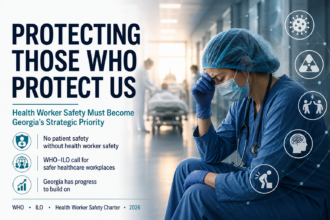
Healthcare worker experiencing occupational stress in a hospital setting, illustrating the importance of occupational safety and health, burnout prevention, infection control, workplace violence prevention, and health worker wellbeing in Georgia.

Three Essential Steps to Protect Georgia’s Health Workforce

By
Prof. Giorgi Pkhakadze
04/07/2026

WHO Chief Mobilizes Global Response as Ebola Spreads Across DR Congo and Into Uganda

By
Prof. Giorgi Pkhakadze
03/06/2026
Facebook Twitter Youtube Instagram
Company
  • Privacy Policy
  • Contact US
  • GMJ Journal
  • Submit Manuscript
  • Editorial Team
  • Register at GMJ
  • Terms of Use

Subscribe to GMJ News — Click here

Join Community
© 2026 Georgian Medical Journal (GMJ). Published by the Public Health Institute of Georgia (PHIG). All rights reserved.
Welcome Back!

Sign in to your account

Username or Email Address
Password

Lost your password?

Not a member? Sign Up