


By using this site, you agree to the Privacy Policy and Terms of Use.
Accept
GMJ NewsGMJ NewsGMJ News
  • Latest News
    • GMJ Briefs
  • Podcast & Media
    • Podcast Episodes
    • GMJ Audio
    • GMJ Videos
  • Research Digest
    • New Studies
    • Georgian Research
    • Data & Numbers
  • Policy & Systems
    • Health Policy
    • Quality & Safety
    • Migration & Health
    • Global Health
  • Practice
    • Clinical Updates
    • Case Discussions
    • Pharmacy & Prescribing
    • Ingredients A-Z
  • Perspectives
    • Editorial
    • Explainers
    • Voices
    • Letters
  • GMJ Articles
    • Vol. 1 Issue 2 (2026)
    • Vol. 1 Issue 1 (2026)
    • Pre-Launch Articles (2025)
  • Read the Journal →
  • About GMJ News
Notification Show More
Font ResizerAa
GMJ NewsGMJ News
Font ResizerAa
  • Latest News
    • GMJ Briefs
  • Podcast & Media
    • Podcast Episodes
    • GMJ Audio
    • GMJ Videos
  • Research Digest
    • New Studies
    • Georgian Research
    • Data & Numbers
  • Policy & Systems
    • Health Policy
    • Quality & Safety
    • Migration & Health
    • Global Health
  • Practice
    • Clinical Updates
    • Case Discussions
    • Pharmacy & Prescribing
    • Ingredients A-Z
  • Perspectives
    • Editorial
    • Explainers
    • Voices
    • Letters
  • GMJ Articles
    • Vol. 1 Issue 2 (2026)
    • Vol. 1 Issue 1 (2026)
    • Pre-Launch Articles (2025)
  • Read the Journal →
  • About GMJ News
Follow US
GMJ News > GMJ Briefs > Educational Collapse in Gaza Threatens Child Development and Mental Health

Educational Collapse in Gaza Threatens Child Development and Mental Health

GMJ
Last updated: 28/06/2026 19:09
By
Prof. Giorgi Pkhakadze
Share
1 Min Read
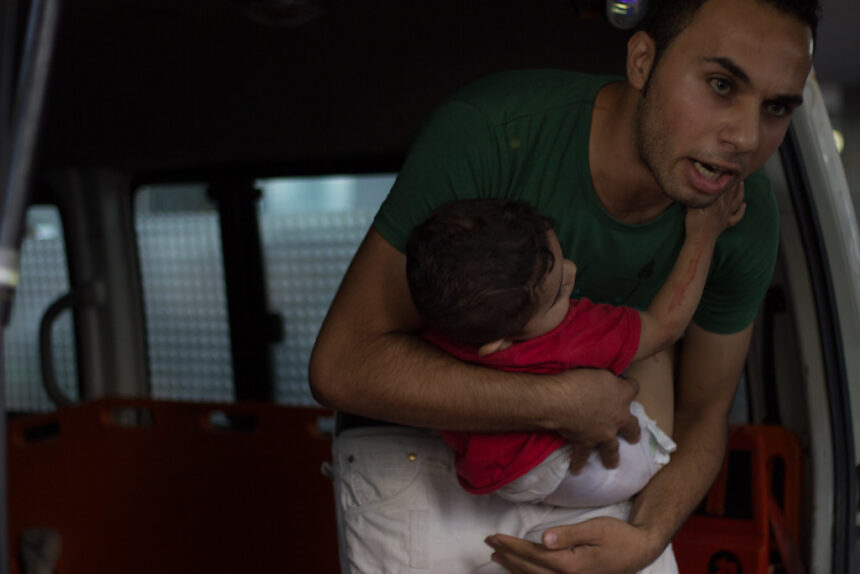
Children in Gaza affected by educational crisis and school destruction
Over 625,000 children in Gaza have lost access to education for more than a year due to systematic destruction of schools and educational infrastructure. UNICEF warns of lasting developmental and psychological impacts from this unprecedented educational crisis. — "GAZA Crisis July 2014" by Syeda Amina Trust® is licensed under CC BY 2.0. To view a copy of this license, visit https://creativecommons.org/licenses/by/2.0/. (CC BY 2.0)
SHARE
1 min read|136 words

Over 625,000 children in Gaza have been denied educational access for more than a year, marking what UNICEF describes as a “demolition of childhood” amid systematic destruction of schools and educational infrastructure. The collapse represents one of the world’s largest ongoing educational emergencies, with 85% of schools damaged, 60% severely compromised, and 25% completely destroyed.

Beyond physical infrastructure loss, the educational crisis compounds documented health risks. Research in international health journals demonstrates that prolonged educational disruption during formative developmental years correlates with significant cognitive delays and psychological trauma. The World Health Organization has identified educational continuity as essential for child psychological resilience during humanitarian crises. With teaching staff displaced and families repeatedly relocated, formal and informal education has become virtually impossible, creating cascading effects on child development and mental health that will require years to address even with stabilized conditions.

Was this article helpful?

GMJ Brief · Announcement

📰 Read the full article: Gaza Children Face Educational Crisis as 625,000 Students Lose Access to Schooling →

Share This Article
Facebook LinkedIn Bluesky Copy Link Print
GMJ
ByProf. Giorgi Pkhakadze
Follow:
Prof. Giorgi Pkhakadze, MD, MPH, PhD, is Editor-in-Chief of the Georgian Medical Journal and Chair of the Public Health Institute of Georgia (PHIG). He is Professor and Head of the Department of Social and Behavioural Sciences at David Tvildiani Medical University, and Secretary/Treasurer of the UEMS Section of Public Health. ORCID: 0000-0001-7609-4515.

Submit Your Paper →

Georgia's peer-reviewed open-access medical journal. No APC until January 2027.
Submit Manuscript →
Plasma protein signatures reveal how individual cell types age and predict disease risk

Plasma proteomics can measure biological aging independently in 40+ cell types, with…

Bidi Smoking Linked to Elevated Cancer Risk in Large Indian Study

A multicentre case-control study in India links bidi smoking—hand-rolled cigarettes common in…

District-Level Tobacco Control Cuts Youth Smoking in Indonesia Despite Weak National Enforcement

District-level tobacco control measures in Indonesia have reduced adolescent smoking rates despite…

Submit Your Paper to GMJ

No APC until January 2027.
Submit Manuscript →

You Might Also Like

Medical illustration showing prostate gland anatomy and common symptoms of prostate cancer

Announcement: Prostate Cancer Affects One in Eight Men: Early Symptoms and Detection Guidelines

By
Prof. Giorgi Pkhakadze
21/06/2026
Legal scales with world map background representing international migration law framework

Migrant Workers Convention Ratification Crisis: Only 25% of Countries Committed

By
Prof. Giorgi Pkhakadze
04/07/2026
World map showing migration policy implementation rates by region

Global Migration Policy Adoption Outpaces Implementation Capacity

By
Prof. Giorgi Pkhakadze
27/06/2026
Microscopic view of lab-grown brain organoids showing neural connections and regenerating nerve fibers

What Cambridge’s Organoid Breakthrough Means for Treating Nerve Damage

By
Prof. Giorgi Pkhakadze
29/06/2026
Facebook Twitter Youtube Instagram
Company
  • Privacy Policy
  • Contact US
  • GMJ Journal
  • Submit Manuscript
  • Editorial Team
  • Register at GMJ
  • Terms of Use

Subscribe to GMJ News — Click here

Join Community
© 2026 Georgian Medical Journal (GMJ). Published by the Public Health Institute of Georgia (PHIG). All rights reserved.
Welcome Back!

Sign in to your account

Username or Email Address
Password

Lost your password?

Not a member? Sign Up