By using this site, you agree to the Privacy Policy and Terms of Use.
Accept
GMJ NewsGMJ NewsGMJ News
  • Latest News
    • GMJ Briefs
  • Podcast & Media
    • Podcast Episodes
    • GMJ Audio
    • GMJ Videos
  • Research Digest
    • New Studies
    • Georgian Research
    • Data & Numbers
  • Policy & Systems
    • Health Policy
    • Quality & Safety
    • Migration & Health
    • Global Health
  • Practice
    • Clinical Updates
    • Case Discussions
    • Pharmacy & Prescribing
    • Ingredients A-Z
  • Perspectives
    • Editorial
    • Explainers
    • Voices
    • Letters
  • GMJ Articles
    • Vol. 1 Issue 2 (2026)
    • Vol. 1 Issue 1 (2026)
    • Pre-Launch Articles (2025)
  • Read the Journal →
  • About GMJ News
Notification Show More
Font ResizerAa
GMJ NewsGMJ News
Font ResizerAa
  • Latest News
    • GMJ Briefs
  • Podcast & Media
    • Podcast Episodes
    • GMJ Audio
    • GMJ Videos
  • Research Digest
    • New Studies
    • Georgian Research
    • Data & Numbers
  • Policy & Systems
    • Health Policy
    • Quality & Safety
    • Migration & Health
    • Global Health
  • Practice
    • Clinical Updates
    • Case Discussions
    • Pharmacy & Prescribing
    • Ingredients A-Z
  • Perspectives
    • Editorial
    • Explainers
    • Voices
    • Letters
  • GMJ Articles
    • Vol. 1 Issue 2 (2026)
    • Vol. 1 Issue 1 (2026)
    • Pre-Launch Articles (2025)
  • Read the Journal →
  • About GMJ News
Follow US
GMJ News > GMJ Briefs > Single PET Scan Now Detects Blood Clots Throughout the Body

Single PET Scan Now Detects Blood Clots Throughout the Body

GMJ
Last updated: 20/06/2026 15:17
By
Prof. Giorgi Pkhakadze
Share
1 Min Read
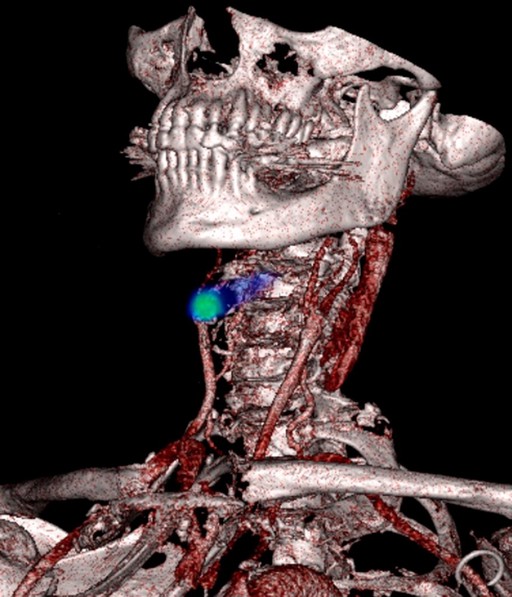
PET scan image showing blood clot detection in legs and lungs using novel radiotracer technology
Novel PET radiotracer enables simultaneous detection of deep vein thrombosis and pulmonary embolism in single whole-body scan. Research recognized with 2026 SNMMI Image of the Year award. — "Advances in stroke treatment" is licensed under CC BY 4.0. To view a copy of this license, visit https://creativecommons.org/licenses/by/4.0/. (CC BY 4.0)
SHARE
1 min read|150 words

A transformative advance in nuclear medicine imaging has emerged with the development of a novel PET radiotracer capable of detecting both deep vein thrombosis and pulmonary embolism in a single whole-body scan. Presented at the 2026 Society of Nuclear Medicine and Molecular Imaging Annual Meeting, this breakthrough technology addresses a critical diagnostic challenge by eliminating the need for multiple separate imaging procedures.

Traditional diagnostic protocols require patients to undergo duplex ultrasound for leg evaluation followed by computed tomography pulmonary angiography for suspected lung involvement—a process that delays treatment decisions in time-sensitive cases. The new PET approach provides comprehensive visualization of blood clots throughout the venous system simultaneously, potentially reducing diagnostic time and enabling faster clinical decision-making.

The achievement has garnered significant recognition within the medical imaging community, with the research selected as the 2026 SNMMI Henry N. Wagner, Jr., Image of the Year award. Read the full article on GMJ Newsroom.

Was this article helpful?

GMJ Brief · Announcement

📰 Read the full article: Novel PET Tracer Detects Blood Clots in Legs and Lungs with Single Scan →

Related reference
  • Deep Vein Thrombosis · Condition
  • Pulmonary Embolism · Condition
Share This Article
Facebook LinkedIn Bluesky Copy Link Print
GMJ
ByProf. Giorgi Pkhakadze
Follow:
Prof. Giorgi Pkhakadze, MD, MPH, PhD, is Editor-in-Chief of the Georgian Medical Journal and Chair of the Public Health Institute of Georgia (PHIG). He is Professor and Head of the Department of Social and Behavioural Sciences at David Tvildiani Medical University, and Secretary/Treasurer of the UEMS Section of Public Health. ORCID: 0000-0001-7609-4515.

Submit Your Paper →

Georgia's peer-reviewed open-access medical journal. No APC until January 2027.
Submit Manuscript →
Maternal mortality crisis deepens for Sudanese refugee women in Central African Republic

Pregnant Sudanese refugee women in Central African Republic face 138 times higher…

Home Exercise Program Reduces Cognitive Decline During Cancer Chemotherapy

New trial shows home-based exercise significantly improved attention and reduced cognitive problems…

MIT Develops 3D Augmented Reality System for Medical Ultrasound Interpretation

MIT researchers have developed an augmented reality system that transforms 2D ultrasound…

Submit Your Paper to GMJ

No APC until January 2027.
Submit Manuscript →

You Might Also Like

Microscopic view of pancreatic cancer organoids in engineered biomaterial scaffold showing cellular transitions

Engineered Biomaterials Offer New Window Into Pancreatic Cancer Cell Behavior

By
Prof. Giorgi Pkhakadze
03/06/2026
Infographic showing zinc and copper supplement bottles with ratio measurements

Three Essential Facts Every Zinc Supplement User Must Know

By
Prof. Giorgi Pkhakadze
24/05/2026
Laboratory testing omega-3 supplement capsules for oxidation levels

Laboratory Tests May Not Predict Real-World Omega-3 Safety Risks

By
Prof. Giorgi Pkhakadze
24/05/2026
Scientific comparison chart showing magnesium supplement absorption rates across different formulations

Announcement: Popular Magnesium Absorption Charts May Overstate Supplement Differences, New Research Shows

By
Prof. Giorgi Pkhakadze
02/06/2026
Facebook Twitter Youtube Instagram
Company
  • Privacy Policy
  • Contact US
  • GMJ Journal
  • Submit Manuscript
  • Editorial Team
  • Register at GMJ
  • Terms of Use

Subscribe to GMJ News — Click here

Join Community
© 2026 Georgian Medical Journal (GMJ). Published by the Public Health Institute of Georgia (PHIG). All rights reserved.
Welcome Back!

Sign in to your account

Username or Email Address
Password

Lost your password?

Not a member? Sign Up