By using this site, you agree to the Privacy Policy and Terms of Use.
Accept
GMJ NewsGMJ NewsGMJ News
  • Latest News
    • GMJ Briefs
  • Podcast & Media
    • Podcast Episodes
    • GMJ Audio
    • GMJ Videos
  • Research Digest
    • New Studies
    • Georgian Research
    • Data & Numbers
  • Policy & Systems
    • Health Policy
    • Quality & Safety
    • Migration & Health
    • Global Health
  • Practice
    • Clinical Updates
    • Case Discussions
    • Pharmacy & Prescribing
    • Ingredients A-Z
  • Perspectives
    • Editorial
    • Explainers
    • Voices
    • Letters
  • Health Topics
  • GMJ Articles
    • Vol. 1 Issue 2 (2026)
    • Vol. 1 Issue 1 (2026)
    • Pre-Launch Articles (2025)
  • Read the Journal →
  • About GMJ News
Notification Show More
Font ResizerAa
GMJ NewsGMJ News
Font ResizerAa
  • Latest News
    • GMJ Briefs
  • Podcast & Media
    • Podcast Episodes
    • GMJ Audio
    • GMJ Videos
  • Research Digest
    • New Studies
    • Georgian Research
    • Data & Numbers
  • Policy & Systems
    • Health Policy
    • Quality & Safety
    • Migration & Health
    • Global Health
  • Practice
    • Clinical Updates
    • Case Discussions
    • Pharmacy & Prescribing
    • Ingredients A-Z
  • Perspectives
    • Editorial
    • Explainers
    • Voices
    • Letters
  • Health Topics
  • GMJ Articles
    • Vol. 1 Issue 2 (2026)
    • Vol. 1 Issue 1 (2026)
    • Pre-Launch Articles (2025)
  • Read the Journal →
  • About GMJ News
Follow US
GMJ News > GMJ Briefs > South Sudan’s Perfect Storm: How Conflict, Climate, and Economics Collide in Humanitarian Catastrophe

South Sudan’s Perfect Storm: How Conflict, Climate, and Economics Collide in Humanitarian Catastrophe

GMJ
Last updated: 29/06/2026 03:07
By
Prof. Giorgi Pkhakadze
Share
1 Min Read
Humanitarian crisis in South Sudan showing statistics on food insecurity and child malnutrition
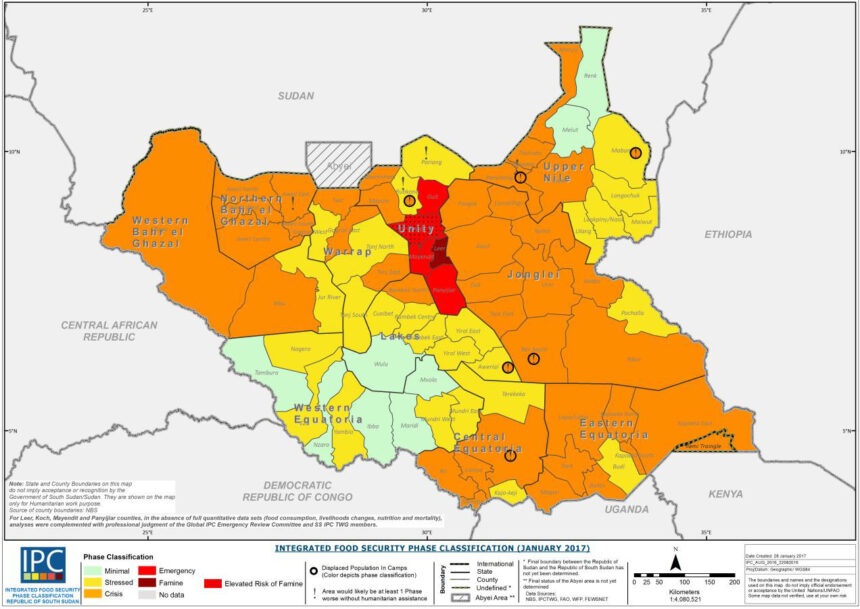
South Sudan faces severe humanitarian crisis with 7.8 million people experiencing acute food insecurity and 2.2 million children suffering malnutrition. UNICEF data reveals crisis affects nearly two-thirds of population. — SouthSudan.jpg by United Nations Integrated Food Security Phase Classification / Public domain via Wikimedia Commons (Public domain)
SHARE
1 min read|131 words

South Sudan is experiencing a severe humanitarian emergency that extends far beyond simple food shortage. With 7.8 million people—nearly two-thirds of the nation’s population—facing acute food insecurity, the crisis represents a convergence of multiple destabilizing factors. UNICEF’s latest assessment reveals that 2.2 million children have developed acute malnutrition, surpassing critical international health thresholds.

The World Health Organization has classified the situation as a Grade 3 emergency, the UN system’s highest designation. Rather than a single cause, the crisis stems from compounding challenges: ongoing conflict disrupts agricultural systems and supply chains, climate shocks devastate food production, and economic instability prevents families from purchasing available food. Health officials warn that without immediate intervention, the situation risks deteriorating into widespread famine conditions affecting vulnerable populations across the region.

Read the full article on GMJ Newsroom.

Was this article helpful?

GMJ Brief · Announcement

📰 Read the full article: South Sudan Food Crisis: 7.8 Million Face Acute Hunger as Child Malnutrition Reaches Critical Levels →

Share This Article
Facebook LinkedIn Bluesky Copy Link Print
GMJ
ByProf. Giorgi Pkhakadze
Follow:
Prof. Giorgi Pkhakadze, MD, MPH, PhD, is Editor-in-Chief of the Georgian Medical Journal and Chair of the Public Health Institute of Georgia (PHIG). He is Professor and Head of the Department of Social and Behavioural Sciences at David Tvildiani Medical University, and Secretary/Treasurer of the UEMS Section of Public Health. ORCID: 0000-0001-7609-4515.

Submit Your Paper →

Georgia's peer-reviewed open-access medical journal. No APC until January 2027.
Submit Manuscript →
Bedroom Light at Night Linked to Metabolic Harm: What the Evidence Shows

Moderate bedroom light exposure triggers measurable metabolic harm within a single night…

Creatine and Kidney Damage: What the Evidence Actually Shows

A 2025 systematic review of 21 studies and analysis of 685 clinical…

How neurotransmitters orchestrate mood, sleep, and cognition: a biochemical primer

Brain function depends on chemical communication between neurons through neurotransmitters. Twelve major…

Submit Your Paper to GMJ

No APC until January 2027.
Submit Manuscript →

You Might Also Like

Chart showing Amish population growth projection from 400,000 to 2 million by 2075

Three Critical Challenges Facing Public Health as Amish Population Doubles Every 25 Years

By
Prof. Giorgi Pkhakadze
13/07/2026
Global HealthPolicy & Systems

Four Health Workers Recover from Ebola Outbreak in Democratic Republic of Congo

By
Prof. Giorgi Pkhakadze
02/06/2026
Pharmacy & PrescribingPolicy & SystemsPracticeQuality & Safety

Abiomed Issues Field Action for 14Fr Catheter Introducer Kits Over Thrombosis Risk

By
Prof. Giorgi Pkhakadze
19/07/2026
Medical illustration showing multiple myeloma cells and treatment timeline concepts

NEJM Editorial Challenges Traditional Early Relapse Definitions in Multiple Myeloma

By
Prof. Giorgi Pkhakadze
07/06/2026
Facebook Twitter Youtube Instagram
Company
  • Privacy Policy
  • Contact US
  • GMJ Journal
  • Submit Manuscript
  • Editorial Team
  • Register at GMJ
  • Terms of Use

Subscribe to GMJ News — Click here

Join Community
© 2026 Georgian Medical Journal (GMJ). Published by the Public Health Institute of Georgia (PHIG). All rights reserved.
Welcome Back!

Sign in to your account

Username or Email Address
Password

Lost your password?

Not a member? Sign Up