By using this site, you agree to the Privacy Policy and Terms of Use.
Accept
GMJ NewsGMJ NewsGMJ News
  • Latest News
    • GMJ Briefs
  • Podcast & Media
    • Podcast Episodes
    • GMJ Audio
    • GMJ Videos
  • Research Digest
    • New Studies
    • Georgian Research
    • Data & Numbers
  • Policy & Systems
    • Health Policy
    • Quality & Safety
    • Migration & Health
    • Global Health
  • Practice
    • Clinical Updates
    • Case Discussions
    • Pharmacy & Prescribing
    • Ingredients A-Z
  • Perspectives
    • Editorial
    • Explainers
    • Voices
    • Letters
  • GMJ Articles
    • Vol. 1 Issue 2 (2026)
    • Vol. 1 Issue 1 (2026)
    • Pre-Launch Articles (2025)
  • Read the Journal →
  • About GMJ News
Notification Show More
Font ResizerAa
GMJ NewsGMJ News
Font ResizerAa
  • Latest News
    • GMJ Briefs
  • Podcast & Media
    • Podcast Episodes
    • GMJ Audio
    • GMJ Videos
  • Research Digest
    • New Studies
    • Georgian Research
    • Data & Numbers
  • Policy & Systems
    • Health Policy
    • Quality & Safety
    • Migration & Health
    • Global Health
  • Practice
    • Clinical Updates
    • Case Discussions
    • Pharmacy & Prescribing
    • Ingredients A-Z
  • Perspectives
    • Editorial
    • Explainers
    • Voices
    • Letters
  • GMJ Articles
    • Vol. 1 Issue 2 (2026)
    • Vol. 1 Issue 1 (2026)
    • Pre-Launch Articles (2025)
  • Read the Journal →
  • About GMJ News
Follow US
GMJ News > GMJ Briefs > Understanding South Sudan’s Crisis: What Health Professionals Need to Know

Understanding South Sudan’s Crisis: What Health Professionals Need to Know

GMJ
Last updated: 22/07/2026 03:07
By
Prof. Giorgi Pkhakadze
Share
1 Min Read
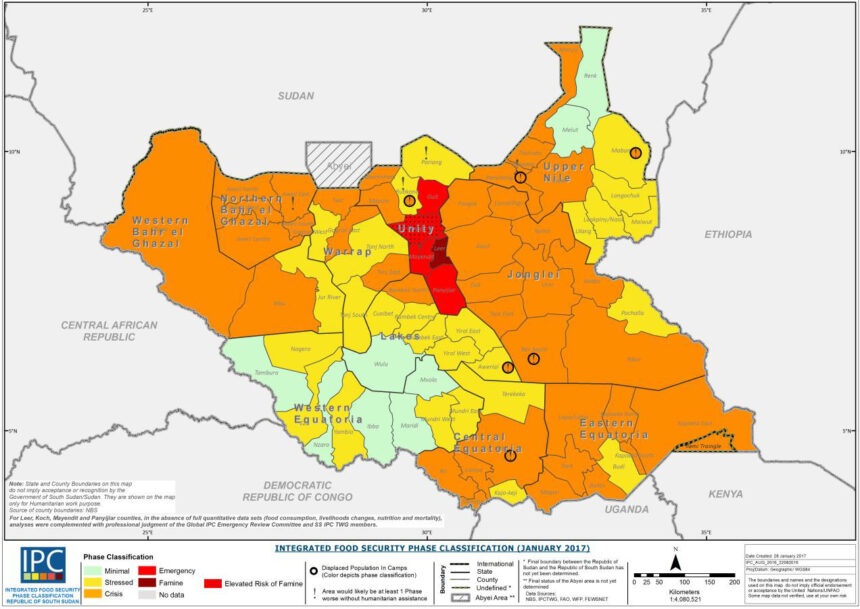
Humanitarian crisis in South Sudan showing statistics on food insecurity and child malnutrition
South Sudan faces severe humanitarian crisis with 7.8 million people experiencing acute food insecurity and 2.2 million children suffering malnutrition. UNICEF data reveals crisis affects nearly two-thirds of population. — SouthSudan.jpg by United Nations Integrated Food Security Phase Classification / Public domain via Wikimedia Commons (Public domain)
SHARE
1 min read|142 words

The humanitarian emergency in South Sudan requires health professionals to understand both the scale and complexity of the crisis. Three critical figures define the situation: 7.8 million people experiencing acute food insecurity (63 percent of the population), 2.2 million children with acute malnutrition, and an emergency driven simultaneously by conflict, climate shocks, and economic collapse.

For medical professionals, these figures translate into clinical realities. Acute child malnutrition indicates widespread preventable disease, developmental delays, and increased mortality risk. The multi-factorial crisis means addressing hunger alone cannot solve the problem—interventions must simultaneously address conflict-driven displacement, climate adaptation, and economic stabilization. Health systems in the region face overwhelming patient loads with severely limited resources. Understanding these interconnections helps clinicians contextualize individual patient presentations within the broader emergency landscape and recognize the limitations of purely medical responses to systemic humanitarian crises.

Read the full article on GMJ Newsroom.

Was this article helpful?

GMJ Brief · Takeaway

📰 Read the full article: South Sudan Food Crisis: 7.8 Million Face Acute Hunger as Child Malnutrition Reaches Critical Levels →

Share This Article
Facebook LinkedIn Bluesky Copy Link Print
GMJ
ByProf. Giorgi Pkhakadze
Follow:
Prof. Giorgi Pkhakadze, MD, MPH, PhD, is Editor-in-Chief of the Georgian Medical Journal and Chair of the Public Health Institute of Georgia (PHIG). He is Professor and Head of the Department of Social and Behavioural Sciences at David Tvildiani Medical University, and Secretary/Treasurer of the UEMS Section of Public Health. ORCID: 0000-0001-7609-4515.

Submit Your Paper →

Georgia's peer-reviewed open-access medical journal. No APC until January 2027.
Submit Manuscript →
Celebrity Disclosure Renews Focus on Prostate Cancer Screening and Early Detection

Television presenter Jeremy Clarkson's recent disclosure of aggressive prostate cancer and remission…

Magnesium Supplement Claims vs. Evidence: What the Science Actually Shows

Animal studies show tissue-specific magnesium uptake, but human trials have not replicated…

Biology’s Universal Blueprint: How Cells Reveal the Mechanics of Life

All living organisms operate according to shared cellular principles—membrane structure, energy metabolism,…

Submit Your Paper to GMJ

No APC until January 2027.
Submit Manuscript →

You Might Also Like

Laboratory researcher examining fungal cultures with agricultural chemicals in background

Agricultural Fungicides Linked to Hospital-Acquired Infections: New One Health Concern

By
Prof. Giorgi Pkhakadze
20/06/2026
Comparison chart showing different magnesium supplement forms and their cognitive research outcomes

Magnesium Form Matters Less Than You Think, New Meta-Analysis Reveals

By
Prof. Giorgi Pkhakadze
01/06/2026
Eye-tracking visualization showing attention patterns to emotional facial expressions in children with depression

New Eye-Tracking Data Maps Depression’s Impact on Children’s Emotion Recognition

By
Prof. Giorgi Pkhakadze
28/07/2026

🚨 WHO Ghana 2026 2nd Quarter Newsletter

By
Prof. Giorgi Pkhakadze
31/07/2026
Facebook Twitter Youtube Instagram
Company
  • Privacy Policy
  • Contact US
  • GMJ Journal
  • Submit Manuscript
  • Editorial Team
  • Register at GMJ
  • Terms of Use

Subscribe to GMJ News — Click here

Join Community
© 2026 Georgian Medical Journal (GMJ). Published by the Public Health Institute of Georgia (PHIG). All rights reserved.
Welcome Back!

Sign in to your account

Username or Email Address
Password

Lost your password?

Not a member? Sign Up