World Health Organization · 1st edition, 2022 · 132 pages
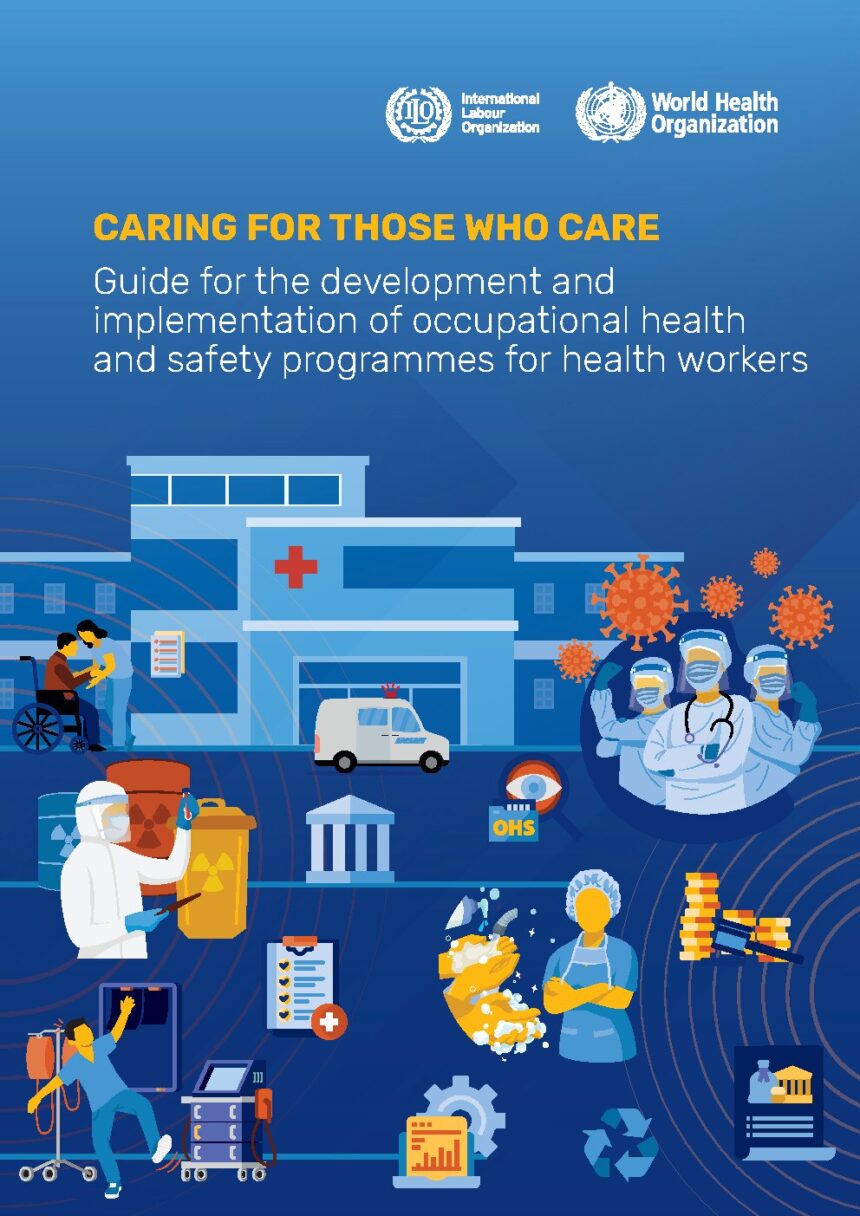
A WHO/ILO joint guide for establishing occupational health and safety programmes at national, subnational and facility levels to protect health workers
- Issuer
- World Health Organization
- Edition
- 1st edition, 2022
- Audience
- Policy-makers, health facility managers, occupational health and safety focal points, members of joint labour–management health and safety committees, occupational health service providers, workers' and employers' representatives, quality and patient safety officers, infection prevention and control specialists, human resources managers, inspectors and auditors
- Evidence
- Consensus-based guidance incorporating ILO conventions and WHO technical recommendations, building on the WHO–ILO Joint Global Framework for National Occupational Health Programmes for Health Workers (2010)
- Reviewed
- 23 Oct 2026 · GMJ
What this guideline says
GMJ summary
This 2022 joint WHO/ILO guide provides a comprehensive framework for developing and implementing occupational health and safety (OHS) programmes for health workers at national, subnational and facility levels. Health workers face numerous occupational hazards including infections (tuberculosis, hepatitis B and C, HIV, COVID-19), musculoskeletal disorders from patient handling, violence and harassment, psychosocial risks, exposure to chemicals and radiation, and environmental risks.
The guide builds on the WHO–ILO Joint Global Framework for National Occupational Health Programmes for Health Workers (2010) and outlines key elements for national programmes (governance, financing, human and physical resources, service delivery), subnational programmes, and facility-level programmes. Essential facility-level elements include written OHS policies, designated focal points, joint labour–management health and safety committees, regular training, risk assessments, worker immunization, incident reporting systems, occupational health services, and environmental hygiene measures.
The guide emphasizes that protecting health worker safety is fundamental to patient safety, quality of care, health workforce retention and environmental sustainability. It provides practical step-by-step guidance for programme development (building political commitment, situational assessment, stakeholder engagement, drafting, piloting) and implementation (action planning, capacity building, monitoring and evaluation). All programmes should be developed in consultation with employers’ and workers’ representatives.
Key points
For clinicians — doses and thresholds as stated in the guideline
- National programmes must include a policy statement at the highest level, a designated unit or focal point within the ministry of health, and a multistakeholder Steering Committee with equal representation of workers and employers
- Health facilities with more than a nationally-specified number of permanent employees must establish joint labour–management committees for health and safety with at least equal worker representation
- All health workers at risk of blood exposure (including cleaners and waste handlers) must receive hepatitis B immunization at 0, 1 and 6 months at no cost to the worker
- Facility focal points for OHS must have minimum training in Work Improvement in Health Services (HealthWISE) or equivalent if no credentialed occupational health professional is available
- Risk assessments must follow the hierarchy of controls: elimination at source, technical measures, organizational measures, then personal protective equipment as last resort
- Facilities must provide blame-free incident reporting systems for blood exposures, needlesticks, violence, and other occupational hazards with immediate access to post-exposure prophylaxis
- Occupational health services must provide pre-placement, periodic and exit medical examinations, health surveillance, immunizations, early diagnosis and treatment of occupational diseases at no cost to workers
- All health facilities must ensure adequate water, sanitation and hygiene (WASH), safe health care waste management, and protocols for extreme weather events protecting health workers and first responders
Essential functions of occupational health services for health workers (Box 10)
Table extracted from the guideline
| Function | Key activities |
|---|---|
| Occupational health risk assessments | Identify hazards, assess risks, evaluate effectiveness of controls |
| Medical surveillance | Pre-placement, periodic, post-illness, and exit examinations based on occupational risks |
| Workplace environment surveillance | Monitor sanitary installations, canteens, housing where provided by employer |
| Advisory functions | Advise on work organization, workplace design, machinery, equipment and substances used |
| PPE management | Select adequate PPE, organize fit-testing, train workers on donning and doffing |
| Early diagnosis and treatment | Diagnose, notify, treat and rehabilitate occupational injuries and diseases, support compensation claims |
| Emergency preparedness | First aid services, post-exposure prophylaxis for HIV and hepatitis B |
| Immunization programmes | Vaccinate health workers according to risk and national vaccination programmes |
| Awareness campaigns | Promote preventive interventions (vaccination, violence prevention, safe patient handling, mental health) |
| Rehabilitation services | Help workers stay at work or return to work early after illness |
| Protection of vulnerable workers | Address needs of workers with chronic diseases, mental health conditions, disabilities and female workers |
| Mental health support | Provide psychosocial support and follow-up, support victims of workplace violence and harassment |
| Training programmes | Train workers and health and safety committees in work improvement and risk prevention |
| Health promotion | Address tobacco smoking, substance abuse, physical activity, diet and other behavioural risk factors |
| Data management | Collect and maintain individual health records, vaccination records, exposure reports, training records |
Source: World Health Organization, Caring for those who care: Guide for the development and implementation of occupational health and safety programmes for health workers. Reproduced in summary form.
From the guideline
Verbatim
“Occupational health and safety (OHS) measures shall not involve any cost for the workers.”
Editor’s perspective
Why this matters for Georgia and the region
Prof. Giorgi Pkhakadze, MD, MPH, PhD
Editor-in-Chief, Georgian Medical Journal · Chair, Public Health Institute of Georgia · WHO consultant, health and migration
As Chair of the Public Health Institute of Georgia and former WHO consultant on health and migration, I recognize this guide as essential for our region where health worker safety infrastructure remains underdeveloped despite advances in universal health coverage and disease elimination programmes. The most critical recommendation for Georgian health facilities is establishing joint labour–management health and safety committees with genuine worker representation—this participatory mechanism aligns with international labour standards Georgia has ratified but rarely implements in practice. Our hepatitis C elimination programme, launched in 2015 and treating over 60,000 patients, demonstrates we can mount ambitious health initiatives; similar political commitment is now needed for health worker protection, particularly hepatitis B vaccination which coverage data suggest remains incomplete even among high-risk clinical staff. The implementation caveat is financing: while the guide correctly states OHS measures must be free to workers, Georgia's mixed health financing model—with strong private sector presence and performance-based hospital payment—creates unclear accountability for funding occupational health services, requiring explicit budget lines in both public programmes and mandatory health insurance benefits packages.
ORCID 0000-0001-7609-4515 · Perspective written for the GMJ Guidelines Library, 23 Oct 2026
Applicability
Georgia and the South Caucasus
This guide has direct relevance for Georgia and the South Caucasus, where health systems are strengthening occupational health frameworks. Georgia’s Labour Code and Law on Occupational Safety address general workplace safety, but specific programmes for health workers require development in line with this WHO/ILO framework. The guide’s emphasis on establishing national policies, designating OHS focal points within ministries of health, and creating facility-level committees aligns with Georgia’s ongoing health system reforms under the Universal Health Care programme. Given Georgia’s robust hepatitis C elimination programme (since 2015) and expanding immunization coverage, the guide’s recommendations on worker vaccination and bloodborne pathogen prevention are immediately applicable. Armenian and Azerbaijani health systems face similar needs for structured OHS programmes. National programmes would need to consider existing labour inspection systems, integration with quality and accreditation frameworks, financing mechanisms within national health insurance schemes, and capacity-building for occupational health professionals—currently limited in the region. The guide’s participatory approach involving workers’ and employers’ representatives supports social dialogue mechanisms that are developing across the South Caucasus.
Questions this guideline answers
Quick answers
What is the minimum requirement for a health facility OHS focal point if no occupational health specialist is available?
The focal point must have at minimum complete Work Improvement in Health Services (HealthWISE) training or equivalent, with technical support from a credentialed occupational health practitioner at district or provincial level where feasible. Core competencies include hazard recognition, risk evaluation, clinical and occupational history-taking, fitness-for-work assessment, understanding health service delivery, knowledge of relevant laws and regulations, and ability to manage projects and assess needs for health promotion.
Which health workers must receive hepatitis B vaccination and what is the schedule?
Any health worker who has direct patient care or handles items contaminated with blood must be immunized, including cleaners, waste handlers and students training in health care. The vaccination schedule is 0, 1 and 6 months. Vaccination must be provided at no cost to the worker, with reminders to ensure completion of all three doses, and immunization records maintained at facility, subnational and national levels.
What is the composition of a joint labour–management health and safety committee?
The committee is a bipartite body with equal representation of workers and employers. It includes the facility manager or representative, focal points for OHS and related functions (IPC, human resources), an expert from occupational health services if available, and workers' representatives designated according to national legislation. The committee should achieve gender balance, represent clinical and auxiliary functions, and reflect staff diversity including migrant workers and people with disabilities.
What are the five steps of workplace risk assessment in health facilities?
Step 1: Identify hazards and those at risk using checklists or screening tools. Step 2: Evaluate and prioritize risks based on probability and severity. Step 3: Decide on preventive action following the hierarchy of controls (avoid risk, technical measures, organizational measures, then personal/individual measures). Step 4: Take action by planning improvements specifying what should be done, by whom and by when. Step 5: Document, monitor and review to ensure measures are effective and do not create additional risks.
Related on GMJ
Interconnected resources
Dictionary of Public Health
GMJ News coverage
ASF accreditation standards
Other guidelines on this topic
- WASH FIT: A practical guide for improving quality of care through water, sanitation and hygiene in health care facilities, Second edition
- Guide to applying the WHO Eye Care Competency Framework
- Global guidelines for the prevention of surgical site infection, second edition
- Sustainable management of radiotherapy facilities and equipment
- Implementation toolkit for accessible telehealth services
- Issuer
- World Health Organization
- Type
- Guidance (normative)
- Edition
- 1st edition, 2022
- Status
- Current
- Published
- 2022-02-18
- Languages
- English (also available in other UN languages)
- Scope
- Global guidance for national, subnational and facility-level occupational health and safety programmes for health workers in all types of health facilities
- Audience
- Policy-makers, health facility managers, occupational health and safety focal points, members of joint labour–management health and safety committees, occupational health service providers, workers' and employers' representatives, quality and patient safety officers, infection prevention and control specialists, human resources managers, inspectors and auditors
- Pages
- 132
- Licence
- CC BY-NC-SA 3.0 IGO
- ISBN
- 9789240040779
- Evidence
- Consensus-based guidance incorporating ILO conventions and WHO technical recommendations, building on the WHO–ILO Joint Global Framework for National Occupational Health Programmes for Health Workers (2010)
- Record history
- Created 23 Oct 2026 · updated 23 Oct 2026 · next check Apr 2027
World Health Organization, International Labour Organization. Caring for those who care: guide for the development and implementation of occupational health and safety programmes for health workers. Geneva: WHO and ILO; 2022. 132 p. ISBN 978-92-4-004077-9.GMJ Guidelines Library records are original summaries written by the GMJ editorial team from the issuer’s published document and reviewed by a physician. They do not replace the full guideline. The document is the copyright of its issuer and is linked, not hosted. Spotted an error or a newer edition? Tell the Guidelines Desk.
Was this article helpful?