Pan American Health Organization · 2020
Framework for national authorities to inform decision-making on adjusting COVID-19 social distancing and travel measures based on transmission scenarios and health system capacity.
- Issuer
- Pan American Health Organization
- Edition
- 2020
- Audience
- National authorities across governmental sectors, public health professionals, health service administrators, policy-makers
- Evidence
- Expert consensus informed by mathematical models and empirical observations from multiple countries
- Reviewed
- 20 Oct 2026 · GMJ
What this guideline says
GMJ summary
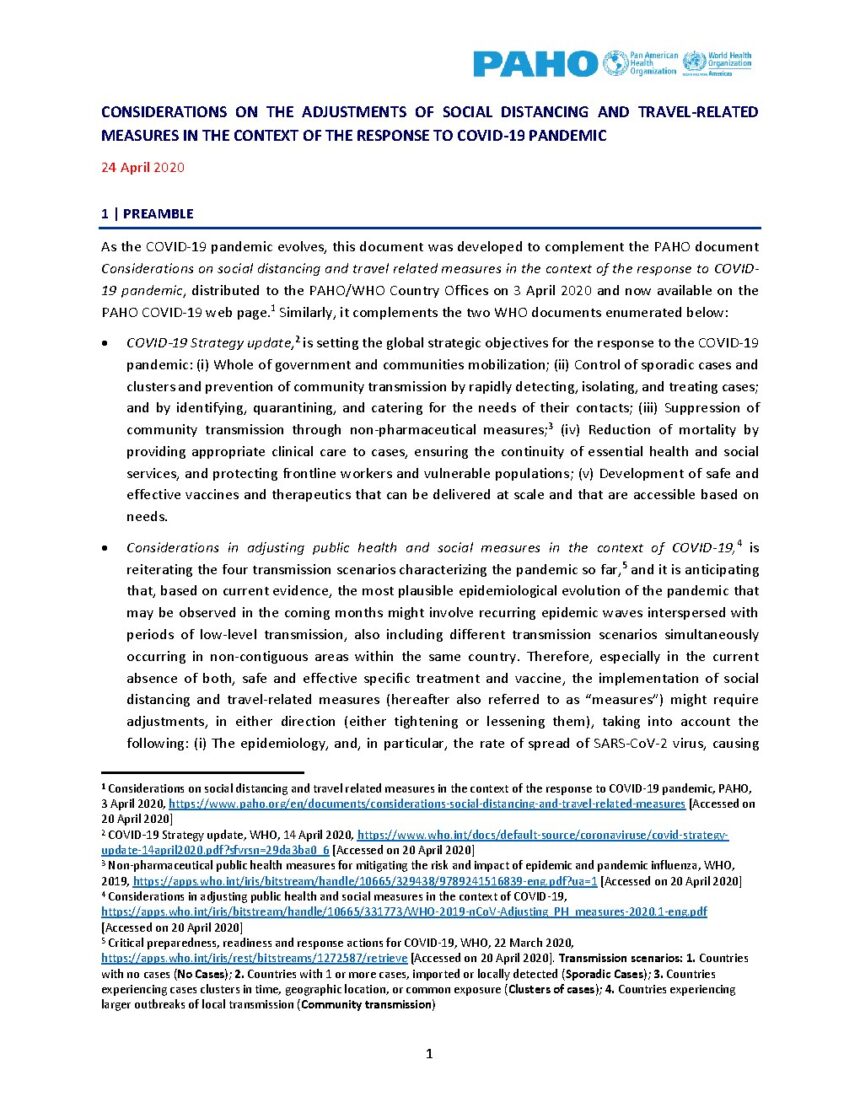
This PAHO guidance, issued 24 April 2020, provides a comprehensive framework for national authorities to adjust COVID-19 social distancing and travel-related measures in either direction—tightening or lessening—based on evolving transmission scenarios. The document anticipates recurring epidemic waves interspersed with periods of low-level transmission and acknowledges the mounting pressure to ease restrictions due to socioeconomic impacts.
The framework emphasises that individual-based measures (isolation of cases and quarantine of contacts) are warranted regardless of transmission scenario, whilst community-based measures require careful adjustment based on six key considerations: epidemiology and rate of SARS-CoV-2 spread; health system capacity for detection, isolation, treatment and contact tracing; risks in vulnerable settings; workplace preventive measures; capacity to manage importation/exportation of cases; and community engagement levels.
The guidance stresses that any lessening of measures must be gradual, prioritised, and planned, with each step taken at least 14 days apart to allow identification of epidemiological changes over one maximum incubation period. Decisions should be informed by robust surveillance data, ideally demonstrating an effective reproductive number (Rt) below 1, continuous decline in case incidence and mortality over 14 days, and health services operating at maximum 75% capacity for at least 7 days.
Key points
For clinicians — doses and thresholds as stated in the guideline
- Isolation of cases and quarantine of contacts are warranted independently of transmission scenario; only exceeding capacity of public health and health services can prevent implementation of these measures
- Each step in the lessening process should be taken at least 14 days apart to allow identification of epidemiological changes over one maximum incubation period
- Effective reproductive number (R<sub>t</sub>) <1, with a decreasing trend over 14 days, warrants initiation of the process to lessen measures
- Continuous decline over 14 days in incidence of confirmed and probable cases, deaths, and proportion of cases not linked to known transmission chains supports lessening of measures
- Proportion of samples from sentinel ILI surveillance positive for SARS-CoV-2 should be below 5% over 14 days
- Health services should operate at maximum 75% of routine capacity for at least 7 days before considering lessening measures, to absorb potential case increases and backlog of postponed interventions
- Continuous decline over 14 days in COVID-19 related ICU admissions and confirmed/probable cases among healthcare workers supports easing restrictions
- Community surveys showing 75% or higher proportion supporting measures can be interpreted as expression of adequate acceptability and compliance
From the guideline
Verbatim
“Each step in the lessening process should be taken at least 14 days apart, to allow for the identification of epidemiological changes over a time interval corresponding to one maximum incubation period at least.”
Editor’s perspective
Why this matters for Georgia and the region
Prof. Giorgi Pkhakadze, MD, MPH, PhD
Editor-in-Chief, Georgian Medical Journal · Chair, Public Health Institute of Georgia · WHO consultant, health and migration
As we reflect on the COVID-19 pandemic response, this PAHO framework provides essential lessons for Georgia's preparedness for future health emergencies. The structured approach to decision-making—requiring documented institutional consultative mechanisms, whole-of-government engagement, and systematic recording of analytical processes—addresses gaps we observed during the pandemic. I would particularly emphasise to Georgian colleagues the specific thresholds outlined: the 14-day observation period between policy adjustments, the 75% health service capacity ceiling before easing measures, and the requirement for R<sub>t</sub> below 1. The most challenging aspect for implementation in Georgia and neighbouring countries will be maintaining the robust, granular surveillance systems required to generate reliable indicators, particularly the effective reproductive number and comprehensive contact tracing data. Our experience with the hepatitis C elimination programme demonstrates Georgia's capacity for data-driven public health interventions, and this framework should inform revision of our pandemic preparedness plans.
ORCID 0000-0001-7609-4515 · Perspective written for the GMJ Guidelines Library, 20 Oct 2026
Applicability
Georgia and the South Caucasus
This guidance remains highly relevant for Georgia and the South Caucasus region in developing preparedness frameworks for future pandemic waves or novel pathogen emergence. Georgia’s established surveillance infrastructure, strengthened through tuberculosis and hepatitis C programmes, provides a foundation for implementing the data-driven decision-making framework outlined here. National programmes would need to adapt the 14-day observation periods and specific thresholds (Rt <1, <5% ILI positivity, 75% health service capacity, 75% community support) to local epidemiological contexts and health system capacity. The framework's emphasis on protecting vulnerable settings (nursing homes, prisons, refugee centres) and healthcare workers whilst balancing socioeconomic impacts aligns with Georgia's Universal Health Coverage programme priorities. Countries in the region should consider establishing the institutional consultative mechanisms and documented decision-making processes recommended here, particularly given the challenges of implementing geographically differentiated measures in countries with varied transmission scenarios across administrative regions.
Questions this guideline answers
Quick answers
What is the minimum time interval between steps when lessening COVID-19 restrictions?
Each step in the lessening process should be taken at least 14 days apart to allow for identification of epidemiological changes over a time interval corresponding to one maximum incubation period.
What epidemiological indicator best signals readiness to begin easing measures?
An effective reproductive number (R<sub>t</sub>) <1, with a decreasing trend towards 1 over a 14-day period, represents the best indicator. Alternatively, continuous decline over 14 days in incidence of confirmed and probable cases, deaths, and proportion of cases not linked to known transmission chains can be used when robust R<sub>t</sub> calculation is not feasible.
At what health service capacity level can authorities consider easing restrictions?
Routine health services should be operating at a maximum of 75% of their capacity for at least 7 days. This ensures health services can absorb a possible rise in COVID-19 cases needing admission and address the backlog of interventions postponed due to COVID-19.
Should 'immunological passports' or laboratory certificates be used to resume international travel?
No. The decision to resume non-essential travel based on documents (e.g., 'immunological passport') issued on the basis of laboratory testing is not warranted, given uncertainties about viral shedding patterns, lack of evidence that antibodies confer protection against re-infection, and low sensitivity of available antibody tests.
Related on GMJ
Interconnected resources
Dictionary of Public Health
GMJ News coverage
Quality & accreditation
- ASF PHC — Standard 4 — Acute & Same-Day Care · Primary Health Clinic
- ASF PHC — Standard 7 — Governance & Staffing · Primary Health Clinic
- ASF Hospital — Standard 5 — Safety & Emergency Preparedness
- ASF Hospital — Standard 11 — Critical Care
- ASF Medical Transport — Standard 6 — Emergency Response During Transport
Other guidelines on this topic
- Technical recommendations for the configuration of a specialized Emergency Medical Team for the treatment of Severe Acute Respiratory Infection (SARI). Version 3.5
- Crisis Management during an Epidemic: General guidelines for efficient response coordination by national regulatory authorities
- Recommendations for the Management of Solid Waste
- Guidelines to Plan for COVID-19 Vaccine Introduction
- Considerations for the Reorganization of Cancer Services during the COVID-19 Pandemic
- Issuer
- Pan American Health Organization
- Type
- Procedures, manuals, guidelines
- Status
- Current
- Published
- 2020-01-01
- Scope
- National and subnational public health authorities across the Americas and globally
- Audience
- National authorities across governmental sectors, public health professionals, health service administrators, policy-makers
- Licence
- CC BY-NC-SA 3.0 IGO
- Evidence
- Expert consensus informed by mathematical models and empirical observations from multiple countries
- Record history
- Created 20 Oct 2026 · updated 20 Oct 2026 · next check Apr 2027
Pan American Health Organization. Considerations on the Adjustments of Social Distancing and Travel-Related Measures in the Context of the Response to COVID-19 Pandemic, 24 April 2020. Washington, D.C.: PAHO; 2020. (PAHO/PHE/CPI/COVID-19-20-0027).GMJ Guidelines Library records are original summaries written by the GMJ editorial team from the issuer’s published document and reviewed by a physician. They do not replace the full guideline. The document is the copyright of its issuer and is linked, not hosted. Spotted an error or a newer edition? Tell the Guidelines Desk.
Was this article helpful?