Pan American Health Organization · May 2020
Operational guidance for national medicines regulatory authorities to establish emergency committees and coordinate regulatory responses during epidemics and pandemics.
- Issuer
- Pan American Health Organization
- Edition
- May 2020
- Audience
- National medicines regulatory authorities, ministries of health, regulatory officials
- Evidence
- Expert consensus and operational framework adapted from ICMRA standards
- Reviewed
- 20 Oct 2026 · GMJ
What this guideline says
GMJ summary
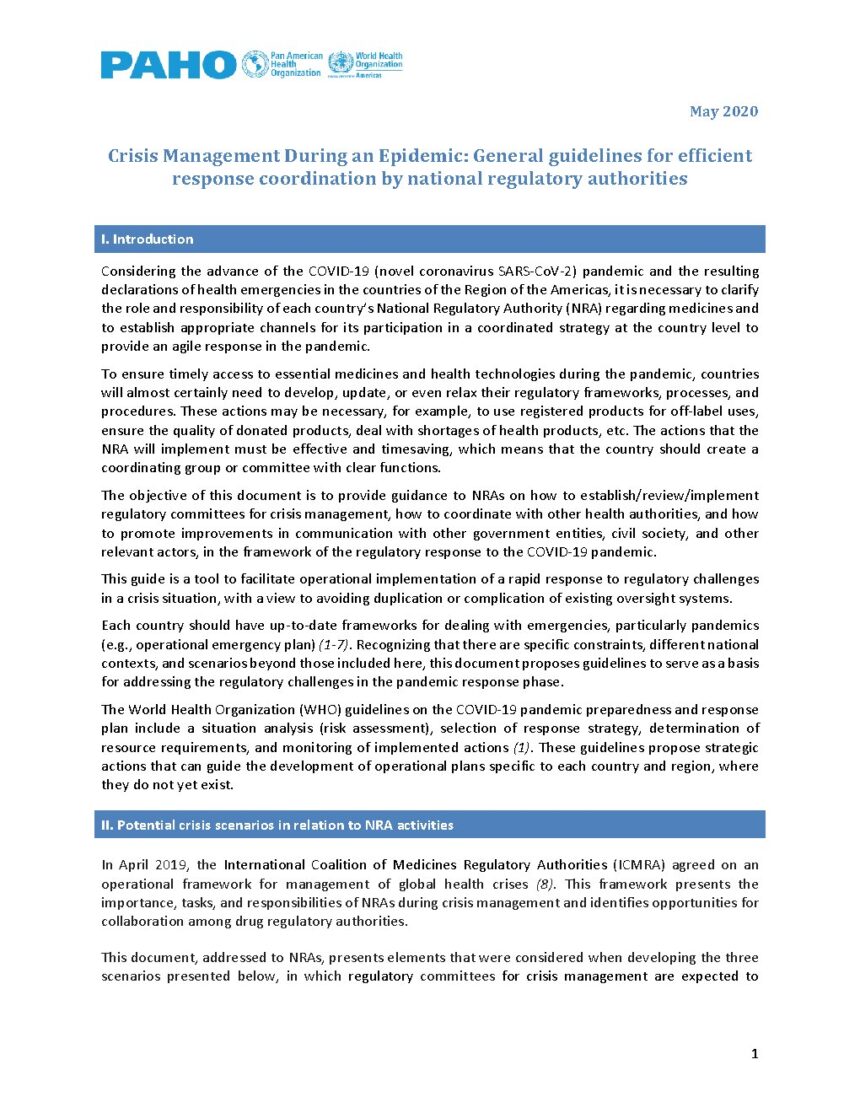
This document provides national regulatory authorities (NRAs) with a systematic framework for managing regulatory challenges during epidemics and pandemics, specifically developed in the context of COVID-19. It outlines how to establish regulatory emergency committees, coordinate with health authorities, and implement rapid response mechanisms whilst maintaining regulatory oversight.
The guidance identifies three crisis scenarios requiring coordinated regulatory action: quality or safety incidents affecting public health (including off-label use such as chloroquine for COVID-19), product shortages due to increased demand, and urgent need for new treatments or vaccines. It proposes an eight-step cyclical approach encompassing committee establishment, coordination, information gathering, legal review, analysis of alternatives, executive reporting, communications strategy, and evaluation of implemented actions.
The framework emphasises the importance of clear communication channels, legal certainty for emergency regulatory actions, international collaboration through existing networks such as PANDRH, and flexible regulatory mechanisms including expedited registration procedures, compassionate use authorisations, and clinical trial adaptations during emergencies.
Key points
For clinicians — doses and thresholds as stated in the guideline
- Establish a regulatory emergency committee including delegates from NRA management, Ministry of Health, and heads of health authorisation, surveillance, pharmacovigilance, clinical trials, quality control, inspections, communications, legal services, and international relations
- Implement three crisis scenario protocols: quality/safety incidents (e.g. off-label chloroquine use for COVID-19), product shortages from increased demand, and urgent need for new treatments or vaccines
- Designate a single committee spokesperson to communicate coordinated actions and prevent information duplication
- Review and update standard operating procedures for abbreviated product registration, off-label use authorisation including compassionate use, donation requirements, clinical trial monitoring, and changes in conditions of sale
- Establish communication flows with pharmaceutical industry associations, distributors, customs, civil society, professional institutions, reference laboratories, and international organisations (PAHO/WHO)
- Monitor supply chains and strategic reserves of medicines, antivirals, vaccines, diagnostic reagents, medical devices, and personal protective equipment for strategic and vulnerable groups
- Utilise mechanisms for mutual recognition, convergence, and regulatory reliance with other NRAs and international organisations for rapid product assessment
- Evaluate implemented actions daily or more frequently as warranted, maintaining flexibility to adjust responses based on critical analysis of evolving situations
From the guideline
Verbatim
“To ensure timely access to essential medicines and health technologies during the pandemic, countries will almost certainly need to develop, update, or even relax their regulatory frameworks, processes, and procedures.”
Editor’s perspective
Why this matters for Georgia and the region
Prof. Giorgi Pkhakadze, MD, MPH, PhD
Editor-in-Chief, Georgian Medical Journal · Chair, Public Health Institute of Georgia · WHO consultant, health and migration
As someone who has worked extensively with WHO on health systems strengthening, I recognise that Georgia's regulatory capacity has matured significantly since establishing the Medicines and Medical Devices Agency. This PAHO framework addresses a critical gap we experienced during COVID-19: the lack of pre-established emergency regulatory structures. The recommendation I would emphasise most strongly to Georgian colleagues is the proactive preparation of standard operating procedures for off-label use and compassionate access before the next crisis, rather than developing them under pressure. However, we must acknowledge a realistic implementation challenge: Georgia's relatively small regulatory workforce means that the same individuals would likely serve on multiple committee functions, potentially limiting the independent oversight that this framework envisions. Nevertheless, even a scaled version of this eight-step approach, adapted to our national context and integrated with our existing National Centre for Disease Control emergency operations, would substantially improve our regulatory preparedness for future epidemics affecting the South Caucasus region.
ORCID 0000-0001-7609-4515 · Perspective written for the GMJ Guidelines Library, 20 Oct 2026
Applicability
Georgia and the South Caucasus
For Georgia’s Medicines and Medical Devices Agency and the National Centre for Disease Control, this framework offers immediately applicable structures for managing regulatory responses to epidemics. Given Georgia’s experience with COVID-19 and its position as a regional health hub in the South Caucasus, establishing the recommended emergency committee structure would strengthen coordination between regulatory authorities, the Ministry of Health, and international partners. The guidance on supply chain monitoring, expedited approval mechanisms, and communication protocols is particularly relevant for countries with limited domestic pharmaceutical production that rely on international procurement. Georgian regulatory authorities should consider adapting the eight-step cycle to their existing legal framework, ensuring that emergency procedures for off-label use, compassionate access, and expedited registration are clearly defined before the next public health emergency.
Questions this guideline answers
Quick answers
What are the three crisis scenarios that require coordinated NRA action?
Scenario 1: quality or safety incidents affecting public health (such as off-label chloroquine use for COVID-19 causing adverse events and shortages for approved indications); Scenario 2: product unavailability due to shortages from increased demand (e.g. antivirals or vaccines during viral pandemics); Scenario 3: urgent need for new medical treatments or vaccines in response to emerging health threats.
Who should be included in the regulatory emergency committee?
The committee should include: a delegate of NRA management, a Ministry of Health delegate, and heads of health authorisation, health surveillance, pharmacovigilance, clinical trial authorisation and control, quality control laboratory, regulatory inspections, communications, legal advisory services, and international/interinstitutional relations. Internal or independent ad hoc experts on subjects related to the crisis (e.g. infectious disease specialists for COVID-19) should also participate regularly.
What standard operating procedures need urgent review during an epidemic?
Procedures requiring preparation or modification include: registry of new products through abbreviated mechanisms, inclusion of new off-label uses for registered products including compassionate use, requirements for timely donation of medicines and health technologies, monitoring of active clinical trials including uncommon modalities, rapid approval of clinical trials for pandemic-related medicines, authorisation of facilities to manufacture products needed for the emergency, and changes in conditions of sale for medicines and health technologies.
How should communication be managed during a regulatory crisis?
The committee should designate a single spokesperson (possibly the communications delegate) to communicate coordinated actions. Partnerships should be established with both mass media and specialised health media outlets. All media channels should be utilised—social media, press, radio, television, billboards, posters, flyers, and sound trucks—with formats appropriate to target audiences. Press releases, briefings, and questions-and-answers about adverse events should be prepared, and institution management should participate in public addresses when necessary.
Related on GMJ
Interconnected resources
Dictionary of Public Health
Drugs A–Z
GMJ News coverage
- UK flu and COVID-19 surveillance data to May 2027 shows continued monitoring amid seasonal trendsOct 2026
- Community Health Workers Boost COVID-19 Testing Among Formerly Incarcerated PeopleAug 2026
- Semaglutide Approved for Advanced Liver Disease: First GLP-1 Drug to Treat MASH with FibrosisSep 2026
- UK Health Security Agency Publishes Framework for Evidence-Based Public Health EvaluationSep 2026
Quality & accreditation
Other guidelines on this topic
- Recommendations for the Management of Solid Waste
- Guidelines to Plan for COVID-19 Vaccine Introduction
- Considerations for the Reorganization of Cancer Services during the COVID-19 Pandemic
- The Immunization Program in the Context of the COVID-19 Pandemic
- Considerations on Social Distancing and Travel-Related Measures in the Context of the Response to COVID-19 Pandemic
- Issuer
- Pan American Health Organization
- Type
- Procedures, manuals, guidelines
- Edition
- May 2020
- Status
- Current
- Published
- 2020-01-01
- Scope
- National regulatory authorities managing epidemic/pandemic responses
- Audience
- National medicines regulatory authorities, ministries of health, regulatory officials
- Licence
- CC BY-NC-SA 3.0 IGO
- Evidence
- Expert consensus and operational framework adapted from ICMRA standards
- Record history
- Created 20 Oct 2026 · updated 20 Oct 2026 · next check Apr 2027
Pan American Health Organization. Crisis Management during an Epidemic: General guidelines for efficient response coordination by national regulatory authorities. Washington, D.C.: PAHO; 2020. PAHO/HSS/MT/COVID-19/20-0014.GMJ Guidelines Library records are original summaries written by the GMJ editorial team from the issuer’s published document and reviewed by a physician. They do not replace the full guideline. The document is the copyright of its issuer and is linked, not hosted. Spotted an error or a newer edition? Tell the Guidelines Desk.
Was this article helpful?