World Health Organization · 1st edition, 2025 · 59 pages
Competency framework defining skills and knowledge needed by public health intelligence professionals for early detection and assessment of health threats
- Issuer
- World Health Organization
- Edition
- 1st edition, 2025
- Audience
- Public health intelligence professionals, field epidemiologists, surveillance officers, emergency response teams, employers, educators, regulatory agencies, policy-makers
- Evidence
- Expert consensus developed through landscape assessment, stakeholder surveys, focus groups and multi-stage review by subject matter experts from WHO, CDC, Robert Koch Institute, TEPHINET, FAO, ECDC, Africa CDC and WHO regional offices
- Reviewed
- 17 Oct 2026 · GMJ
What this guideline says
GMJ summary
The Public health intelligence competency framework is a comprehensive manual that defines the core competencies and professional attributes required for effective public health intelligence (PHI) work. Developed through extensive consultation with global partners, it addresses the critical need for standardized training and capacity development in early detection, verification, analysis and assessment of health threats.
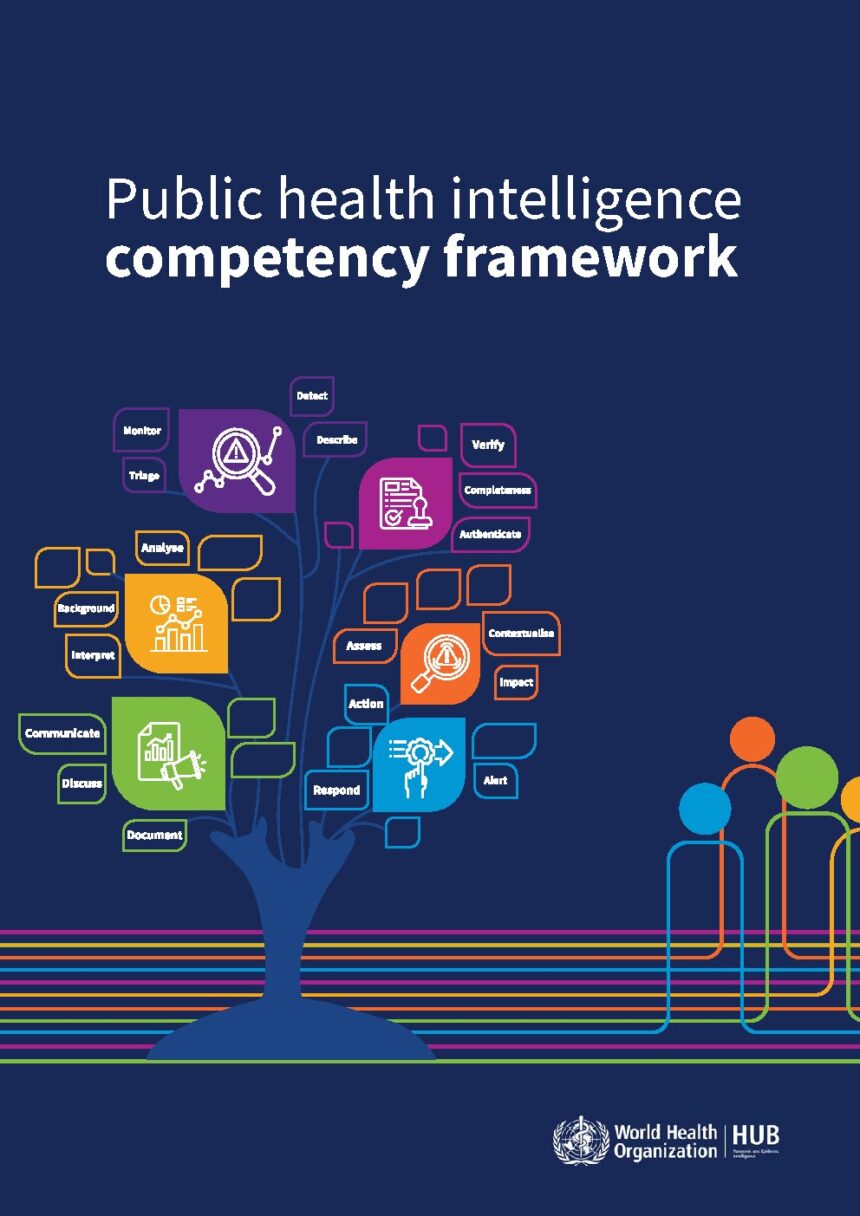
The Framework is organized into four technical domains—detect, verify, analyse and assess—representing sequential steps in the PHI process, plus one functional domain covering collaborative information exchange. It encompasses 29 core competencies (13 technical, 16 functional) that PHI professionals must demonstrate, from evaluating data from multiple sources to generating actionable insights for decision-making. The Framework adopts an all-hazards and multisectoral One Health approach, recognizing the interconnectedness of human health, animal health and environmental factors.
Designed for use by employers, educators, regulatory agencies and PHI professionals themselves, the Framework serves multiple purposes: curriculum development, workforce planning, job descriptions, performance evaluation, accreditation standards and professional self-assessment. It is accompanied by the Public health intelligence curriculum, which translates the competencies into targeted courses with specific learning objectives aligned to the tasks outlined in the Framework.
Key points
For clinicians — doses and thresholds as stated in the guideline
- Four technical domains define the PHI process: detect (routine monitoring and triage of signals), verify (confirm authenticity and accuracy), analyse (epidemiological and statistical analysis), and assess (risk assessment and generation of actionable insights)
- Thirteen technical competencies include evaluating data from multiple sources, ensuring data security and privacy, considering contextual factors, contributing to quality improvement, taking adaptive collaborative approaches to decision-making, and incorporating systems thinking with One Health and all-hazards perspectives
- Sixteen functional competencies cover collaborative information exchange: ensuring clear timely communication, proactive stakeholder management, purposeful information conveyance, tailored audience communication, working within competence limits, lifelong learning, ethical conduct, cultural sensitivity, adaptability and strategic planning
- Detection tasks involve monitoring official and unofficial quantitative and qualitative data sources directly and indirectly related to human health, social listening, aggregating related signals, and applying decision instruments to determine which signals should be monitored, verified or discarded
- Verification requires reaching out to original signal sources, local health authorities and appropriate points of contact; compiling information from official sources; consulting with colleagues and experts; and evaluating limitations, quality and significance of data
- Analysis encompasses applying relevant validation techniques, performing epidemiological and statistical analysis, spatial analysis and modelling, interpreting trends from multiple sources, appraising uncertainty and limitations, and incorporating new information as it arrives
- Assessment involves applying risk assessment tools to evaluate likelihood and impact, measuring consequences on health systems and societies, identifying vulnerable populations, formulating risk questions, integrating uncertainties, determining response scale required, and providing risk management options
- The Framework aligns with the International Health Regulations (2005) requirement to apply Annex 2 to assess if threats may constitute a public health emergency of international concern, and with the WHO Collaborative Surveillance Framework and Competencies for One Health Field Epidemiology (COHFE) Framework
Technical and functional competencies in the public health intelligence process
Table extracted from the guideline
| Competency number | Competency statement |
|---|---|
| Competency 1 | Evaluates data and information from a range of sources |
| Competency 2 | Engages in practices to ensure data security, confidentiality and privacy |
| Competency 3 | Considers contextual factors in the analysis of PHI data |
| Competency 4 | Contributes to a culture of continuous quality improvement of PHI data |
| Competency 5 | Takes an adaptive, collaborative and rigorous approach to PHI decision-making |
| Competency 6 | Incorporates a systems approach to decision-making, considering One Health and all-hazards perspectives |
| Competency 7 | Takes a solutions-oriented approach to problem solving in PHI |
| Competency 8 | Demonstrates effective use of data for generating actionable insights |
| Competency 9 | Adapts priorities based on unexpected or changing situations |
| Competency 10 | Engages multisectoral One Health stakeholders for implementing joint PHI activities |
| Competency 11 | Builds and maintains a trusting network of multisectoral One Health stakeholders |
| Competency 12 | Learns from a range of multisectoral One Health partners |
| Competency 13 | Incorporates a holistic approach to PHI |
| Competency 14 | Ensures others have clear, accurate, and timely information |
| Competency 15 | Proactively manages interactions with others |
| Competency 16 | Adapts communication to the goals, needs, cultural context, urgency, and sensitivity of the interaction |
| Competency 17 | Listens actively and attentively |
| Competency 18 | Conveys information purposefully |
| Competency 19 | Acknowledges the importance of stakeholder information needs |
| Competency 20 | Tailors communication to the audience |
| Competency 21 | Works within the limits of competence and scope of practice for PHI activities |
| Competency 22 | Engages in lifelong learning and reflective practice to improve performance |
| Competency 23 | Demonstrates high standards of ethical conduct |
| Competency 24 | Focuses on well-being, recognises stress and seeks support when needed |
| Competency 25 | Operates with cultural sensitivity, respectfulness, and compassion |
| Competency 26 | Adapts to unexpected or changing situations |
| Competency 27 | Plans strategically |
| Competency 28 | Empowers others |
| Competency 29 | Manages tensions and conflicts |
Source: World Health Organization, Public health intelligence competency framework. Reproduced in summary form.
From the guideline
Verbatim
“Public health intelligence is a core public health function responsible for identifying, collecting, connecting, synthesizing, analysing, assessing, interpreting and generating a wide range of information for actionable insights.”
Editor’s perspective
Why this matters for Georgia and the region
Prof. Giorgi Pkhakadze, MD, MPH, PhD
Editor-in-Chief, Georgian Medical Journal · Chair, Public Health Institute of Georgia · WHO consultant, health and migration
As WHO consultant on health and migration and Chair of the Public Health Institute of Georgia, I recognize this Framework addresses a critical gap in our region's capacity to meet International Health Regulations core requirements. Georgia's National Center for Disease Control has made substantial progress in surveillance system strengthening, particularly following our experience with COVID-19 and ongoing challenges with endemic zoonoses such as brucellosis and rabies in agricultural areas. The competency I would stress most for our context is Competency 6—incorporating a systems approach with One Health and all-hazards perspectives—because effective PHI in the South Caucasus requires seamless collaboration between human health, veterinary and environmental sectors, which historically have operated in silos. One realistic implementation caveat is that smaller regional surveillance units may lack the staffing to fully separate the detect, verify, analyse and assess functions, requiring professionals to demonstrate competencies across multiple domains simultaneously, which argues for prioritizing the functional competencies around communication and adaptability alongside the technical skills.
ORCID 0000-0001-7609-4515 · Perspective written for the GMJ Guidelines Library, 17 Oct 2026
Applicability
Georgia and the South Caucasus
This Framework is highly relevant for Georgia and the wider South Caucasus region as countries strengthen capacity to meet International Health Regulations (2005) core requirements for detecting, assessing and reporting public health events. Georgia’s National Center for Disease Control and Public Health, which coordinates surveillance activities, can use the Framework to standardize competency requirements across its epidemic intelligence units, field epidemiology training programme graduates and regional surveillance officers. The emphasis on multisectoral One Health collaboration aligns with Georgia’s ongoing challenges at the human-animal-environment interface, including zoonotic diseases such as brucellosis, rabies and anthrax that remain endemic in agricultural communities. For the South Caucasus and Eastern European context, the Framework provides a structured approach to develop PHI workforce capacity that can support cross-border collaboration on shared health threats, particularly important given regional migration patterns and trade corridors. National programmes should adapt the Framework to local organizational structures, available data systems and specific hazard profiles while maintaining alignment with the core competencies to ensure interoperability with international surveillance networks.
Questions this guideline answers
Quick answers
What is public health intelligence and how does it differ from surveillance?
Public health intelligence is a core function responsible for identifying, collecting, connecting, synthesizing, analysing, assessing, interpreting and generating a wide range of information for actionable insights, then disseminating them for informed decision-making to protect population health. It encompasses but is broader than surveillance, integrating event-based and indicator-based surveillance with information from non-health sectors, social listening, and contextual analysis to support early warning, risk assessment and response decisions across all hazards.
Who should use this competency framework?
The Framework is intended for employers (governmental, nongovernmental, academic, private-sector organizations at all levels) to set hiring and performance criteria; licensing and regulatory agencies to establish accreditation standards; organizations delivering pre-service, in-training or in-service curricula to inform course creation and curriculum development; PHI workforce members for self-assessment and identifying areas for improvement; and policy-makers to establish evidence-based policies and strategic planning. It applies across local, subnational, national, regional and global settings.
How do the four technical domains relate to the PHI workflow?
The technical domains represent sequential steps in the PHI process, though they may be skipped, repeated or combined depending on circumstances: Detect involves routine monitoring of data and signals and their triage to determine action (discard, monitor, verify). Verify confirms authenticity and accuracy of signals and credibility of sources through consultation with original sources and official channels. Analyse involves epidemiological and statistical analysis and interpretation, often requiring consultation with experts. Assess determines significance of the event, risk to populations, multisectoral impact, efficacy of response measures and generates actionable insights. Communication, discussion and documentation occur continuously throughout.
How does this Framework align with other WHO competency frameworks?
The Framework follows WHO standard operating procedures for competency-based frameworks and aligns with the WHO Global Competency Framework for Universal Health Coverage (2022), the Competencies for One Health Field Epidemiology (COHFE) Framework (2024), and the WHO Global Competency and Outcomes Framework for the Essential Public Health Functions (2023). It complements the WHO Collaborative Surveillance Framework (2023) by defining specific competencies needed by the PHI workforce to implement collaborative surveillance. The competency model uses the same structure of knowledge, skills and behaviours/attitudes used across these frameworks.
Related on GMJ
Interconnected resources
GMJ News coverage
Quality & accreditation
Other guidelines on this topic
- Framework and toolkit for infection prevention and control outbreak preparedness, readiness and response: implementation manual
- Risk Communication and Community Engagement for Contact Tracing in the Context of COVID-19 in the Region of the Americas
- Guidance for Developing Status Profiles on Communicable Diseases to Further Progress toward Their Elimination in the Region of the Americas
- Manual for Stratifying Malaria Risk and the Elimination of Foci
- Malaria case management: Plasmodium vivax malaria – A field guide
- Issuer
- World Health Organization
- Type
- Manual
- Edition
- 1st edition, 2025
- Status
- Current
- Published
- 2025-11-27
- Languages
- English
- Scope
- Global; all-hazards approach covering infectious diseases, natural disasters, chemical/biological/radiological/nuclear threats
- Audience
- Public health intelligence professionals, field epidemiologists, surveillance officers, emergency response teams, employers, educators, regulatory agencies, policy-makers
- Pages
- 59
- Licence
- CC BY-NC-SA 3.0 IGO
- ISBN
- 978-92-4-011540-8
- Evidence
- Expert consensus developed through landscape assessment, stakeholder surveys, focus groups and multi-stage review by subject matter experts from WHO, CDC, Robert Koch Institute, TEPHINET, FAO, ECDC, Africa CDC and WHO regional offices
- Record history
- Created 17 Oct 2026 · updated 17 Oct 2026 · next check Apr 2027
World Health Organization. Public health intelligence competency framework. Geneva: World Health Organization; 2025. Licence: CC BY-NC-SA 3.0 IGO.GMJ Guidelines Library records are original summaries written by the GMJ editorial team from the issuer’s published document and reviewed by a physician. They do not replace the full guideline. The document is the copyright of its issuer and is linked, not hosted. Spotted an error or a newer edition? Tell the Guidelines Desk.
Was this article helpful?