World Health Organization · 1st edition, 2026 · 58 pages
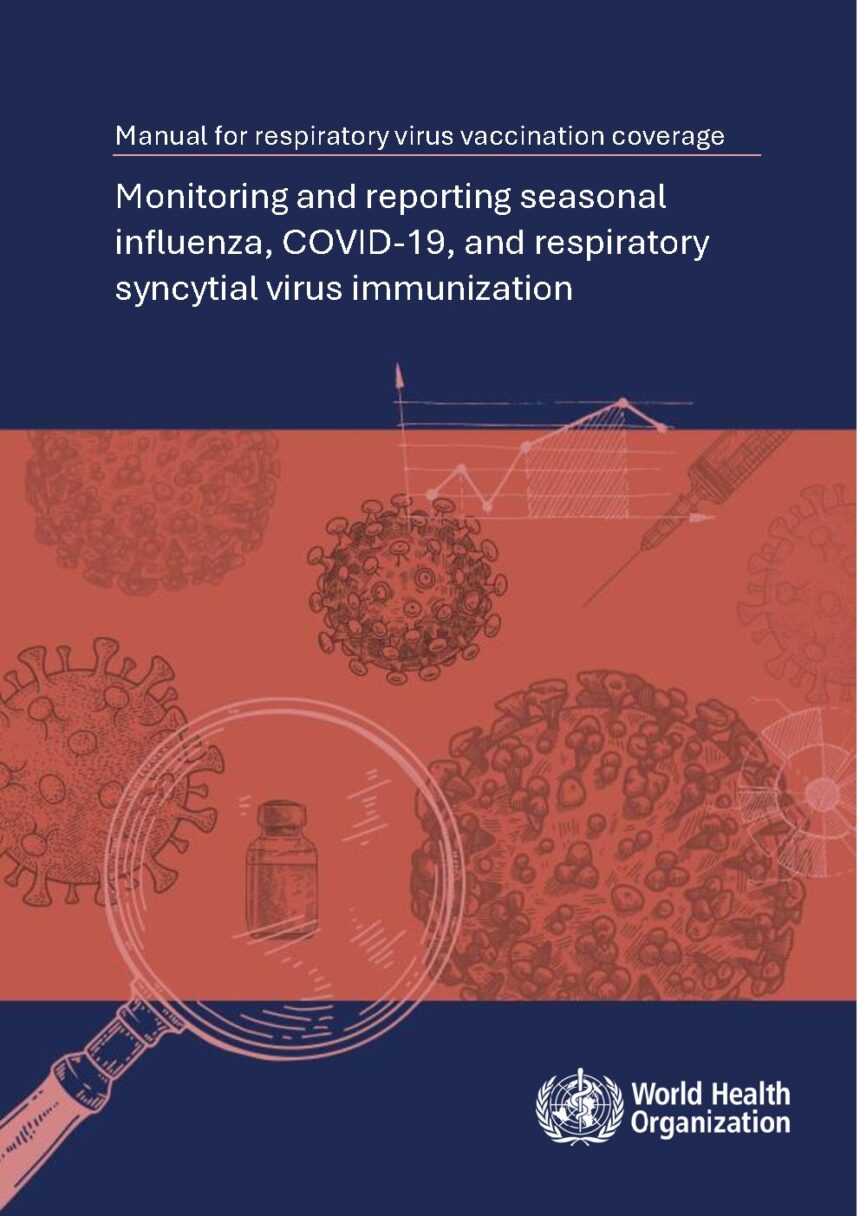
WHO operational manual for national immunization programmes to monitor and report seasonal influenza, COVID-19, and RSV vaccine coverage among target groups.
- Issuer
- World Health Organization
- Edition
- 1st edition, 2026
- Audience
- National immunization programme managers, epidemiologists, health information system staff, district health authorities, technical partners supporting immunization monitoring
- Evidence
- Expert consensus, operational best practices, review of grey literature (WHO EURO 2016 methods, Sabin Institute 2023 analysis, PAHO tools), and analysis of 2018–2023 JRF data on influenza coverage reporting trends
- Reviewed
- 17 Oct 2026 · GMJ
What this guideline says
GMJ summary
This WHO manual provides comprehensive technical guidance for countries to establish, strengthen, and standardize monitoring systems for seasonal influenza, COVID-19, and respiratory syncytial virus (RSV) immunization programmes. It addresses the unique challenges of tracking coverage in adult and priority populations—older adults, health and care workers, people with chronic conditions, and pregnant persons—using direct methods (administrative reporting, electronic immunization registries, coverage surveys) and indirect proxies (procurement, insurance claims).
The manual emphasizes that coverage (proportion of target population vaccinated) differs from programmatic goals (operational targets) and should never exceed 100%. It recommends core disaggregation by geography, age, occupation (for HCWs), chronic condition status, and pregnancy status. For seasonal influenza and COVID-19, annual uptake equals coverage because vaccine-induced protection wanes and strain formulations change; for RSV vaccines, coverage accumulates over multiple years.
Countries are encouraged to use administrative reporting systems integrated with electronic medical records, triangulate multiple data sources to validate accuracy, and leverage existing surveillance and civil registration systems for denominator estimates. The manual stresses interoperability with national health information systems, data quality audits, and transparent reporting to WHO and UNICEF through the Joint Reporting Form. Long-term planning should prioritize governance, standard operating procedures, and incremental system improvements aligned with national health data strategies.
Key points
For clinicians — doses and thresholds as stated in the guideline
- Estimate coverage by dividing the number of individuals vaccinated (numerator) by the size of the target population group (denominator); ensure definitions, timing, and geography align to avoid mismatches.
- Core disaggregation: by district, age (older adults ≥60 or 65 years per national policy), health and care workers, people with at least one chronic condition, and pregnant persons.
- For seasonal influenza and COVID-19: annual uptake and coverage are equivalent because vaccines require yearly re-vaccination and strain updates; for RSV: coverage accumulates over multiple years.
- Use direct measurement methods (administrative reporting, electronic immunization registries, coverage surveys) for accuracy; indirect methods (procurement, insurance claims) require adjustments for wastage and non-reporting.
- Recommended minimum monitoring: report cumulative individuals vaccinated and estimated coverage monthly during active campaigns, disaggregated by geography, age, HCWs, chronic conditions, and pregnancy status.
- Triangulate administrative data with coverage surveys, procurement records, and insurance claims to detect inconsistencies (e.g., if procurement is too low to achieve reported coverage or coverage exceeds 100%).
- Leverage civil registration and vital statistics (CRVS) systems, census data, occupational registries (HCWs), disease-specific registries (chronic conditions), and global UN Population Division estimates when local denominators are unavailable.
- Integrate seasonal respiratory virus immunization data into national health management information systems, align with childhood immunization registries where feasible, and ensure interoperability using standardized formats (HL7, FHIR).
Core, recommended, and optional disaggregation dimensions for immunization coverage monitoring
Table extracted from the guideline
| Dimension | Core | Recommended | Optional | Use, definitions and notes |
|---|---|---|---|---|
| Antigen | By antigen (seasonal influenza, COVID-19, RSV) | By product type | Calculate coverage per antigen and by product per antigen where applicable | |
| Geography | By district or other subnational level | Monitor equitable distribution across subnational levels | ||
| Age group | For older adults per national policy (and children where recommended) | More refined older adult age brackets (60–64, 65–69, 70–79, 80+); general adult (18–59); childhood (0–6 months, 6–59 months, 5–18 years) where recommended | Countries should use own definition of older adults (often ≥60 or ≥65 years) aligned with national recommendations | |
| Occupation | Among HCWs (for seasonal influenza and COVID-19) | Other occupational groups (teachers, police, farm workers) | Monitor coverage in occupational groups if recommended; HCW definition determined by country (per International Classification of Health Workers) | |
| Chronic health condition status | Among people with at least one chronic condition | For specific defined conditions | Monitor uptake among people at increased risk of severe disease; definitions to be determined by country (e.g., diabetes, chronic lung/heart/kidney disease, BMI >40, immunocompromising conditions, HIV/AIDS) | |
| Pregnancy status | Among pregnant persons | Monitor uptake in pregnant persons at increased risk of severe disease | ||
| At-risk settings | Prisons, group homes, long-term care facilities, high-density congregate living, refugee/IDP settings | Monitor uptake in congregate living settings | ||
| Sex | By male/female | Monitor for gender inequalities; may be required in some regions or by funders | ||
| Other dimensions | Socioeconomic, ethnic, linguistic, religious, disadvantaged groups, noncitizens, migratory or underserved populations, travellers | Monitor equitable distribution; coverage surveys may be best suited for these groups |
Source: World Health Organization, Manual for respiratory virus vaccination coverage: monitoring and reporting seasonal influenza, COVID-19, and respiratory syncytial virus immunization. Reproduced in summary form.
From the guideline
Verbatim
“Countries should use coverage as the principal measure for monitoring progress in vaccinating target population groups. Coverage should be used for epidemiological analyses (including burden averted) and reporting to regional and global-level monitoring processes.”
Editor’s perspective
Why this matters for Georgia and the region
Prof. Giorgi Pkhakadze, MD, MPH, PhD
Editor-in-Chief, Georgian Medical Journal · Chair, Public Health Institute of Georgia · WHO consultant, health and migration
As Chair of Georgia's Public Health Institute and a WHO consultant, I see this manual as essential for our region as we expand beyond childhood immunization to systematic adult and priority-group respiratory virus vaccination. In Georgia and neighbouring Armenia and Azerbaijan, we have strong civil registration systems and occupational health databases that can provide denominators for older adults and health workers, yet we struggle to capture private-sector and pharmacy-based immunizations—the manual's guidance on triangulation and data-sharing agreements is directly applicable. I would stress to Georgian colleagues the distinction between programmatic goals and actual coverage: reporting that we met a campaign target does not equal population protection, and honest coverage measurement (which may reveal gaps) is more valuable than inflated figures. One realistic caveat: establishing electronic immunization registries that interoperate with hospital, primary care, and pharmacy systems requires sustained political commitment and multi-year investment; countries should start with paper-based aggregate systems enhanced by periodic surveys, then transition incrementally rather than attempting full digitalization without adequate infrastructure and governance.
ORCID 0000-0001-7609-4515 · Perspective written for the GMJ Guidelines Library, 17 Oct 2026
Applicability
Georgia and the South Caucasus
This manual is directly relevant for Georgia and South Caucasus countries as they strengthen or introduce seasonal respiratory virus immunization programmes. Georgia has an established national immunization programme infrastructure (including EPI systems and CRVS registries) that can be adapted to monitor influenza, COVID-19, and RSV vaccines among older adults, health workers, and people with chronic conditions. The emphasis on integrating respiratory virus monitoring with existing electronic health records and reporting through the WHO-UNICEF Joint Reporting Form aligns with Georgia’s commitments to WHO EURO targets. Eastern European countries in transition should prioritize establishing denominator estimates through civil registration systems, occupational HCW registries, and disease-specific programmes (e.g., diabetes, cardiovascular disease registries) to enable accurate coverage calculation. The manual’s guidance on sentinel administrative approaches and triangulation methods is practical for settings with incomplete private-sector reporting or limited digital infrastructure. Countries introducing RSV immunization (e.g., maternal vaccination, monoclonal antibodies for infants) should note the distinction between annual uptake and multi-year cumulative coverage unique to RSV.
Questions this guideline answers
Quick answers
What is the difference between immunization coverage and a programmatic goal?
Coverage is the actual proportion of the target population that has been vaccinated (a measure that cannot exceed 100%). A programmatic goal is an operational target—for example, if a country has enough vaccine for 50,000 of 100,000 people with HIV/AIDS, reaching 50,000 means 100% of the goal but only 50% coverage of that population group.
Why are annual uptake and coverage the same for influenza and COVID-19 vaccines but not for RSV vaccines?
Influenza and COVID-19 vaccines require yearly re-vaccination because strain formulations are updated twice annually and vaccine-induced protection wanes, so each year's uptake equals coverage. RSV vaccines do not require regular strain updates and provide longer protection; RSV coverage accumulates over multiple years, meaning uptake in one year adds to the protected population from previous years.
What denominator sources should countries use to calculate coverage for health and care workers?
Countries should use national health workforce licensing databases or occupational registries where available. If these are incomplete, global sources include WHO National Health Workforce Accounts (NHWA) data and ILO ILOSTAT labour force data; however, ensure definitions align (e.g., ILOSTAT includes non-clinical health-sector staff, which may inflate HCW totals if the programme targets only clinical workers).
How should countries monitor coverage when vaccines are delivered through private pharmacies or workplaces not captured in public reporting systems?
Use coverage surveys to estimate private-sector uptake, establish data-sharing agreements with private providers and pharmacies to report immunizations to national electronic registries, or use health insurance claims data (if most of the population is insured) to approximate coverage. Triangulate these sources with public administrative data to identify gaps and validate estimates.
Related on GMJ
Interconnected resources
Dictionary of Public Health
GMJ News coverage
Quality & accreditation
- ASF PHC — Standard 4 — Acute & Same-Day Care · Primary Health Clinic
- ASF PHC — Standard 7 — Governance & Staffing · Primary Health Clinic
- ASF Hospital — Standard 5 — Safety & Emergency Preparedness
- ASF Hospital — Standard 11 — Critical Care
- ASF Medical Transport — Standard 6 — Emergency Response During Transport
Other guidelines on this topic
- User manual for the Member State Rapid Risk Assessment (MS-RRA) tool
- Framework of a national program for preventing and controlling diseases caused by respiratory viruses with epidemic and pandemic potential
- Microplanning Manual for Malaria Elimination in the Region of the Americas. Version for field personnel
- Maternal and neonatal tetanus elimination in Latin America and the Caribbean: Field Guide
- Manual of procedures for leishmaniasis surveillance and control in the Region of the Americas. Second edition
- Issuer
- World Health Organization
- Type
- Manual
- Edition
- 1st edition, 2026
- Status
- Current
- Published
- 2026-06-26
- Languages
- Arabic, Chinese, English, French, Russian, Spanish
- Scope
- Global
- Audience
- National immunization programme managers, epidemiologists, health information system staff, district health authorities, technical partners supporting immunization monitoring
- Pages
- 58
- Licence
- CC BY-NC-SA 3.0 IGO
- ISBN
- 9789240118829
- Evidence
- Expert consensus, operational best practices, review of grey literature (WHO EURO 2016 methods, Sabin Institute 2023 analysis, PAHO tools), and analysis of 2018–2023 JRF data on influenza coverage reporting trends
- Record history
- Created 17 Oct 2026 · updated 17 Oct 2026 · next check Apr 2027
World Health Organization. Manual for respiratory virus vaccination coverage: monitoring and reporting seasonal influenza, COVID-19, and respiratory syncytial virus immunization. Geneva: World Health Organization; 2026. Licence: CC BY-NC-SA 3.0 IGO.GMJ Guidelines Library records are original summaries written by the GMJ editorial team from the issuer’s published document and reviewed by a physician. They do not replace the full guideline. The document is the copyright of its issuer and is linked, not hosted. Spotted an error or a newer edition? Tell the Guidelines Desk.
Was this article helpful?