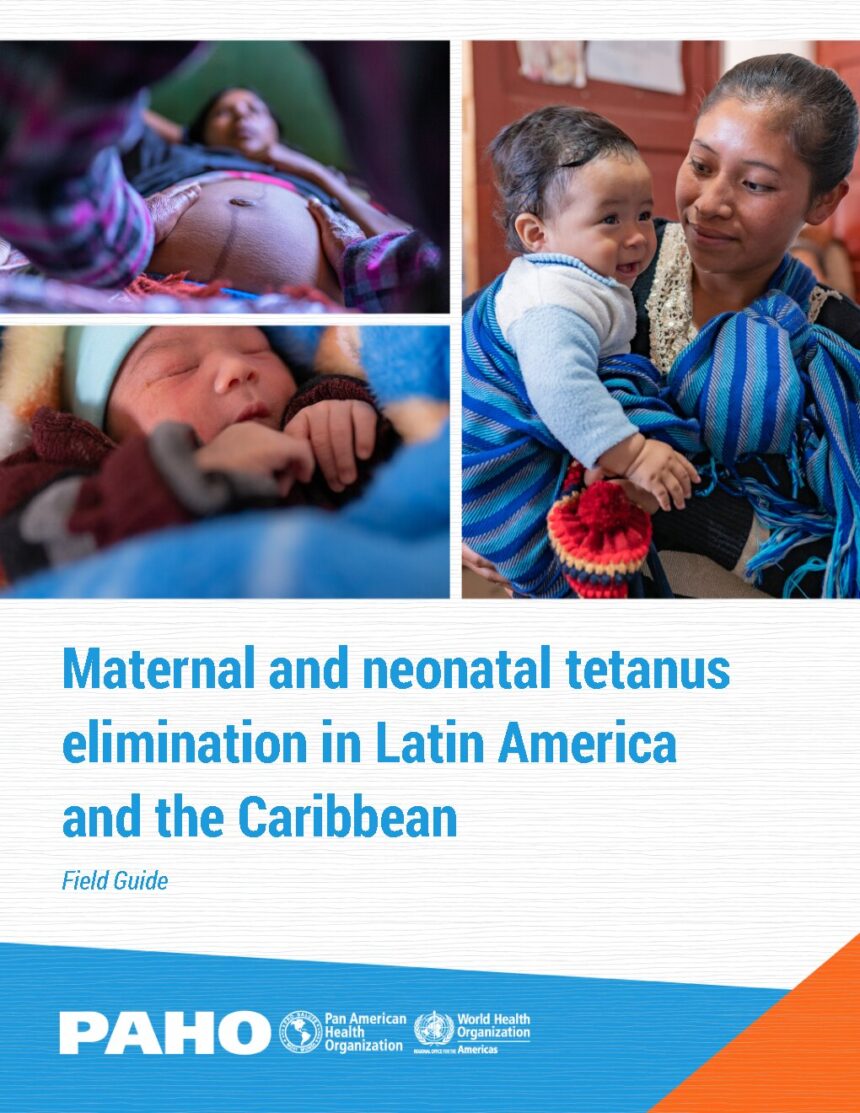
Pan American Health Organization · 2024 · 31 pages
Operational guide for immunization and maternal health programme managers to sustain MNT elimination status.
- Issuer
- Pan American Health Organization
- Edition
- 2024
- Audience
- Immunization programme managers, epidemiological surveillance officers, maternal and child health programme directors
- Evidence
- Expert consensus incorporating WHO position papers and PAHO TAG recommendations
- Reviewed
- 17 Oct 2026 · GMJ
What this guideline says
GMJ summary
This 2024 PAHO field guide provides comprehensive operational guidance for sustaining maternal and neonatal tetanus elimination (MNTE) in Latin America and the Caribbean following regional validation in 2017. The guide emphasizes a paradigm shift from targeted vaccination of pregnant women toward ensuring long-term population protection through routine childhood and adolescent immunization programmes.
The core strategy rests on three pillars: achieving 95% coverage with six doses of tetanus toxoid-containing vaccine (TTCV) in children and adolescents (three primary doses in infancy plus boosters at 12–23 months, 4–7 years, and 9–15 years); ensuring all women of reproductive age receive complete vaccination schedules verified at every health service contact; and maintaining robust epidemiological surveillance to identify districts at risk of resurgence (defined as >1 neonatal tetanus case per 1000 live births).
The guide incorporates 2019 PAHO TAG recommendations for maternal Tdap vaccination during the second or third trimester (at least 15 days before delivery) to protect neonates against both tetanus and pertussis. Annual data reviews using a WHO risk-assessment algorithm, combined with clean delivery practices and skilled birth attendance, form the foundation for sustaining elimination status in all municipalities across the region.
Key points
For clinicians — doses and thresholds as stated in the guideline
- Primary TTCV series: 3 doses in first year of life starting at 6 weeks, minimum 4-week intervals, completed by 6 months
- Booster schedule: 3 booster doses at 12–23 months, 4–7 years, and 9–15 years, with minimum 4-year intervals between boosters
- Pregnant women with unknown vaccination status: administer at least 2 TTCV doses with 4-week interval; second dose at least 2 weeks before delivery; complete 5-dose schedule postpartum
- MNTE elimination threshold maintained when all municipalities have annual neonatal tetanus incidence <1 case per 1000 live births
- Tdap in pregnancy: administer during second or third trimester, minimum 15 days before delivery, to protect neonate against pertussis
- High-risk areas: municipalities with ≥1 NT case in each of last 3 years OR >1 case/1000 live births in any year require intensified vaccination
- Women of reproductive age in at-risk areas: 5-dose TTCV schedule via supplementary immunization activities (SIA) with rounds at baseline, 4 weeks, and 6 months, plus doses at 1 year and 2 years
- Annual data review mandatory: evaluate NT incidence, skilled birth attendance coverage, and DTP1/DTP2/DTP3 coverage for all districts using WHO risk algorithm
Recommended vaccination schedule for previously unvaccinated adolescents and adults, pregnant women with incomplete vaccination schedules, and women of reproductive age in at-risk areas
Table extracted from the guideline
| Group | As soon as possible | 4 weeks later | 6 months since last dose | At least 1 year since last dose | 1 year since last dose | Total doses |
|---|---|---|---|---|---|---|
| Adolescents and adults with no previous vaccination or no record, including WRA and pregnant women | TTCV | TTCV | TTCV | — | TTCV | 5 |
| Pregnant woman who received 3 doses of TTCV in childhood | TTCV (at least 2 weeks before due date) | — | TTCV | — | TTCV | 6 |
| Pregnant woman who received 4 doses of TTCV in infancy | TTCV | — | — | — | TTCV | 6 |
| Pregnant woman who received 3 doses of TTCV in infancy and 2 boosters before pregnancy | — | — | — | — | TTCV | 6 |
| WRA vaccination in high-risk areas | TTCV – Round 1 of SIA | TTCV – Round 2 of SIA | TTCV – Round 3 of SIA | TTCV | TTCV (or in next pregnancy) | 5 |
Source: Pan American Health Organization, Maternal and neonatal tetanus elimination in Latin America and the Caribbean: Field Guide. Reproduced in summary form.
From the guideline
Verbatim
“The goal of eliminating maternal and neonatal tetanus (MNT) as a public health problem is considered met when all municipalities in a country have an annual incidence rate of NT of less than 1 case per 1000 live births.”
Editor’s perspective
Why this matters for Georgia and the region
Prof. Giorgi Pkhakadze, MD, MPH, PhD
Editor-in-Chief, Georgian Medical Journal · Chair, Public Health Institute of Georgia · WHO consultant, health and migration
As someone who has worked extensively on immunization programme strengthening in the South Caucasus, I see this PAHO guide as directly applicable to consolidating Georgia's tetanus elimination achievements. The most critical recommendation for Georgian clinicians is the shift toward verifying and completing TTCV schedules at every health contact—not just antenatal visits—which requires integration across primary care, maternal health, and paediatric services. Georgia's robust electronic immunization registry provides an excellent infrastructure for tracking the six-dose schedule and identifying under-vaccinated women, but we must ensure interoperability with antenatal care records. The realistic implementation challenge will be in mountainous regions and among mobile populations where skilled birth attendance rates may be lower and where 'silent areas' for neonatal tetanus could exist without active case finding through community networks and improved verbal autopsy systems.
ORCID 0000-0001-7609-4515 · Perspective written for the GMJ Guidelines Library, 17 Oct 2026
Applicability
Georgia and the South Caucasus
Georgia achieved maternal and neonatal tetanus elimination and maintains high routine DTP coverage (DTP3 coverage 94% in 2022 according to WHO/UNICEF estimates). The guide’s emphasis on transitioning from pregnancy-focused vaccination to comprehensive life-course immunization is directly relevant to Georgian immunization programme planning. National programmes should verify that all municipalities maintain NT incidence <1/1000 live births through annual data reviews, ensure skilled birth attendance in rural areas (particularly in mountainous regions), and consider adopting the six-dose TTCV schedule if not already implemented. The recommendation for Tdap vaccination in pregnancy aligns with Georgia's maternal immunization platform and would require policy review regarding optimal timing (second vs third trimester) and integration with existing antenatal care protocols. Surveillance quality in remote areas and among internally displaced populations warrants particular attention to identify potential 'silent areas' for NT.
Questions this guideline answers
Quick answers
How many tetanus vaccine doses does a child need for lifelong protection?
Six doses total: three primary doses in the first year of life (starting at 6 weeks with minimum 4-week intervals, completed by 6 months), followed by three booster doses at 12–23 months, 4–7 years, and 9–15 years. When initiated after age 1 year, five properly spaced doses provide protection throughout reproductive years.
What should I do for a pregnant woman with unknown tetanus vaccination history?
Administer at least two TTCV doses with a 4-week interval, ensuring the second dose is given at least 2 weeks before delivery. After delivery, give three additional doses to complete the 5-dose schedule. Never restart the schedule unnecessarily—if any previous doses can be verified, continue from where she left off according to the recommended intervals.
When has a district lost maternal and neonatal tetanus elimination status?
A district is at high risk of losing MNTE status when it reports one or more neonatal tetanus cases in each of the last three years, or when annual incidence exceeds 1 case per 1000 live births in any year. Such districts require immediate intensified vaccination activities and investigation of clean delivery practices.
Should pregnant women receive Tdap or just tetanus toxoid?
PAHO TAG recommends Tdap vaccination during the second or third trimester, at least 15 days before delivery, to protect the neonate against both tetanus and pertussis. This is particularly valuable in countries with high infant pertussis mortality and complements routine infant DTP vaccination. Continue monitoring vaccine safety and coverage (target >50%) among pregnant women.
Related on GMJ
Interconnected resources
GMJ News coverage
Quality & accreditation
- ASF PHC — Standard 4 — Acute & Same-Day Care · Primary Health Clinic
- ASF PHC — Standard 7 — Governance & Staffing · Primary Health Clinic
- ASF Hospital — Standard 4 — Care & Treatment
- ASF Hospital — Standard 6 — Aftercare & Follow-up
- ASF Hospital — Standard 5 — Safety & Emergency Preparedness
- ASF Hospital — Standard 11 — Critical Care
- ASF Medical Transport — Standard 6 — Emergency Response During Transport
Other guidelines on this topic
- Manual of procedures for leishmaniasis surveillance and control in the Region of the Americas. Second edition
- Guidance on active case-finding for acute flaccid paralysis, measles, and rubella
- Protocol for the Use of the Performance Monitoring Tool for the National Expanded Program on Immunization
- Control of diphtheria and pertussis: Field guide
- Technical guide on the use of maternal vaccine and long-acting monoclonal antibodies against respiratory syncytial virus to protect infants
- Issuer
- Pan American Health Organization
- Type
- Procedures, manuals, guidelines
- Edition
- 2024
- Replaces
- Neonatal Tetanus Elimination Field Guide, 2nd edition, 2005
- Status
- Current
- Published
- 2024-01-01
- Languages
- English
- Scope
- Regional (Latin America and the Caribbean)
- Audience
- Immunization programme managers, epidemiological surveillance officers, maternal and child health programme directors
- Pages
- 31
- Licence
- CC BY-NC-SA 3.0 IGO
- ISBN
- 978-92-75-12855-8 (PDF)
- Evidence
- Expert consensus incorporating WHO position papers and PAHO TAG recommendations
- Record history
- Created 17 Oct 2026 · updated 17 Oct 2026 · next check Apr 2027
Pan American Health Organization. Maternal and neonatal tetanus elimination in Latin America and the Caribbean. Field Guide. Washington, D.C.: PAHO; 2024. Available from: https://doi.org/10.37774/9789275128558GMJ Guidelines Library records are original summaries written by the GMJ editorial team from the issuer’s published document and reviewed by a physician. They do not replace the full guideline. The document is the copyright of its issuer and is linked, not hosted. Spotted an error or a newer edition? Tell the Guidelines Desk.
Was this article helpful?