World Health Organization · 1st edition, 2025 · 151 pages
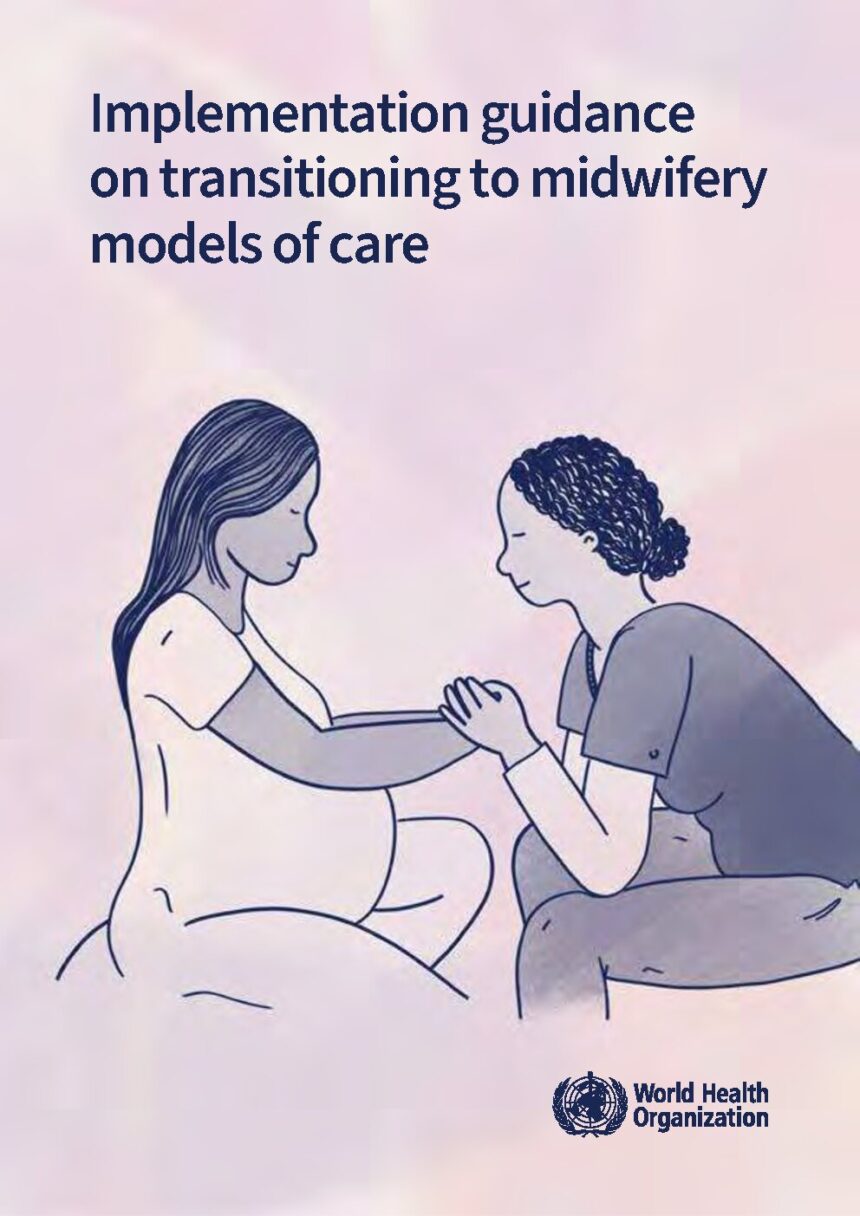
Strategic and operational framework for countries to establish midwifery-led maternal and newborn care models with professional midwives coordinating services.
- Issuer
- World Health Organization
- Edition
- 1st edition, 2025
- Audience
- Government officials in Ministries of Health; maternal and newborn health programme managers; health workforce planners; midwives, obstetricians, paediatricians, nurses; professional associations; regulatory authorities; educational institutions; implementing partners; women's groups and community representatives
- Evidence
- Systematic review of literature, expert consensus from STAGE Midwifery Working Group, country consultations, case studies from five countries
- Reviewed
- 16 Oct 2026 · GMJ
What this guideline says
GMJ summary
This 151-page normative guidance document provides a comprehensive framework for countries to transition to midwifery models of care—defined as care provided by autonomous midwives working in interprofessional teams throughout pregnancy, childbirth and the postnatal period. The guidance emphasizes continuity of midwife care as optimal, where the same midwife or small team provides care across the entire continuum.
The document structures the transition around eight essential areas: women and community engagement; service delivery design; interprofessional collaboration; midwifery leadership and research; policy and regulatory environment; education and continuous professional development; health workforce strategies; and supportive health system environment. Each area is mapped across five phases of transition maturity. A transition framework assessment tool enables countries to identify their current phase in each area and prioritize actions accordingly.
Five transition stories illustrate implementation in diverse contexts: Bangladesh (establishing midwifery from absence of the profession), Democratic Republic of the Congo (continuity of care for sexual violence survivors), England (national scale-up), Ethiopia (pilot in four hospitals) and West Bank (conflict-affected setting). The guidance supports adaptable, context-specific solutions aligned with universal health coverage goals, demonstrating that midwifery models save lives, reduce unnecessary interventions, improve care experiences and optimize resource use.
Key points
For clinicians — doses and thresholds as stated in the guideline
- Midwifery models of care are defined by professional midwives providing autonomous, coordinated care across pregnancy, childbirth and the postnatal period, within interprofessional teams with clear referral pathways for complications.
- Continuity of midwife care—where the same midwife or small team (≤8 midwives) provides care throughout the continuum—represents the optimal model, with each midwife typically managing approximately 36–37 women annually.
- Transition requires addressing eight core areas: women/community engagement, service delivery, interprofessional collaboration, midwifery leadership/research, policy/regulation, education/continuous professional development, workforce strategies, and supportive health system environment.
- Essential pillars for successful transition include: political commitment with dedicated funding, governance structures (national midwifery working group and project management team), strategic partnerships with stakeholders, and sustainability mechanisms.
- A four-step planning process is recommended: (1) conduct situation analysis using the transition framework assessment tool, (2) design strategic plan aligned with health priorities, (3) develop operational plan with monitoring/evaluation framework, (4) develop financial plan and allocate resources.
- Policy and regulatory requirements include: laws recognizing midwives as autonomous practitioners, licensing schemes with defined scope of practice, accreditation of education programmes, code of conduct/ethics, and workplace policies enabling full scope of practice.
- Education standards require: competency-based midwifery curriculum of minimum three years' duration, faculty competent in pedagogical methods and clinical expertise, clinical practice settings with mentorship, and comprehensive continuing professional development programmes.
- Service delivery platforms can include: community-based settings, birth centres (freestanding or alongside hospitals), hospital-based services, private midwifery practice, and adaptations for humanitarian/crisis settings—all requiring clear referral systems and interprofessional collaboration mechanisms.
Core service delivery elements of each midwifery model of care
Table extracted from the guideline
| Element | Description |
|---|---|
| Care recipients | Women and newborns |
| Package of midwifery services | Reproductive, maternal and newborn care services |
| Continuum of care | Pre-pregnancy, pregnancy, labour and childbirth and/or the postnatal period |
| Main care providers | Midwives providing and coordinating care, making their own decisions within their scope of practice |
| Approach to care | Based on the midwifery philosophy of care: person-centred; relationship and partnership between midwives and women; optimization of physiological, biological, psychological, social and cultural processes; use of interventions only when indicated |
Source: World Health Organization, Implementation guidance on transitioning to midwifery models of care. Reproduced in summary form.
From the guideline
Verbatim
“Midwifery models of care provide women and newborns with care from an autonomous midwife, working as part of a team, throughout pregnancy, childbirth and the postnatal period.”
Editor’s perspective
Why this matters for Georgia and the region
Prof. Giorgi Pkhakadze, MD, MPH, PhD
Editor-in-Chief, Georgian Medical Journal · Chair, Public Health Institute of Georgia · WHO consultant, health and migration
As Georgia continues strengthening its maternal and newborn health services within the universal health coverage framework established in 2013, this WHO guidance offers a timely roadmap for optimizing our care delivery model. The transition framework assessment tool is particularly valuable for our context—it will help the Ministry of Health systematically evaluate whether our current nurse-midwife workforce has the regulatory autonomy, education standards and service delivery structures to function as the autonomous practitioners described here. I would stress to Georgian obstetricians and facility managers the emphasis on non-hierarchical interprofessional collaboration: the evidence shows that when midwives work autonomously within their scope while collaborating with physicians for complications, we see reduced unnecessary caesarean sections, better maternal experience and cost savings—outcomes highly relevant given our rising intervention rates. The realistic caveat is that Georgia, like other post-Soviet health systems, will need substantial investment in midwifery education reform and regulatory change before we can implement continuity models at scale; the Bangladesh story shows this is a decade-long process requiring sustained political commitment and funding, not a quick programmatic fix.
ORCID 0000-0001-7609-4515 · Perspective written for the GMJ Guidelines Library, 16 Oct 2026
Applicability
Georgia and the South Caucasus
For Georgia and the South Caucasus region, this guidance offers a framework to strengthen maternal and newborn health systems while advancing towards universal health coverage. Georgia’s health system reforms since 2013, including the UHC programme, provide a foundation for integrating midwifery models, though careful assessment of current midwifery workforce capacity, regulatory frameworks and education standards will be essential. Countries in the region should consider how existing maternal health infrastructure, primary health care networks and referral systems can be adapted to support midwifery-led care. The transition framework assessment tool can help national programmes identify priority areas—whether strengthening midwifery education (as many post-Soviet systems have nurse-midwife cadres rather than direct-entry midwives), establishing regulatory frameworks for autonomous practice, or redesigning service delivery to enable continuity of care. Regional contexts of varied rural/urban geography, migration patterns affecting health workforce and diverse financing mechanisms will require locally tailored implementation strategies, as illustrated by the document’s emphasis on flexibility and context-specific adaptation.
Questions this guideline answers
Quick answers
What is the minimum duration for midwifery education programmes?
The guidance requires competency-based midwifery education programmes of at least three years' duration, with faculty competent in pedagogical methods and clinical expertise, incorporating both theoretical and clinical practice components.
How many women should each midwife care for in a continuity model?
In continuity of midwife care models, each midwife or small team of midwives (typically 8 or fewer) manages an annual caseload of approximately 36–37 women, providing care throughout pregnancy, childbirth and the postnatal period.
Can midwifery models be implemented in settings without existing professional midwives?
Yes. The Bangladesh transition story demonstrates successful implementation starting in 2008 when no professional midwives existed, through developing national curriculum, creating midwifery posts (eventually 3,000 positions), establishing education programmes and regulatory frameworks over more than a decade.
What governance structures are needed to support the transition?
Two key structures are recommended: (1) a National Technical and Strategic Advisory Midwifery Working Group for strategic direction and oversight, and (2) a project management team to operationalize the strategic plan. Countries may also establish temporary task forces for specific issues and regional working groups at subnational levels.
Related on GMJ
Interconnected resources
Dictionary of Public Health
GMJ News coverage
Quality & accreditation
Other guidelines on this topic
- Guidance on planning, implementing and scaling up task sharing for contraceptive services
- Labour Care Guide: Implementation Resource Package
- Prehospital emergency care – operational guidance for ambulance systems
- Parent counselling guide on kangaroo mother care (KMC)
- Kangaroo mother care: a clinical practice guide
- Issuer
- World Health Organization
- Type
- Guidance (normative)
- Edition
- 1st edition, 2025
- Status
- Current
- Published
- 2025-06-17
- Languages
- English
- Scope
- Global, applicable to all country contexts including low-, middle- and high-income settings, humanitarian and crisis settings
- Audience
- Government officials in Ministries of Health; maternal and newborn health programme managers; health workforce planners; midwives, obstetricians, paediatricians, nurses; professional associations; regulatory authorities; educational institutions; implementing partners; women's groups and community representatives
- Pages
- 151
- Licence
- CC BY-NC-SA 3.0 IGO
- ISBN
- 978-92-4-011019-9
- Evidence
- Systematic review of literature, expert consensus from STAGE Midwifery Working Group, country consultations, case studies from five countries
- Record history
- Created 16 Oct 2026 · updated 16 Oct 2026 · next check Apr 2027
Implementation guidance on transitioning to midwifery models of care. Geneva: World Health Organization; 2025. Licence: CC BY-NC-SA 3.0 IGO.GMJ Guidelines Library records are original summaries written by the GMJ editorial team from the issuer’s published document and reviewed by a physician. They do not replace the full guideline. The document is the copyright of its issuer and is linked, not hosted. Spotted an error or a newer edition? Tell the Guidelines Desk.
Was this article helpful?