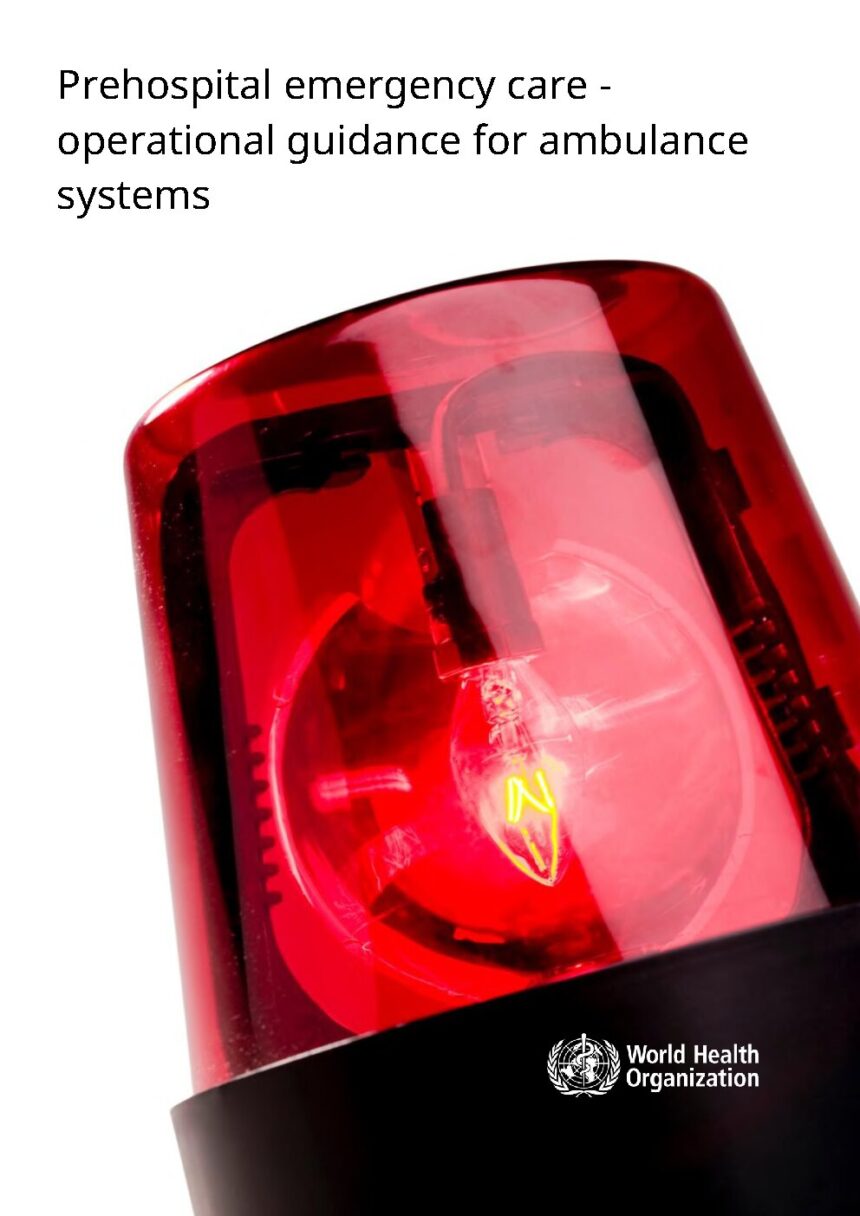
World Health Organization · 1st edition, 2025 · 199 pages
Comprehensive operational standards, protocols and clinical algorithms for developing and strengthening ambulance-based emergency medical services.
- Issuer
- World Health Organization
- Edition
- 1st edition, 2025
- Audience
- Ambulance service managers, medical coordinators, prehospital health workers, national and subnational planners responsible for organizing prehospital emergency care systems
- Evidence
- Expert consensus with operational best practices; clinical algorithms based on WHO guidance
- Reviewed
- 15 Oct 2026 · GMJ
What this guideline says
GMJ summary
This 199-page operational guidance establishes comprehensive standards for ambulance systems, covering system regulation, operations, communications, and clinical protocols. It provides adaptable frameworks for emergency care system (ECS) regulatory authorities to develop context-appropriate standards for ambulance provider certification, quality improvement, medical control, dispatch operations, and special situations including mass casualty incidents.
The document presents detailed operational resources including standardized clinical documentation forms, equipment and medication lists for basic and advanced ambulances, destination policies, infection prevention protocols, and scene safety procedures. It includes 21 clinical algorithms for conditions ranging from difficulty breathing and shock to trauma, burns, obstetric emergencies, and snakebite.
The guidance emphasizes that ambulances must have at least two personnel including one certified prehospital provider (PP), adherence to standard precautions, systematic quality improvement with specific performance targets (e.g., average response time <15 minutes for severe road crash injuries, scene time <20 minutes), and coordination through emergency communication and dispatch centres operating 24/7 with prioritized call handling.
Key points
For clinicians — doses and thresholds as stated in the guideline
- All ambulances must be staffed by at least two personnel: one certified basic or advanced prehospital provider (BPP or APP) remaining in the patient compartment during transport, and a licensed driver trained at minimum in first aid
- Emergency communication and dispatch centres must be available 24 hours/day, categorize calls into at least 'highest priority' and 'other', and provide pre-arrival instructions to callers
- Suggested quality improvement targets include: average response time <15 minutes for severe road crash injuries, average scene time <20 minutes, average ambulance recovery interval <30 minutes, and ambulance uptime >90%
- Basic prehospital providers must be trained in basic life support, neonatal resuscitation, oral rehydration, vital signs measurement, external haemorrhage control, splinting, and management of emergency labour and delivery
- Advanced prehospital providers (in addition to basic scope) may perform endotracheal intubation, surgical airway, IV fluid resuscitation, needle decompression for tension pneumothorax, and interpret 12-lead ECG
- Medical control officers must be available 365 days/year, 24/7 to provide real-time advice to prehospital personnel; only MCOs can authorize deviation from clinical protocols
- Receiving facilities must be notified at least 5 minutes before ambulance arrival with standardized pre-arrival report including patient demographics, vital signs, interventions, and estimated arrival time
- Mass casualty incidents are defined as events resulting in more patients than can be managed by locally available resources with routine procedures (generally four or more victims); standardized triage and incident command systems must be established
Suggested targets for prehospital quality improvement
Table extracted from the guideline
| Target name | Target definition | Proposed target |
|---|---|---|
| Ambulance uptime | Percentage of ambulances on-road (functional) at given point of time | >90% |
| Average ambulance recovery interval | Arrival of ambulance at receiving facility to return of ambulance to service/available for dispatch | average <30 minutes |
| Time to first provider in severe injury from road crash | From initiation of first call to emergency communication and dispatch centre to arrival of first prehospital provider on scene | average <15 minutes |
| Scene time interval | Total length of time from arrival at scene to departure from scene | average <20 minutes |
| Percentage of calls with delayed response | Inability to answer call within 30 seconds of first ring | 0% |
| Activation interval time | Initiation of response to call (answering the phone) to dispatch of ambulance | average <180 seconds |
| Percent of adult patients with respiratory rate <8 that receive breathing intervention | Breathing interventions include airway manoeuvre, oxygen administration, bag valve mask ventilation, beta-agonist | >80% |
| Percent of adult patients with shock given IV fluids | IV fluids started in the field (where permitted within scope of practice) | >80% |
| Percentage of patients with severe pain who received analgesia | Patients reporting severe pain who receive pharmaceutical analgesia | >80% |
Source: World Health Organization, Prehospital emergency care – operational guidance for ambulance systems. Reproduced in summary form.
From the guideline
Verbatim
“All ambulances must be staffed by at least two personnel. Each ambulance should have at least one BPP or APP who is trained and currently certified, who remains in the patient compartment to provide clinical monitoring and management during transport.”
Editor’s perspective
Why this matters for Georgia and the region
Prof. Giorgi Pkhakadze, MD, MPH, PhD
Editor-in-Chief, Georgian Medical Journal · Chair, Public Health Institute of Georgia · WHO consultant, health and migration
As someone who has worked on health system strengthening across the South Caucasus, I view this WHO operational guidance as essential infrastructure for building functional emergency medical services in our region. The most critical recommendation for Georgian and regional policymakers is the establishment of quality improvement systems with measurable targets—average response time under 15 minutes for severe injuries and scene time under 20 minutes—because without systematic monitoring we cannot identify where our prehospital systems are failing patients. The detailed scope-of-practice definitions for basic and advanced providers will help Georgian medical educators align our training programmes with international standards while adapting to local resource constraints. One realistic implementation challenge is that many former Soviet health systems, including Georgia's, historically relied on physician-staffed ambulances rather than the tiered basic/advanced provider model described here; transitioning to this more sustainable model will require careful workforce planning, regulatory reform, and stakeholder engagement to ensure that expanded scope of practice for non-physician providers is legally protected and professionally accepted.
ORCID 0000-0001-7609-4515 · Perspective written for the GMJ Guidelines Library, 15 Oct 2026
Applicability
Georgia and the South Caucasus
This guidance is highly relevant for Georgia and the South Caucasus region where prehospital emergency medical services are at varying stages of development. Implementation requires establishing or strengthening an ECS regulatory authority with authority to certify providers, accredit training centres, and enforce standards. Countries in the region will need to adapt the scope of practice definitions, medication lists, and equipment standards to local regulations and resource availability. The emphasis on quality improvement metrics, standardized documentation, and medical control systems addresses gaps commonly seen in transitioning health systems. National programmes should prioritize establishing universal access numbers (if not already in place), training sufficient numbers of basic and advanced providers according to standardized curricula (such as WHO’s Basic Ambulance Provider course), and developing robust communication infrastructure linking dispatch centres, ambulances, and receiving facilities. The guidance on mass casualty preparedness and special event planning is particularly relevant given the region’s exposure to natural hazards and mass gatherings.
Questions this guideline answers
Quick answers
What is the minimum staffing requirement for an ambulance?
Every ambulance must have at least two personnel: one who is certified as a basic or advanced prehospital provider (BPP or APP) who remains in the patient compartment to provide clinical monitoring and management during transport, and a licensed driver trained in operating emergency vehicles who must be, at minimum, trained in first aid. If there is only one trained PP, the driver must assist prehospital personnel on the scene when not driving.
What is the difference between basic and advanced prehospital providers?
Basic prehospital providers (BPPs) can perform basic life support including vital signs measurement, basic airway repositioning, CPR, external bleeding control, splinting, neonatal resuscitation, oral rehydration, and emergency delivery management. Advanced prehospital providers (APPs) can perform all basic functions plus advanced procedures including endotracheal intubation, surgical airway, IV/IO fluid resuscitation, needle decompression for tension pneumothorax, nasogastric tube placement, 12-lead ECG interpretation, and point-of-care ultrasound.
When should an ambulance bypass the closest hospital?
Certain patients should be taken to facilities with specific capabilities rather than the closest hospital based on condition-specific destination guidelines (e.g., severe trauma requiring trauma centre, conditions requiring neurosurgery or intensive care). Bypass may also occur based on family/physician preference if the patient has complicated chronic illness with records at a particular facility, or if the intended receiving facility is on ambulance diversion status. Patients whose condition is so unstable they will probably not survive transport to a more appropriate distant hospital should be taken to the closest hospital for intervention before transfer. When uncertain, providers should contact medical control for advice.
What are the requirements for emergency communication and dispatch centres?
Dispatch centres must be available 24 hours/day, 7 days/week; be designated by the ECS regulatory authority; employ trained and certified dispatchers; verify incident locations; provide pre-arrival instructions; document all calls; categorize calls into at least 'highest priority' and 'other' with priority response to high-acuity calls; maintain communication with responding units and hospitals; have electronic call recording for documentation and quality improvement; test communication systems daily; and answer calls within 30 seconds (target: 0% delayed response rate). The average time from call initiation to ambulance dispatch should be <180 seconds.
Related on GMJ
Interconnected resources
Dictionary of Public Health
Drugs A–Z
GMJ News coverage
- Palestinian Paediatrician's Health Deteriorates in Israeli Detention After 18 Months Without ChargeSep 2026
- Five-year survival gap persists after septic shock discharge, study findsAug 2026
- Skin Biopsy PCR Test Accelerates Diagnosis of Tattoo-Associated Toxic Shock SyndromeJul 2026
- A 68-Year-Old Man With Chest Pain: Diagnosing Descending Thoracic Aortic AneurysmOct 2026
Quality & accreditation
- ASF Hospital — Standard 5 — Safety & Emergency Preparedness
- ASF Hospital — Standard 11 — Critical Care
- ASF Medical Transport — Standard 6 — Emergency Response During Transport
- ASF Hospital — Standard 20 — Supporting the Care Workforce
- ASF Laboratory — Standard 3 — Personnel & Competence
- ASF Hospital — Standard 7 — Governance & Management
- ASF Hospital — Standard 4 — Care & Treatment
Other guidelines on this topic
- Key criteria for the ethical acceptability of controlled human infection studies during public health emergencies
- Kangaroo mother care: a clinical practice guide
- National Health Simulation Exercise Programme: implementation guidance to strengthen emergency preparedness, readiness and response
- Guidance on evidence generation on new regimens for tuberculosis preventive treatment
- Validation of elimination of soil-transmitted helminthiases as a public health problem in children: criteria and procedure
- Issuer
- World Health Organization
- Type
- Guidance (normative)
- Edition
- 1st edition, 2025
- Status
- Current
- Published
- 2025-09-17
- Languages
- English
- Scope
- Global
- Audience
- Ambulance service managers, medical coordinators, prehospital health workers, national and subnational planners responsible for organizing prehospital emergency care systems
- Pages
- 199
- Licence
- CC BY-NC-SA 3.0 IGO
- ISBN
- 978-92-4-011406-7
- Evidence
- Expert consensus with operational best practices; clinical algorithms based on WHO guidance
- Record history
- Created 15 Oct 2026 · updated 15 Oct 2026 · next check Apr 2027
World Health Organization. Prehospital emergency care - operational guidance for ambulance systems. Geneva: World Health Organization; 2025. Licence: CC BY-NC-SA 3.0 IGO.GMJ Guidelines Library records are original summaries written by the GMJ editorial team from the issuer’s published document and reviewed by a physician. They do not replace the full guideline. The document is the copyright of its issuer and is linked, not hosted. Spotted an error or a newer edition? Tell the Guidelines Desk.
Was this article helpful?