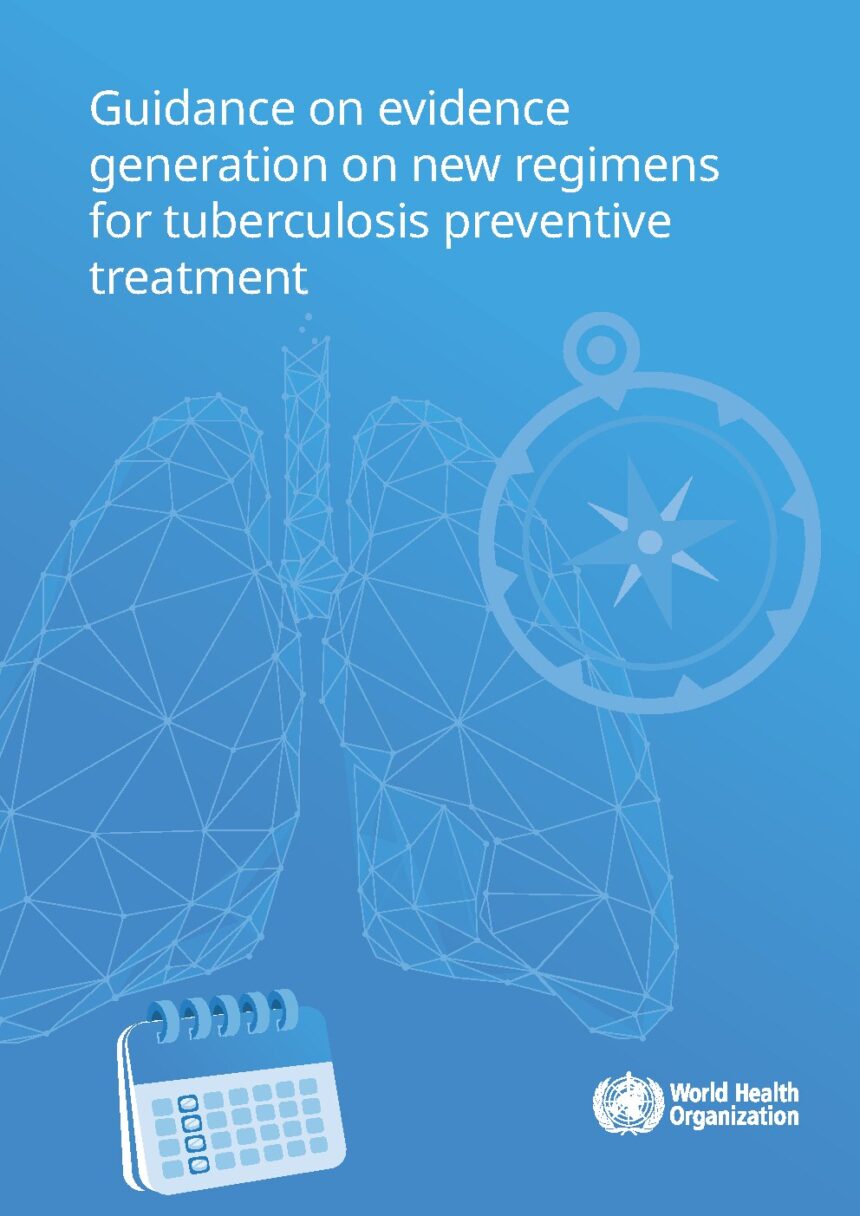
World Health Organization · 1st edition, 2025 · 136 pages
Methodological guidance for designing clinical trials of TB preventive treatment to inform WHO guideline development and policy recommendations.
- Issuer
- World Health Organization
- Edition
- 1st edition, 2025
- Audience
- Research community generating evidence on TPT: funding agencies, academic researchers (trialists, health economists, qualitative researchers), drug developers, consumer groups, biostatisticians; also informative for prospective guideline development group members.
- Evidence
- Methodological guidance based on GRADE framework for guideline development; informed by systematic review of 46 recent Phase 3 and 4 TPT trials (Annex 7) and expert consensus from Scientific GEG Development Group.
- Reviewed
- 15 Oct 2026 · GMJ
What this guideline says
GMJ summary
This WHO guidance document provides detailed recommendations for researchers, funders, and developers on how to design, conduct, and report clinical trials and studies of tuberculosis preventive treatment (TPT) regimens. It aims to ensure that evidence generated meets the requirements of the WHO guideline development process using the GRADE framework, thereby facilitating strong, evidence-based recommendations that can be rapidly adopted by national TB programmes.
The document outlines 22 key messages covering trial design, population selection, intervention specification, outcome reporting, data analysis, and additional evidence needs beyond efficacy and safety—including values, cost-effectiveness, equity, acceptability, and feasibility. It emphasizes inclusive trial populations, harmonized outcome measures (particularly for safety and tolerability), sufficient sample sizes to achieve precise estimates, and the importance of sharing individual participant data. The guidance complements WHO’s target product profiles for TPT and serves as a companion to the 2024 guidance on TB treatment regimens.
By aligning research design with WHO’s evidence-to-decision criteria, this guidance seeks to overcome common limitations that have resulted in conditional rather than strong recommendations, such as low certainty of evidence due to imprecision, incomplete or inconsistent data reporting, and lack of information on implementation factors critical to policy uptake in high-burden countries.
Key points
For clinicians — doses and thresholds as stated in the guideline
- Consider the WHO 12 evidence-to-decision criteria during trial design to maximize policy impact and strength of future recommendations.
- Use inclusive selection criteria to enrol populations reflecting demographic, geographical, and epidemiological diversity, including children, pregnant women, older people, and those with comorbidities (e.g., HIV, diabetes, silicosis).
- Include an appropriate comparator arm receiving standard-of-care TPT consistent with WHO recommendations; random allocation increases certainty of evidence.
- Report efficacy outcomes as survival without incident TB after adequate follow-up (typically 24 months from TPT initiation or 12 months post-completion of longest regimen); use harmonized definitions for pulmonary, extrapulmonary, and paediatric TB.
- Report safety outcomes comprehensively: proportions experiencing adverse events (AEs) of Grade ≥3, AEs of special interest, and AEs of Grade 1–2, using recognized instruments (e.g., CTCAE, CIOMS, or DAIDS grading) and covering follow-up equal to longest regimen duration plus washout period.
- Characterize tolerability by reporting treatment interruption, discontinuation of regimen or individual drugs, and all Grade 1–2 AEs; consider validated patient-reported outcome measures.
- Ensure sufficient sample size to achieve precise estimates (narrow confidence intervals) for all critical outcomes, not only the primary endpoint, to avoid downgrading certainty of evidence for imprecision.
- Share de-identified individual participant data via public repositories (e.g., WHO global IPD platform for TB treatment) to enable meta-analyses and further research.
- Conduct substudies on values (relative importance of outcomes to patients), resources required, cost-effectiveness, equity, acceptability, and feasibility; qualitative research can inform several evidence-to-decision criteria, especially when quantitative data are lacking.
Differences and similarities in scope and approach between WHO recommendations for and regulatory approval of TPT medicines and regimens
Table extracted from the guideline
| Aspect | WHO recommendation | Regulatory approval |
|---|---|---|
| Prerequisite | Regulatory approval by ≥1 SRA or WLA; consideration of whether drugs used to treat or prevent TB | Submission of dossier, common technical documents, manufacturing/quality processes, nonclinical and clinical data per national/regional legislation |
| Goal | Guidance on whether to use and which regimen to prioritize, considering balance of benefits/harms plus cost, equity, feasibility; focus on population-level impact on TB incidence | Ensure product meets standards of quality, safety, efficacy; positive benefit–risk evaluation prerequisite for approval; focus on individual drug contribution to regimen |
| Meaning of decision | Regimen recommended, suggested, or recommended against; enables Global Fund grants, GDF procurement, EML inclusion upon WHO recommendation | Marketing authorization; product can be commercially available; safety concerns may lead to withdrawal |
| Remit | Global (national adaptation may be needed) | National or regional (some authorities follow SRA/WLA; WHO PQ has global remit) |
| Main decision criteria | 12 EtD criteria: certainty of evidence, values, desirable/undesirable effects, balance of effects, resources/cost-effectiveness, equity, acceptability, feasibility | Preclinical pharmacology/toxicology, dose selection, clinical safety/efficacy, manufacturing quality, compliance with standards |
| Evidence base | Systematic review or IPD meta-analysis of all available trials/studies | Typically 1–2 pivotal Phase 3 RCTs plus early-phase and preclinical data |
| Approach to analysis | Summary of all evidence, standard and IPD meta-analysis; interpretation of effect sizes and CIs of all critical outcomes considering values and certainty; meeting P<0.05 or noninferiority margin not by itself decisive | IPD analysis per predefined statistical plan; testing limited set of protocol-defined hypotheses (superiority/noninferiority) against agreed significance levels central to decision |
| Post-decision considerations | Identify research gaps, operational assistance, monitor global uptake, resource requirements; guidelines evolve with reassessment against novel comparators; presentation changes not subject to guideline process | Additional research may be condition of approval, postmarketing pharmacovigilance, population-specific studies; implementation not regulator's remit; no formal reassessment vs. novel comparators; presentation/dosing changes often require new approval |
Source: World Health Organization, Guidance on evidence generation on new regimens for tuberculosis preventive treatment. Reproduced in summary form.
What changed in this edition
Versus the previous edition
- First edition of this guidance document on evidence generation for tuberculosis preventive treatment; modelled on the WHO Guidance on evidence generation on new regimens for tuberculosis treatment released in 2024.
From the guideline
Verbatim
“The evidence available to WHO for development of guidelines on drugs and regimens often presents challenges that limit the strength of recommendations.”
Editor’s perspective
Why this matters for Georgia and the region
Prof. Giorgi Pkhakadze, MD, MPH, PhD
Editor-in-Chief, Georgian Medical Journal · Chair, Public Health Institute of Georgia · WHO consultant, health and migration
As Editor-in-Chief of the Georgian Medical Journal and WHO consultant, I welcome this rigorous guidance because it addresses a critical gap: even when effective TPT regimens exist, weak evidence design has resulted in conditional WHO recommendations that slow national uptake. For Georgian and regional TB programmes collaborating with international research networks, I would stress the importance of Key Message #2—inclusive selection criteria. Trials must enrol populations that mirror our reality: high diabetes prevalence, silicosis in miners, and TB/HIV co-infection in key populations. One realistic caveat for implementation in Georgia is the need for health economic data that reflect our middle-income context and Universal Health Care programme costs, not only those of low-income or high-income settings, to persuade national decision-makers of cost-effectiveness and budget impact when prioritising competing health interventions.
ORCID 0000-0001-7609-4515 · Perspective written for the GMJ Guidelines Library, 15 Oct 2026
Applicability
Georgia and the South Caucasus
Georgia and countries in the South Caucasus and Eastern Europe face moderate TB burdens with pockets of multidrug-resistant TB. National TB programmes in the region will benefit from this guidance when planning or reviewing trials of novel TPT regimens, particularly for high-risk groups such as household contacts of MDR-TB cases, people living with HIV, and vulnerable populations (migrants, displaced persons, prisoners). Programmes should assess whether trial populations reflect local epidemiology (e.g., diabetes prevalence, age distribution, silicosis in miners) and whether cost-effectiveness analyses account for regional health system costs and willingness-to-pay thresholds. Implementation feasibility—including drug procurement via the Global Fund or national budgets, laboratory capacity for TBI testing (TST, IGRA), and integration of TPT into primary care—will be critical for translating international trial evidence into national policy and practice.
Questions this guideline answers
Quick answers
Why is this guidance needed if WHO already has target product profiles for TPT?
The target product profiles describe the minimum and optimal characteristics desired for new TPT regimens (what to achieve), whereas this guidance provides detailed methodological advice on how to design, conduct, and report trials so that the evidence generated meets WHO's needs for guideline development using the GRADE framework. It bridges the gap between product development and policy-making.
What are the most common reasons that TPT trial evidence leads only to conditional rather than strong WHO recommendations?
The most frequent issue is imprecision—wide confidence intervals due to small sample sizes or few events—which lowers certainty of evidence. Other common limitations include lack of an appropriate comparator arm (leading to indirectness), exclusion of key populations (children, pregnant women, comorbid conditions), incomplete or inconsistent reporting of safety outcomes, and absence of data on implementation factors such as cost-effectiveness, acceptability, and feasibility in high-burden settings.
Does following this guidance replace regulatory requirements for clinical trials?
No. This guidance complements but does not replace national or international regulatory guidance (e.g., ICH-GCP, FDA, EMA). Regulatory agencies focus primarily on drug quality, safety, and efficacy for individual patients, whereas WHO guideline development additionally considers population-level impact, equity, cost-effectiveness, and feasibility of implementation in resource-limited settings. Researchers should engage both regulators and WHO early in trial planning.
How should trials measure and report tolerability of TPT regimens?
Tolerability—the degree to which adverse effects can be tolerated by patients—should be assessed by detailed reporting of treatment interruption and discontinuation (of the regimen or individual drugs), all Grade 1–2 adverse events, and, if available, validated patient-reported outcome measures. Qualitative substudies to capture patient experiences are valuable. In pragmatic trials, differences in tolerability will affect the effectiveness outcome through nonadherence, providing an additional way to assess tolerability differences between regimens.
Related on GMJ
Interconnected resources
Dictionary of Public Health
Drugs A–Z
GMJ News coverage
Quality & accreditation
Other guidelines on this topic
- Validation of elimination of soil-transmitted helminthiases as a public health problem in children: criteria and procedure
- Guidance for use of the Measuring Abortion Care Framework and Indicators
- Consolidated guidelines on tuberculosis: Module 4: Treatment and care
- Consolidated guidelines on tuberculosis. Module 3: Diagnosis
- Toolkit for adaptation of the WHO recommendations for a positive pregnancy and postnatal experience
- Issuer
- World Health Organization
- Type
- Guidance (normative)
- Edition
- 1st edition, 2025
- Status
- Current
- Published
- 2026-02-26
- Languages
- English
- Scope
- Guidance on planning, execution, and reporting of Phase 2, 3, and 4 clinical trials of tuberculosis preventive treatment regimens, including substudies, to inform WHO guideline development; does not cover screening for TB disease or testing for TB infection.
- Audience
- Research community generating evidence on TPT: funding agencies, academic researchers (trialists, health economists, qualitative researchers), drug developers, consumer groups, biostatisticians; also informative for prospective guideline development group members.
- Pages
- 136
- Licence
- CC BY-NC-SA 3.0 IGO
- ISBN
- 978-92-4-011718-1
- Evidence
- Methodological guidance based on GRADE framework for guideline development; informed by systematic review of 46 recent Phase 3 and 4 TPT trials (Annex 7) and expert consensus from Scientific GEG Development Group.
- Record history
- Created 15 Oct 2026 · updated 15 Oct 2026 · next check Apr 2027
Guidance on evidence generation on new regimens for tuberculosis preventive treatment. Geneva: World Health Organization; 2025. 136 p. Licence: CC BY-NC-SA 3.0 IGO.GMJ Guidelines Library records are original summaries written by the GMJ editorial team from the issuer’s published document and reviewed by a physician. They do not replace the full guideline. The document is the copyright of its issuer and is linked, not hosted. Spotted an error or a newer edition? Tell the Guidelines Desk.
Was this article helpful?