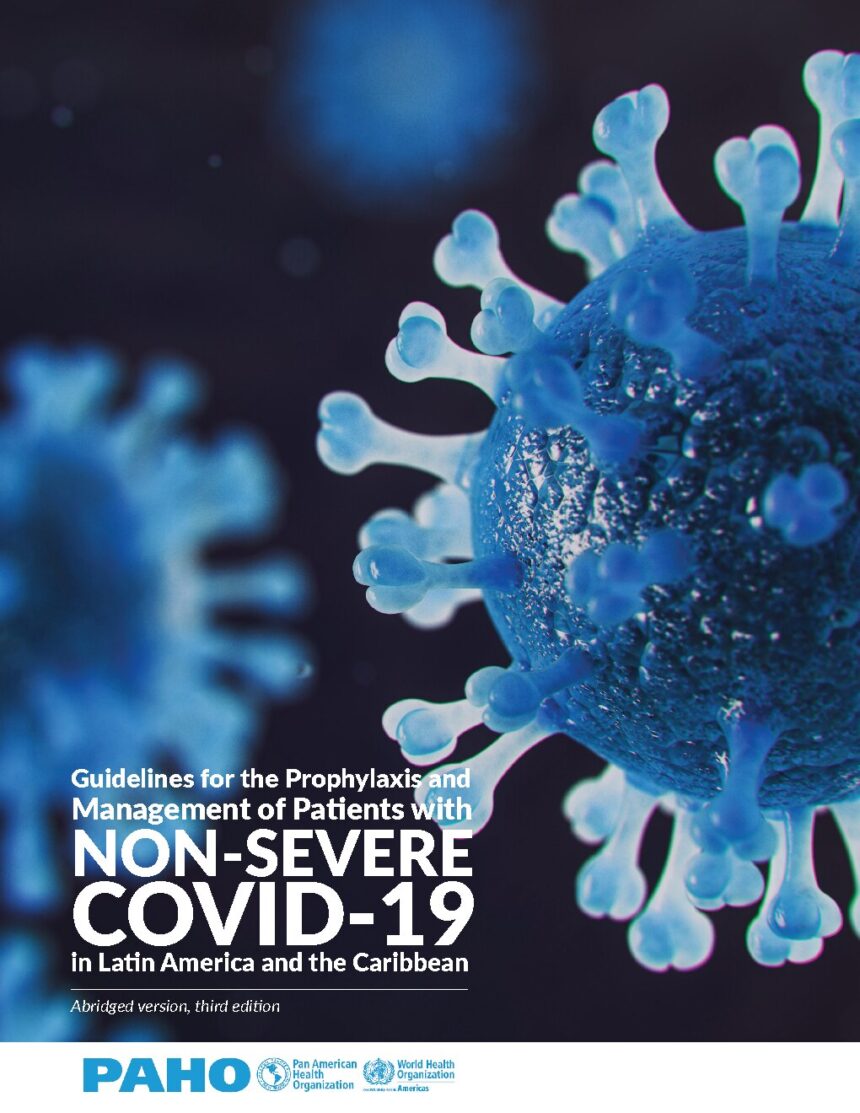
Pan American Health Organization · 3rd edition, 2023
Evidence-based recommendations for outpatient COVID-19 management, pharmacological treatments, and follow-up for clinicians in Latin America and the Caribbean.
- Issuer
- Pan American Health Organization
- Edition
- 3rd edition, 2023
- Audience
- Clinicians in emergency departments and primary care (general practitioners, emergency medicine, pulmonology, internal medicine, family medicine, infectious disease specialists, respiratory/physical therapists, nursing staff, pharmacists), decision-makers, government entities
- Evidence
- GRADE-rated recommendations based on systematic literature review with evidence profiles; living guideline methodology with continuous updating
- Reviewed
- 17 Oct 2026 · GMJ
What this guideline says
GMJ summary
This third-edition guideline provides GRADE-based recommendations for managing non-severe COVID-19 (defined as absence of oxygen saturation 30 breaths/minute, or signs of severe respiratory distress) in Latin America and the Caribbean. Developed by PAHO using rapid review methodology updated through November 2022, it addresses prophylaxis, risk stratification, diagnostic imaging, home care, pharmacological treatments, and discharge criteria.
The guideline strongly recommends against most proposed COVID-19 treatments including ivermectin, hydroxychloroquine, colchicine, fluvoxamine, convalescent plasma, antibiotics (without bacterial infection), and corticosteroids in non-severe disease. For patients at high risk of hospitalisation, conditional recommendations support nirmatrelvir-ritonavir, remdesivir, and molnupiravir (except in pregnancy). Monoclonal antibodies sotrovimab, casirivimab, and imdevimab are not recommended.
The guideline emphasises identifying risk factors for progression (age >60 years, comorbidities including hypertension, obesity, diabetes, cardiovascular disease, chronic lung/kidney/liver disease, cancer, immunodeficiency, lack of COVID-19 vaccination), home isolation with pulse oximetry monitoring for moderate cases, symptomatic treatment with paracetamol (maximum 4 g/day), adequate hydration, and individualised anticoagulation. Chest imaging is suggested conditionally for patients with risk factors showing signs of progression to guide referral decisions.
Key points
For clinicians — doses and thresholds as stated in the guideline
- Non-severe COVID-19 defined as oxygen saturation ≥90% on room air, respiratory rate ≤30 breaths/minute in adults, and absence of severe respiratory distress; severe disease threshold of SpO₂ <90% should be interpreted cautiously (SpO₂ 90–94% may indicate early deterioration)
- Strong recommendation against prophylactic medicines, ivermectin, hydroxychloroquine, colchicine, fluvoxamine, convalescent plasma, lopinavir-ritonavir, aspirin, tocilizumab, antibiotics (without bacterial infection), corticosteroids, vitamin C/D, zinc, and chlorine dioxide in non-severe disease
- Conditional recommendation for nirmatrelvir-ritonavir, remdesivir, or molnupiravir only in patients at high risk of hospitalisation (>60 years, ≥1 comorbidity, unvaccinated); strong recommendation against use in low-risk patients
- Risk factors for progression: age >60 years, >1 comorbidity (hypertension, obesity, diabetes, cardiovascular disease, chronic lung/kidney/liver disease, immunodeficiency, cancer), unvaccinated status; in children: asthma, neurodevelopmental disorders, prematurity
- Symptomatic treatment with paracetamol 500 mg every 6–8 hours (maximum 4 g/day) for fever or pain; adequate hydration and nutrition; no antibiotics unless bacterial co-infection suspected
- Home isolation recommended with pulse oximetry monitoring for moderate cases with risk factors; patients trained to seek care when SpO₂ decreases or respiratory distress develops, independent of SpO₂
- Chest imaging (X-ray, CT, or ultrasound) conditionally suggested for non-severe patients with risk factors and signs of progression to guide referral decisions; not routinely recommended at discharge
- Prophylactic anticoagulation (e.g. enoxaparin 40 mg daily) should be individualised based on medical history, thromboembolism risk factors, and institutional protocols; continue pre-existing oral anticoagulants
World Health Organization definitions of COVID-19 severity
Table extracted from the guideline
| Severity | Definition |
|---|---|
| Critical COVID-19 | Acute respiratory distress syndrome, sepsis, septic shock, or conditions requiring life-sustaining therapies (mechanical ventilation invasive/non-invasive or vasopressor therapy) |
| Severe COVID-19 | Oxygen saturation <90% on room air; OR respiratory rate >30 bpm (adults, children >5 years), ≥60 bpm (<2 months), ≥50 bpm (2–11 months), ≥40 bpm (1–5 years); OR signs of severe respiratory distress (accessory muscle use, inability to complete sentences, severe chest wall indrawing, grunting, central cyanosis, general danger signs) |
| Non-severe COVID-19 | Absence of any criteria for severe or critical COVID-19 |
| Mild disease | Symptomatic patients meeting COVID-19 case definition without viral pneumonia or hypoxia; no respiratory distress or dyspnea; normal diagnostic images |
| Moderate disease (pneumonia) | Clinical signs of pneumonia (fever, cough, dyspnea, rapid breathing) but no severe pneumonia; SpO₂ ≥90% on room air (≥94% at sea level in patients with normal baseline); rapid breathing: <2 months ≥60/min, 2–12 months ≥50/min, 1–5 years ≥40/min |
Source: Pan American Health Organization, Guidelines for the Prophylaxis and Management of Patients with Non-severe COVID-19 in Latin America and the Caribbean. Reproduced in summary form.
What changed in this edition
Versus the previous edition
- Third edition updated through November 2022 using living guideline methodology to reflect evolving evidence on pharmacological interventions
- Updated recommendations on nirmatrelvir-ritonavir, molnupiravir, and remdesivir based on new evidence for high-risk patients
- Strong recommendation against sotrovimab and casirivimab-imdevimab added based on reduced efficacy against circulating variants
- Reinforced recommendations against previously proposed treatments (ivermectin, hydroxychloroquine, colchicine, fluvoxamine) with accumulated evidence
From the guideline
Verbatim
“It is recommended not to administer colchicine, ivermectin, fluvoxamine, convalescent plasma, lopinavir + ritonavir, aspirin, chloroquine/hydroxychloroquine (with or without azithromycin), N-acetylcysteine, tocilizumab, or any other medication for the management of patients with non-severe COVID-19.”
Editor’s perspective
Why this matters for Georgia and the region
Prof. Giorgi Pkhakadze, MD, MPH, PhD
Editor-in-Chief, Georgian Medical Journal · Chair, Public Health Institute of Georgia · WHO consultant, health and migration
As Georgia continues managing COVID-19 within its Universal Health Care programme and robust primary care network, this PAHO guideline offers critical evidence to combat therapeutic nihilism and treatment overuse. The strong recommendations against ivermectin, hydroxychloroquine, and broad-spectrum antibiotics directly address prescribing patterns still observed in some Georgian clinics, where patient demand and commercial pressures can drive inappropriate use. I would stress to Georgian family physicians the conditional recommendations on nirmatrelvir-ritonavir and molnupiravir for genuinely high-risk patients—those over 60 with comorbidities or unvaccinated—while avoiding their use in low-risk groups where cost cannot be justified. The practical caveat for Georgia is ensuring pulse oximeters reach rural mountain communities where altitude affects oxygen saturation interpretation, and that telehealth infrastructure supports the recommended remote monitoring, which remains patchy outside Tbilisi despite recent digital health investments.
ORCID 0000-0001-7609-4515 · Perspective written for the GMJ Guidelines Library, 17 Oct 2026
Applicability
Georgia and the South Caucasus
These recommendations are directly applicable to Georgia and the South Caucasus region, where outpatient COVID-19 management remains relevant despite high prior infection rates. Implementation considerations include: (1) availability and cost of conditional-use antivirals (nirmatrelvir-ritonavir, molnupiravir, remdesivir) in national essential medicines lists and insurance coverage under Georgia’s Universal Health Care programme; (2) capacity of primary care facilities to risk-stratify patients using defined criteria and provide pulse oximetry for home monitoring; (3) altitude adjustments for oxygen saturation thresholds in mountainous areas of Georgia, Armenia, and Azerbaijan; (4) training family medicine practitioners to avoid inappropriate antibiotics, corticosteroids, and unproven treatments still promoted in some settings; and (5) adapting telehealth monitoring protocols to rural and remote areas with limited internet connectivity. National programmes should develop clear referral pathways from primary care to hospital services based on the defined severity criteria and ensure consistent messaging against ineffective treatments to preserve antimicrobial stewardship and reduce healthcare costs.
Questions this guideline answers
Quick answers
Which antiviral treatments are recommended for outpatients with COVID-19?
Nirmatrelvir-ritonavir (conditional recommendation), remdesivir (conditional), or molnupiravir (conditional, except in pregnant/lactating women and children) are suggested only for patients with non-severe COVID-19 at high risk of hospitalisation (age >60 years, ≥1 comorbidity, unvaccinated). They are strongly recommended against in low-risk patients. All other proposed treatments including ivermectin, hydroxychloroquine, colchicine, and fluvoxamine are strongly recommended against.
What oxygen saturation level defines severe COVID-19 requiring referral?
SpO₂ <90% on room air is the threshold, but the guideline cautions this is arbitrary. SpO₂ 90–94% is abnormal in patients with healthy lungs and may indicate early severe disease if trending downward. Clinicians should use judgement considering patient baseline (chronic lung disease) and trajectory. If in doubt, consider the illness as severe. Respiratory rate >30 breaths/minute or signs of severe respiratory distress also define severe disease.
Should antibiotics or corticosteroids be given to outpatients with COVID-19?
No. Strong recommendation against antibiotics unless there is suspected over-aggregated bacterial infection based on diagnostic confirmation and clinical criteria. Strong recommendation against corticosteroids for non-severe COVID-19 management. Treatment should focus on paracetamol 500 mg every 6–8 hours (maximum 4 g/day) for fever/pain, adequate hydration and nutrition.
How should patients with COVID-19 be monitored at home?
Symptomatic patients with moderate COVID-19 and risk factors for progression should use pulse oximeters at home after training in proper use. They should seek medical assistance when SpO₂ decreases (according to altitude) or when respiratory distress develops independent of SpO₂. Monitoring can be remote via telehealth or through home visits depending on availability. Warning signs include increased breathing difficulty, blood pressure drop, blue lips/face, confusion, persistent chest pain, or SpO₂ <90%.
Related on GMJ
Interconnected resources
Dictionary of Public Health
Drugs A–Z
Conditions A–Z
GMJ News coverage
- UK flu and COVID-19 surveillance data to May 2027 shows continued monitoring amid seasonal trendsOct 2026
- Community Health Workers Boost COVID-19 Testing Among Formerly Incarcerated PeopleAug 2026
- Cambridge researchers identify three distinct severe pneumonia subtypes, opening path to personalised treatmentSep 2026
- Machine Learning Model Predicts Child Pneumonia Hospitalisation Risk in Malawi Primary CareJun 2026
Quality & accreditation
- ASF Hospital — Standard 5 — Safety & Emergency Preparedness
- ASF Hospital — Standard 11 — Critical Care
- ASF Medical Transport — Standard 6 — Emergency Response During Transport
- ASF PHC — Standard 4 — Acute & Same-Day Care · Primary Health Clinic
- ASF PHC — Standard 7 — Governance & Staffing · Primary Health Clinic
Other guidelines on this topic
- Living Systematic Review of Therapeutic Options for Post COVID-19 Condition, 11 January 2023
- Integrated approach to management of skin-related neglected tropical diseases and common skin conditions
- Prevention and management of heat-related illness at mass gatherings: risk assessment tool
- Framework of a national program for preventing and controlling diseases caused by respiratory viruses with epidemic and pandemic potential
- Recommendations for the Management of Major Obstetric Emergencies
- Issuer
- Pan American Health Organization
- Type
- Procedures, manuals, guidelines
- Edition
- 3rd edition, 2023
- Replaces
- Guidelines for the Prophylaxis and Management of Patients with Non-severe COVID-19 in Latin America and the Caribbean, 2nd edition
- Status
- Current
- Published
- 2023-01-01
- Languages
- English (Spanish version available)
- Scope
- Prophylaxis, risk stratification, screening, home care, diagnostic imaging, pharmacological treatments, supplements, prophylactic anticoagulation, monitoring, and discharge for non-severe COVID-19 in Latin America and the Caribbean
- Audience
- Clinicians in emergency departments and primary care (general practitioners, emergency medicine, pulmonology, internal medicine, family medicine, infectious disease specialists, respiratory/physical therapists, nursing staff, pharmacists), decision-makers, government entities
- Licence
- CC BY-NC-SA 3.0 IGO
- Evidence
- GRADE-rated recommendations based on systematic literature review with evidence profiles; living guideline methodology with continuous updating
- Next review
- Continuous (living guideline updated regularly as new evidence emerges)
- Record history
- Created 17 Oct 2026 · updated 17 Oct 2026 · next check Apr 2027
Pan American Health Organization. Guidelines for the Prophylaxis and Management of Patients with Non-severe COVID-19 in Latin America and the Caribbean. Abridged version, third edition. Washington, D.C.: PAHO; 2023. (PAHO/IMS/EIH/COVID-19/22-0036).GMJ Guidelines Library records are original summaries written by the GMJ editorial team from the issuer’s published document and reviewed by a physician. They do not replace the full guideline. The document is the copyright of its issuer and is linked, not hosted. Spotted an error or a newer edition? Tell the Guidelines Desk.
Was this article helpful?