Pan American Health Organization · 1st edition, 2022
Step-by-step operational manual for district and community supervisors to plan, implement and monitor mass drug administration for NTD control.
- Issuer
- Pan American Health Organization
- Edition
- 1st edition, 2022
- Audience
- First-level supervisors (supervisory area), district/implementation unit NTD focal points, national NTD programme managers, community drug distributors, community leaders, teachers, health communicators
- Evidence
- Expert consensus based on WHO/PAHO technical guidance and country field experience (Guyana, Haiti, Rwanda, Honduras, Paraguay, Tanzania)
- Reviewed
- 18 Oct 2026 · GMJ
What this guideline says
GMJ summary
This manual provides a structured, bottom-up approach to operational planning (microplanning) for preventive chemotherapy against neglected tropical diseases. It guides first-level supervisors in supervisory areas (SAs) and implementation units (IUs) through six core steps: mapping coverage areas, estimating target populations, selecting distribution channels (schools, fixed points, households), planning activities and community engagement, calculating resources, and monitoring coverage to take corrective action.
Preventive chemotherapy involves regular administration of safe medicines to at-risk populations regardless of infection status, targeting lymphatic filariasis, onchocerciasis, schistosomiasis, soil-transmitted helminthiases, trachoma, foodborne trematodiases, taeniasis, scabies and yaws. Minimum coverage thresholds range from 65% to 90% depending on disease. The manual emphasizes achieving these thresholds by identifying hard-to-reach populations (nomadic groups, migrants, slum dwellers, geographically isolated communities), validating denominators, and using data during campaigns to trigger mop-up activities where coverage is inadequate.
Originally developed for vaccination campaigns, microplanning has proven effective for NTD programmes by empowering local knowledge, defining context-specific approaches, and enabling efficient management of human and financial resources at the point of service. The manual includes practical tools (18 standardized forms) for mapping, population estimation, distribution planning, resource calculation, supervision checklists, and coverage monitoring at both SA and IU levels.
Key points
For clinicians — doses and thresholds as stated in the guideline
- Preventive chemotherapy requires minimum threshold coverage of 65–90% depending on disease: lymphatic filariasis 65%, onchocerciasis and trachoma 85%, schistosomiasis and soil-transmitted helminthiases 75%, yaws 90%.
- Microplanning starts 6 months before mass drug administration (MDA): national/subnational training at month 6, SA team training at month 4, completed SA microplans at month 3 before MDA begins.
- First-level supervisors map all supervisory areas to ensure 100% geographical coverage with no gaps or overlaps, marking boundaries, communities, infrastructure, landmarks, and locations of hard-to-reach populations.
- Three distribution channels can be combined: school-based (cost-effective for children), fixed points (markets, health facilities, bus stations for accessible sites), and house-to-house (resource-intensive but reaches missed populations).
- Hard-to-reach populations requiring special strategies include nomadic pastoralists, seasonal migrants, slum dwellers, high-rise residents, persons with disabilities, geographically isolated communities, and populations in conflict/insecurity.
- Daily monitoring during MDA compares treated persons against targets; supervisors conduct mop-up in areas where coverage is inadequate, adjusting from fixed-point to house-to-house distribution as needed.
- Community drug distributors (CDDs) work in pairs (one provides drug, one records) covering 30–50 households/day or 100 people/day in difficult terrain, 50–80 households or 200 people/day in accessible areas.
- Administrative coverage = (number who consumed medicines / total target population) × 100; validate using Supervisor's Coverage Tool to identify low-coverage areas requiring mop-up before campaign ends.
Recommended medicines, frequency and minimum threshold coverage of preventive chemotherapy for neglected tropical diseases
Table extracted from the guideline
| Disease | Medicine and combinations | Frequency | Minimum threshold coverage | Target population |
|---|---|---|---|---|
| Lymphatic filariasis | DEC + albendazole + ivermectin (non-oncho endemic) OR DEC + albendazole OR ivermectin + albendazole OR albendazole alone | Once/year; twice/year in Loa loa endemic areas | 65% | Entire population at risk |
| Onchocerciasis | Ivermectin | Once/year | 85% | Entire population at risk |
| Schistosomiasis | Praziquantel | Once or twice/year depending on prevalence | 75% | PreSAC, SAC, WRA, adults at risk |
| Soil-transmitted helminthiases | Albendazole or mebendazole | Once or twice/year depending on prevalence | 75% | PreSAC, SAC, WRA |
| Trachoma | Azithromycin + tetracycline eye ointment | Once/year | 80% | Entire population at risk |
| Fascioliasis | Triclabendazole | Once/year | 75% | Entire population at risk |
| Taeniasis/cysticercosis | Niclosamide, praziquantel or albendazole | Once or twice/year depending on prevalence | 75% | Entire population at risk |
| Scabies | Ivermectin OR topical scabicides | Once/year | — | Entire community at risk |
| Yaws | Azithromycin | Single dose | 90% | Entire community at risk |
Source: Pan American Health Organization, Microplanning manual to guide implementation of preventive chemotherapy to control and eliminate neglected tropical diseases. Reproduced in summary form.
From the guideline
Verbatim
“To achieve the expected impact of preventive chemotherapy, medicines should be administered to populations who are eligible to receive the intervention.”
Editor’s perspective
Why this matters for Georgia and the region
Prof. Giorgi Pkhakadze, MD, MPH, PhD
Editor-in-Chief, Georgian Medical Journal · Chair, Public Health Institute of Georgia · WHO consultant, health and migration
As someone who has supported Georgia's national disease control programmes through public health system strengthening, I recognize that this microplanning manual addresses a critical gap we face even in programmes beyond classic neglected tropical diseases. Georgia's periodic deworming campaigns for preschool and school-aged children, conducted through primary care and school health platforms, would benefit immediately from this structured approach—particularly the emphasis on validating denominators (our administrative coverage sometimes exceeds 100% in certain municipalities, indicating denominator problems), systematically identifying hard-to-reach groups (internally displaced persons, rural mountain villages with seasonal access, Roma settlements), and using daily data during campaigns to trigger mop-up rather than waiting for post-campaign evaluation. The manual's insistence that microplanning is a process, not just a document—requiring engagement of community leaders, teachers, and local health workers who have the tacit knowledge of where people actually live and work—resonates with lessons from our hepatitis C elimination programme, where community engagement proved essential to reaching key populations. One implementation reality for Georgia: the resource requirements (CDD training, supervision visits, daily data review, mop-up within the campaign period) demand a level of decentralized capacity and operational funding that our municipalities vary widely in possessing, so phased implementation prioritizing areas with known coverage challenges would be more realistic than attempting nationwide adoption simultaneously.
ORCID 0000-0001-7609-4515 · Perspective written for the GMJ Guidelines Library, 18 Oct 2026
Applicability
Georgia and the South Caucasus
Georgia has no endemic onchocerciasis, lymphatic filariasis, schistosomiasis or trachoma, but soil-transmitted helminthiases (ascariasis, trichuriasis, hookworm) persist in rural areas and among vulnerable populations. The manual’s bottom-up microplanning approach is directly applicable to deworming programmes targeting preschool and school-aged children, which Georgia implements through primary health care and school health services. The emphasis on identifying hard-to-reach populations—migrants, internally displaced persons from Abkhazia and South Ossetia, rural mountain communities, and Roma settlements—aligns with Georgia’s equity challenges. National programmes would need to adapt the supervisory area definitions to Georgia’s administrative structure (regions, municipalities, communities) and integrate microplanning with existing immunization and school health platforms that already conduct periodic mass campaigns.
Questions this guideline answers
Quick answers
What is microplanning and why is it needed for mass drug administration?
Microplanning is a bottom-up operational planning process originating at the lowest service delivery level (supervisory area). It defines activities, resources, timing and locations for delivering preventive chemotherapy, empowers local knowledge and problem-solving, defines approaches based on local demographic and epidemiological characteristics, and facilitates better management of human and financial resources at the point of service. Without microplanning, programmes risk missing hard-to-reach populations, wasting resources, and failing to achieve the 65–90% coverage thresholds needed for disease control and elimination.
How do I estimate the target population when census data are outdated or unavailable?
Start with the most recent census and adjust using population growth rates from the census bureau, accounting for large-scale population movements (new economic activity, natural disasters, conflict). If the health ministry determines census data should not be used, triangulate with reliable records from immunization campaigns or other public health programmes covering the same population, satellite-generated population estimates (GRID3, WorldPop, Facebook Data for Good), or conduct your own physical count of people. Compare estimates from multiple sources; similarity builds confidence in the dataset. Always validate SA-level estimates by reviewing previous MDA coverage—if reported coverage exceeds 100%, the denominator is likely underestimated.
When should I use house-to-house distribution versus fixed points or schools?
Schools are cost-effective for reaching school-aged children where enrolment is high. Fixed points work for accessible populations in high-traffic locations (markets, health facilities, bus stations) but coverage decreases if people must travel long distances. House-to-house requires more resources (more CDDs, longer duration) but is essential for reaching populations missed by other channels: geographically isolated communities, persons with limited mobility, nomadic or migrant groups, and for mop-up when coverage is inadequate. Combine multiple approaches in the same supervisory area—e.g., schools for children, fixed points for accessible adults, house-to-house for remote villages and populations that were missed during initial distribution.
What triggers mop-up activities and how quickly must they be conducted?
Determine mop-up triggers before MDA begins, typically when reported administrative coverage falls below the minimum threshold (65–90% depending on disease) or when rapid coverage monitoring or the Supervisor's Coverage Tool indicates surveyed coverage is inadequate. Supervisors review coverage data daily during MDA, comparing reported persons treated against targets. Mop-up should be conducted immediately—during the original MDA period in areas where coverage is found inadequate—using more intensive approaches (switching from fixed points to house-to-house, deploying additional CDD teams, extending hours to evenings/weekends, targeting specific missed groups identified through data review). Waiting until after MDA ends reduces effectiveness as populations may migrate or become harder to reach.
Related on GMJ
Interconnected resources
Dictionary of Public Health
Drugs A–Z
Conditions A–Z
GMJ News coverage
Quality & accreditation
Other guidelines on this topic
- Portfolio: Evidence-based Programs for a Person-centered, Integrated Care for Older People at the Primary Health-care Level
- School Health Promotion in Latin America and the Caribbean: A Regional Assessment
- Monitoring and epidemiological assessment of mass drug administration in the global programme to eliminate lymphatic filariasis: a manual for national elimination programmes, 2nd ed
- National Onchocerciasis Elimination Committees: A Handbook for Expert Advisory Groups in Africa
- Tool for Promoting Culturally Safe Childbirth: Basic Manual
- Issuer
- Pan American Health Organization
- Type
- Procedures, manuals, guidelines
- Edition
- 1st edition, 2022
- Status
- Current
- Published
- 2022-01-01
- Languages
- English, Spanish
- Scope
- Operational planning and implementation of preventive chemotherapy mass drug administration for lymphatic filariasis, onchocerciasis, schistosomiasis, soil-transmitted helminthiases, trachoma, foodborne trematodiases, taeniasis, scabies, yaws
- Audience
- First-level supervisors (supervisory area), district/implementation unit NTD focal points, national NTD programme managers, community drug distributors, community leaders, teachers, health communicators
- Licence
- CC BY-NC-SA 3.0 IGO
- Evidence
- Expert consensus based on WHO/PAHO technical guidance and country field experience (Guyana, Haiti, Rwanda, Honduras, Paraguay, Tanzania)
- Record history
- Created 18 Oct 2026 · updated 18 Oct 2026 · next check Apr 2027
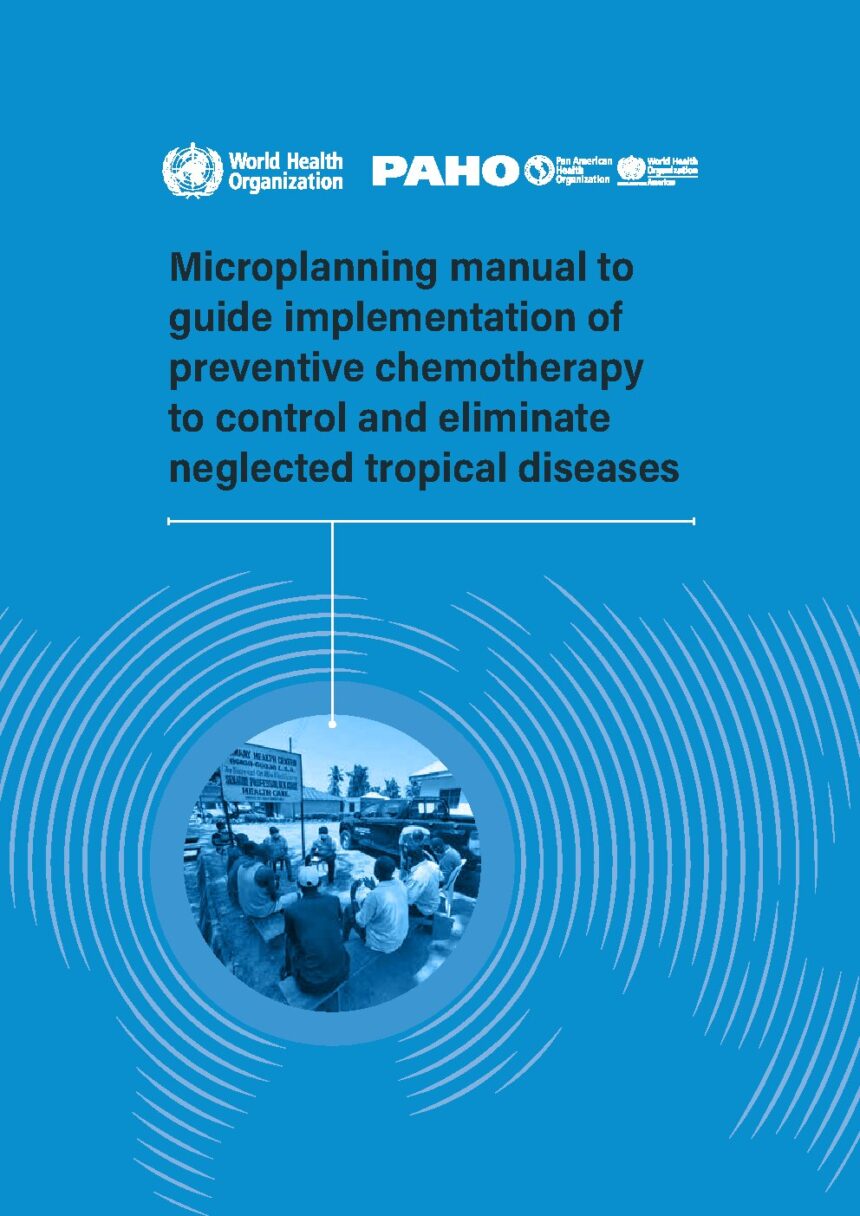
Microplanning manual to guide implementation of preventive chemotherapy to control and eliminate neglected tropical diseases. Geneva: World Health Organization and Pan American Health Organization; 2022. Licence: CC BY-NC-SA 3.0 IGO.GMJ Guidelines Library records are original summaries written by the GMJ editorial team from the issuer’s published document and reviewed by a physician. They do not replace the full guideline. The document is the copyright of its issuer and is linked, not hosted. Spotted an error or a newer edition? Tell the Guidelines Desk.
Was this article helpful?