World Health Organization · 2010 edition · 9 pages
Ethical framework for donation and transplantation for clinicians, transplant programmes, and health authorities worldwide.
- Issuer
- World Health Organization
- Edition
- 2010 edition
- Audience
- Health authorities, transplant programmes, clinicians, professional organizations, health insurers
- Evidence
- Expert consensus endorsed by World Health Assembly
- Reviewed
- 23 Oct 2026 · GMJ
What this guideline says
GMJ summary
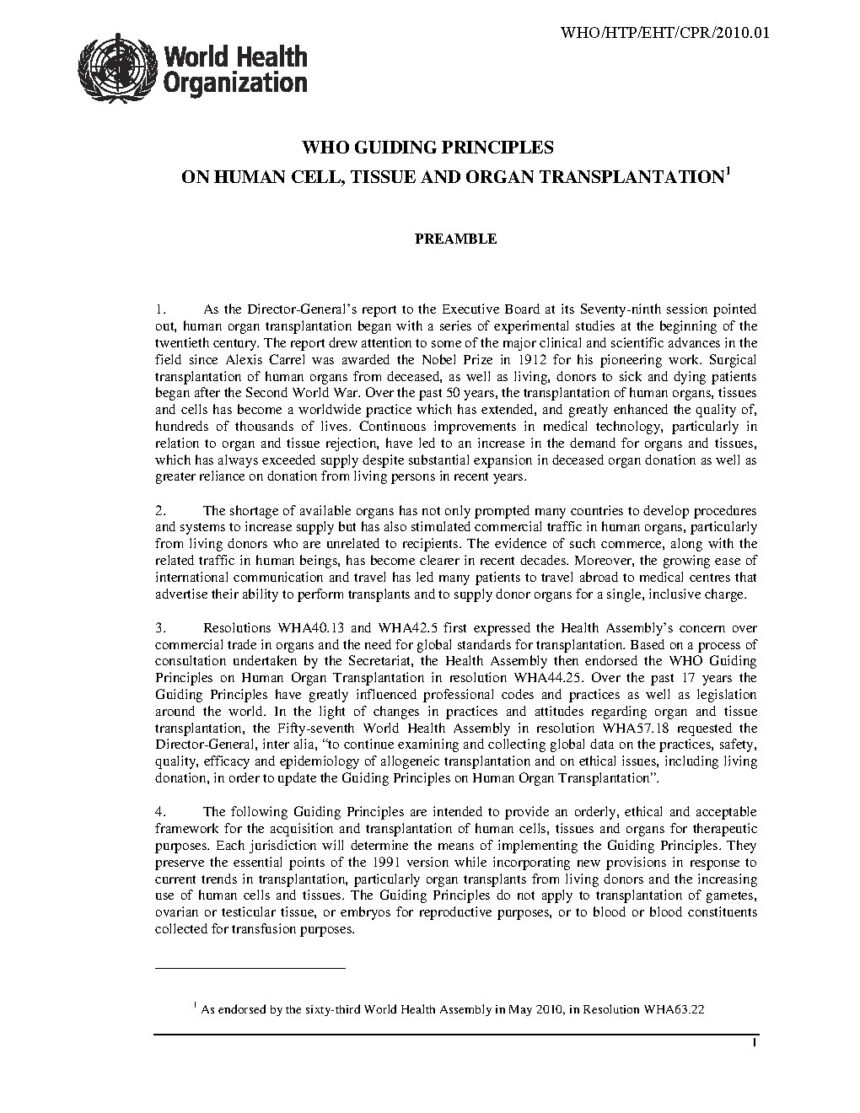
These eleven WHO Guiding Principles establish an ethical and legal framework for the procurement and transplantation of human cells, tissues, and organs. Endorsed by the World Health Assembly in 2010, they update the 1991 version to address contemporary challenges including the increasing use of living donors, commercial trafficking in organs, and transplant tourism.
The core principles prohibit the sale of organs and payment to donors, mandate informed voluntary consent, protect vulnerable groups (especially minors and legally incompetent persons), require separation of death determination from transplant teams, and promote deceased donation as the primary source. For living donation, the principles require genetic, legal, or emotional relationships to recipients, comprehensive psychosocial evaluation, informed consent, and long-term donor follow-up.
The document emphasizes transparency in allocation (based on clinical and ethical criteria, not financial considerations), quality and safety monitoring with traceability systems, and professional accountability. Health professionals and insurers are prohibited from participating in or funding transplants obtained through exploitation, coercion, or payment.
Key points
For clinicians — doses and thresholds as stated in the guideline
- Living donors must provide informed, voluntary consent free from coercion; psychosocial evaluation by an independent qualified party is required, especially for unrelated donors
- Living donors should generally be genetically, legally, or emotionally related to recipients; unrelated donations require particular scrutiny for coercion or commercialism
- Minors may donate only under narrow exceptions allowed by national law (e.g., regenerative cells to family when no adult donor available, kidney to identical twin); minor's objection always prevails
- Physicians determining death must not be involved in organ removal or transplant procedures, nor responsible for care of intended recipients
- Payment for cells, tissues, or organs is prohibited; only reimbursement of reasonable verifiable expenses (including lost income) and costs of recovery, processing, and preservation is permitted
- Allocation must follow clinical criteria and ethical norms defined by multidisciplinary committees, not financial considerations; criteria must be equitable, transparent, and not based on gender, race, religion, or economic condition
- Long-term follow-up of both donors and recipients is mandatory to document benefit and harm; adverse events must be reported nationally and for exported products
- Health professionals must not perform transplants, and insurers must not cover procedures, if cells, tissues, or organs were obtained through exploitation, coercion, or payment
What changed in this edition
Versus the previous edition
- Expanded scope from organs alone to include cells and tissues
- Added new provisions addressing organ transplants from living donors and increasing use of human cells and tissues
- Clarified that Guiding Principles do not apply to transplantation of gametes, ovarian or testicular tissue, embryos for reproductive purposes, or blood/blood constituents for transfusion
- Strengthened provisions on psychosocial evaluation for living donors, particularly unrelated donors
- Added emphasis on traceability, vigilance systems, and adverse event reporting
- Expanded commentary on transplant tourism and requirements for health insurers not to cover unethical transplants
From the guideline
Verbatim
“Payment for cells, tissues and organs is likely to take unfair advantage of the poorest and most vulnerable groups, undermines altruistic donation, and leads to profiteering and human trafficking.”
Editor’s perspective
Why this matters for Georgia and the region
Prof. Giorgi Pkhakadze, MD, MPH, PhD
Editor-in-Chief, Georgian Medical Journal · Chair, Public Health Institute of Georgia · WHO consultant, health and migration
As Georgia develops its transplant capacity, these WHO principles offer critical guidance for building programmes that protect both donors and recipients while preventing exploitation. The emphasis on independent psychosocial evaluation for living donors is particularly important in contexts where family pressure may be significant, and our national regulatory framework must ensure such evaluations are conducted by appropriately trained professionals separate from transplant teams. The prohibition on payment while allowing reimbursement of donor expenses requires careful definition in Georgian law to prevent disguised commercialism. Most challenging will be establishing the transparent multidisciplinary allocation committees and comprehensive traceability systems the principles require—these demand sustained investment in registry infrastructure and data systems that many countries in our region still lack, but they are essential for maintaining public trust and preventing abuses in transplantation programmes.
ORCID 0000-0001-7609-4515 · Perspective written for the GMJ Guidelines Library, 23 Oct 2026
Applicability
Georgia and the South Caucasus
For Georgia and the South Caucasus, these principles provide essential guidance for developing or strengthening national transplant programmes. Countries in the region establishing deceased donor programmes must implement legal frameworks for consent (explicit or presumed), death determination protocols, transparent allocation systems, and traceability registries. Living donor programmes require independent psychosocial evaluation capacity, donor protection through follow-up systems, and mechanisms to prevent coercion or payment. National health authorities must define sanctions for commercial trafficking, establish multidisciplinary allocation committees, monitor transplant fees to prevent profiteering, and ensure that cost does not exclude patients from transplantation. Regional cooperation on coding systems for traceability and joint action against transplant tourism would strengthen implementation across the Caucasus and Eastern Europe.
Questions this guideline answers
Quick answers
Can family members donate organs to their relatives?
Yes, living donors may donate if they are genetically, legally (e.g., spouses), or emotionally related to recipients. Donors must provide informed, voluntary consent free from coercion, undergo psychosocial evaluation, receive complete information on risks and benefits, and have access to professional care and long-term follow-up.
Is it ever acceptable to pay living organ donors?
No. Payment for organs is prohibited as it exploits vulnerable groups and undermines altruistic donation. However, donors may be reimbursed for reasonable verifiable expenses including medical costs and lost income. Free periodic medical assessments and insurance for donation-related complications may legitimately be provided.
Can minors ever donate organs?
Only under narrow exceptions permitted by national law, such as donation of regenerative cells to family members when no comparable adult donor is available, or kidney donation between identical twins. Independent review (e.g., by a court) should be required when parents have a conflict of interest, and the minor's objection must always prevail.
What should happen if a patient received a transplant abroad involving payment for organs?
Physicians may provide post-transplant care to such patients but should not face professional sanctions if they decline and refer the patient elsewhere. However, physicians must not refer patients to facilities that use paid organs, and health insurers should refuse to pay for such transplants.
Related on GMJ
Interconnected resources
GMJ News coverage
ASF accreditation standards
Other guidelines on this topic
- Falls: assessment and prevention in older people and in people 50 and over at higher risk
- Health Technology Assessment of Medical Devices, 2nd edition
- Monitoring labour and delivery — MSF Essential obstetric and newborn care
- Administrative measures in health facilities — MSF Tuberculosis
- Abruptio placentae — MSF Essential obstetric and newborn care
- Issuer
- World Health Organization
- Type
- Publication
- Edition
- 2010 edition
- Replaces
- WHO Guiding Principles on Human Organ Transplantation, 1991
- Status
- Current
- Published
- 2025-01-20
- Scope
- Global
- Audience
- Health authorities, transplant programmes, clinicians, professional organizations, health insurers
- Pages
- 9
- Evidence
- Expert consensus endorsed by World Health Assembly
- Record history
- Created 23 Oct 2026 · updated 23 Oct 2026 · next check Apr 2027
World Health Organization. WHO guiding principles on human cell, tissue and organ transplantation. Geneva: WHO; 2010. WHO/HTP/EHT/CPR/2010.01.GMJ Guidelines Library records are original summaries written by the GMJ editorial team from the issuer’s published document and reviewed by a physician. They do not replace the full guideline. The document is the copyright of its issuer and is linked, not hosted. Spotted an error or a newer edition? Tell the Guidelines Desk.
Was this article helpful?