Pan American Health Organization · 2020
Operational guidance for health administrators and providers on maintaining NCD services during the COVID-19 pandemic.
- Issuer
- Pan American Health Organization
- Edition
- 2020
- Audience
- Health administrators and providers
- Evidence
- Based on PAHO/WHO recommendations and international organization guidance
- Reviewed
- 20 Oct 2026 · GMJ
What this guideline says
GMJ summary
This guidance addresses the critical challenge of maintaining essential health services for people living with noncommunicable diseases (NCDs) during the COVID-19 pandemic. It recognizes that NCDs are the leading cause of morbidity and mortality, and that service disruptions can lead to worsening outcomes, particularly as people with NCDs face higher risk for severe COVID-19 and require continuous care.
The document provides a framework for prioritizing NCD services based on local COVID-19 transmission levels, distinguishing between scenarios with no community transmission (where primary health centre functionalities can resume with appropriate precautions) and active community transmission (where telehealth services should be maintained and in-person visits minimized). Essential services that must continue regardless of transmission level include dialysis, chemotherapy, and emergency care access for non-COVID patients.
The guidance emphasizes six key pillars: informed and empowered individuals living with NCDs, access to essential medications, continuation of primary care services, continuation of specialized care (dialysis, cancer treatment, emergency care), establishment of quality telehealth services, and strengthening of NCD programmes. It stresses the importance of equitable access to care, optimizing health workforce capacity through task shifting, and protecting provider wellbeing with adequate personal protective equipment and mental health support.
Key points
For clinicians — doses and thresholds as stated in the guideline
- When there is no community transmission (Phase 2–3), resume all primary health centre functionalities using appropriate PPE and pre-visit screening; maintain emergency care access with isolated areas for non-COVID patients with NCDs
- During active community transmission (Phase 4), maintain telehealth services and minimize in-person visits while continuing dialysis and chemotherapy services; keep emergency care access open with isolated areas for non-COVID patients
- Ensure continued access to essential medications through patient education, safe pharmacy access or home delivery, and government assurance of secure medication supply chains
- Implement telehealth services (video-based or audio-based via cellular phones) to enable uninterrupted patient-provider communication for managing mild exacerbations and avoiding unnecessary in-person consultations
- Prioritize cancer treatment (chemotherapy, radiotherapy, surgery) according to health service capacity, local transmission context, and cancer type, as treatment disruption can be detrimental
- Designate dialysis centres as essential services and ensure continued provision of dialysis care, as disruption would be life-threatening for individuals with end-stage renal disease
- Optimize health workforce capacity through task shifting to nurses and community healthcare workers when possible; provide adequate personal protective equipment, mental health support, and adequate staffing resources to protect provider wellbeing
- Disseminate information to people with NCDs using mass media campaigns, social media, text messaging, WhatsApp, TV, radio, and email about self-management strategies, medication access, increased COVID-19 risk, and when to seek emergency care
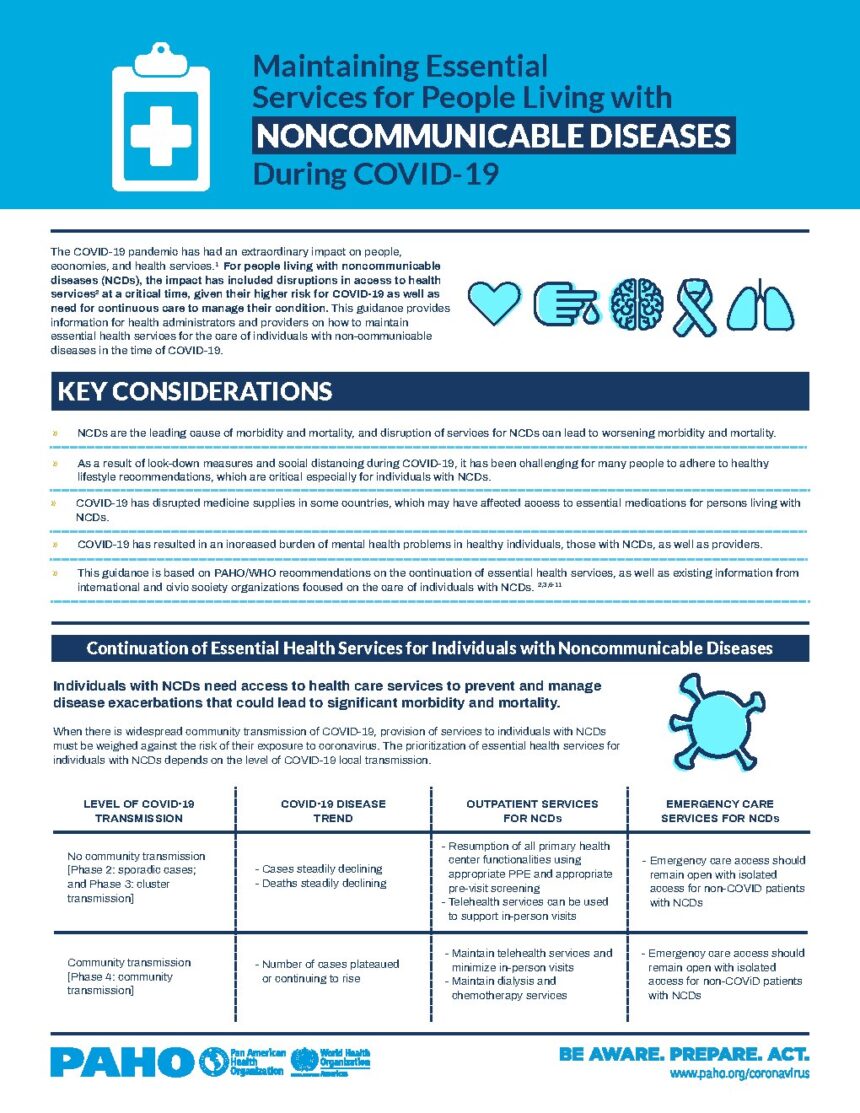
Prioritization of Essential Health Services for NCDs by COVID-19 Transmission Level
Table extracted from the guideline
| Level of COVID-19 Transmission | COVID-19 Disease Trend | Outpatient Services for NCDs | Emergency Care Services for NCDs |
|---|---|---|---|
| No community transmission [Phase 2: sporadic cases; and Phase 3: cluster transmission] | – Cases steadily declining – Deaths steadily declining |
– Resumption of all primary health center functionalities using appropriate PPE and appropriate pre-visit screening – Telehealth services can be used to support in-person visits |
– Emergency care access should remain open with isolated access for non-COVID patients with NCDs |
| Community transmission [Phase 4: community transmission] | – Number of cases plateaued or continuing to rise | – Maintain telehealth services and minimize in-person visits – Maintain dialysis and chemotherapy services |
– Emergency care access should remain open with isolated access for non-COVID patients with NCDs |
Source: Pan American Health Organization, Maintaining Essential Services for People Living with Noncommunicable Diseases during COVID-19. Reproduced in summary form.
From the guideline
Verbatim
“Individuals with end-stage renal disease need access to regular dialysis treatment for survival. Disruption of dialysis services would be life-threatening.”
Editor’s perspective
Why this matters for Georgia and the region
Prof. Giorgi Pkhakadze, MD, MPH, PhD
Editor-in-Chief, Georgian Medical Journal · Chair, Public Health Institute of Georgia · WHO consultant, health and migration
As we reflect on the COVID-19 pandemic's impact across the South Caucasus, this PAHO guidance offers essential lessons for Georgia's health system preparedness. The distinction between service delivery models based on transmission phases is particularly instructive for our context, where we have invested significantly in universal health coverage but must now ensure that NCD programmes—covering cardiovascular disease, diabetes, and cancer care that affect a substantial portion of our population—are explicitly protected during health emergencies. I would stress to Georgian clinicians the recommendation on task shifting to nurses and community health workers, which aligns with our ongoing primary healthcare strengthening efforts but requires advance regulatory preparation and training rather than improvisation during crises. The critical implementation caveat for Georgia is the telehealth infrastructure: while mobile phone penetration is high, reliable connectivity in rural and mountainous regions remains challenging, meaning that any national NCD continuity plan must include robust audio-based consultation protocols and cannot rely solely on video platforms that work well in Tbilisi but may fail in regions like Racha or Tusheti.
ORCID 0000-0001-7609-4515 · Perspective written for the GMJ Guidelines Library, 20 Oct 2026
Applicability
Georgia and the South Caucasus
For Georgia and the South Caucasus, this guidance remains highly relevant as the region faces ongoing challenges with both NCD burden and potential respiratory disease outbreaks. Georgia’s Universal Health Coverage programme, established in 2013, provides a foundation for implementing these recommendations, though the health system must ensure that NCD services—particularly primary care access, medication supply chains, and specialized services like dialysis—are explicitly designated as essential and protected during health emergencies. The guidance’s emphasis on telehealth infrastructure is particularly pertinent given Georgia’s geography with rural and mountainous areas where connectivity may be limited; national programmes would need to consider hybrid approaches using audio-based consultation via mobile phones where video telehealth is not feasible. The recommendation for task shifting to nurses and community healthcare workers aligns with ongoing health workforce optimization efforts in the region, but would require regulatory frameworks and training programmes to be established in advance of future emergencies.
Questions this guideline answers
Quick answers
Should primary care services for NCDs continue during active COVID-19 community transmission?
Yes, but the approach differs by transmission level. During active community transmission (Phase 4), maintain telehealth services and minimize in-person visits, while ensuring dialysis and chemotherapy services continue. When there is no community transmission, resume all primary health centre functionalities using appropriate PPE and pre-visit screening.
Which NCD services are absolutely essential and cannot be interrupted?
Dialysis services for individuals with end-stage renal disease (disruption would be life-threatening), chemotherapy and radiotherapy for cancer patients (disruption can be detrimental), and emergency care access for NCD-related exacerbations or complications must continue regardless of COVID-19 transmission levels, with appropriate infection prevention measures.
How can telehealth services be implemented when video technology is not available?
Audio-based consultation should be considered given the ubiquitous use of cellular phones. While camera or video-based telehealth services may not be feasible at all locations, phone consultations can enable real-time communication to manage mild exacerbations and avoid unnecessary in-person visits or hospitalization.
How should emergency care be provided safely for people with NCDs during a pandemic?
Health systems must provide emergency services adequately separated from COVID-19 care. This can be done within the same facility if distinct spaces without shared ventilatory systems exist, or by designating separate hospitals or emergency facilities for COVID-19 versus non-COVID-19 patients to reduce infection risk for those needing care for other reasons.
Related on GMJ
Interconnected resources
Dictionary of Public Health
Conditions A–Z
GMJ News coverage
- African Health Leaders Unite on Noncommunicable Diseases: New Commitments for SDG Targets by 2030Sep 2026
- Hypertension's Hidden Complexity: Why One-Size-Fits-All Treatment FailsOct 2026
- Primary aldosteronism: why screening for this overlooked cause of hypertension mattersSep 2026
- Eight Common Food Additives Linked to Hypertension and Cardiovascular Disease in Large Cohort StudyJul 2026
Quality & accreditation
- ASF Hospital — Standard 5 — Safety & Emergency Preparedness
- ASF Hospital — Standard 11 — Critical Care
- ASF Medical Transport — Standard 6 — Emergency Response During Transport
- ASF PHC — Standard 4 — Acute & Same-Day Care · Primary Health Clinic
- ASF PHC — Standard 7 — Governance & Staffing · Primary Health Clinic
Other guidelines on this topic
- Immunization throughout the Life Course at the Primary Care Level in the Context of the COVID-19 Pandemic
- Managing People with Asthma during COVID-19: Considerations for Health Providers
- Considerations for the Use of Hotels during the COVID-19 Pandemic
- Considerations for the Use of Hotels during the COVID-19 Pandemic
- Key Considerations for Integrating Gender Equality into Health Emergency and Disaster Response: COVID-19
- Issuer
- Pan American Health Organization
- Type
- Procedures, manuals, guidelines
- Status
- Current
- Published
- 2020-01-01
- Audience
- Health administrators and providers
- Licence
- CC BY-NC-SA 3.0 IGO
- Evidence
- Based on PAHO/WHO recommendations and international organization guidance
- Record history
- Created 20 Oct 2026 · updated 20 Oct 2026 · next check Apr 2027
Pan American Health Organization. Maintaining Essential Services for People Living with Noncommunicable Diseases during COVID-19. Washington, D.C.: PAHO; 2020. (PAHO/NMH/NV/COVID-19/20-0030).GMJ Guidelines Library records are original summaries written by the GMJ editorial team from the issuer’s published document and reviewed by a physician. They do not replace the full guideline. The document is the copyright of its issuer and is linked, not hosted. Spotted an error or a newer edition? Tell the Guidelines Desk.
Was this article helpful?