Pan American Health Organization · 2020
Guidance for primary care and public health providers on distinguishing asthma exacerbations from COVID-19 and managing both conditions safely.
- Issuer
- Pan American Health Organization
- Edition
- 2020
- Audience
- Primary care providers, pulmonologists, public health professionals
- Evidence
- Expert consensus based on emerging COVID-19 evidence and established asthma management guidelines
- Reviewed
- 20 Oct 2026 · GMJ
What this guideline says
GMJ summary
This Pan American Health Organization guidance addresses the clinical challenge of managing asthma during the COVID-19 pandemic. It focuses on differentiating asthma exacerbations from COVID-19 symptoms (both presenting with cough and dyspnoea), maintaining asthma control through continued controller medication including inhaled corticosteroids, and reorganising primary care services to reduce infection risk whilst ensuring access to essential asthma care.
The document emphasises that asthma exacerbations should be managed per established protocols including oral corticosteroids when indicated, but discourages nebuliser use except in severe cases due to aerosol generation risk. It provides practical algorithms for triaging patients, maintaining medication supply chains, and protecting both patients and healthcare workers through appropriate infection prevention measures.
Key strategic recommendations include establishing remote consultations where feasible, outdoor triage with screening for COVID-19 symptoms, separated care areas for suspected COVID-19 cases, ensuring 90-day medication supplies, and leveraging community health workers for medication delivery to reduce patient exposure.
Key points
For clinicians — doses and thresholds as stated in the guideline
- Continue all controller medications including inhaled corticosteroids and immunomodulators (e.g. omalizumab); there is no evidence these increase COVID-19 risk
- Manage asthma exacerbations with metered-dose inhaler using aero-chamber: 2–6 puffs for children under 4 years, 4–10 puffs for those over 4 years, every 1–4 hours
- Avoid nebulisers in asthma exacerbations except in severe cases (hypoxia, low peak expiratory flow, feeble respiratory effort, confusion, cardiac arrhythmias) and only in isolation rooms with full PPE
- Use oral corticosteroids for moderate to severe asthma exacerbations despite COVID-19 pandemic; this is distinct from WHO recommendation against steroids for COVID-19 treatment
- Screen patients with three questions: (1) travel to COVID-19 endemic country, (2) classic COVID-19 symptoms present, (3) contact with confirmed/suspected COVID-19 case
- Triage all patients outside clinic buildings; provide infrared temperature screening and symptom assessment before entry; separate COVID-19 suspect and non-suspect areas
- Healthcare workers exposed to COVID-19 should self-quarantine for 14 days; those infected may return after 72 hours fever-free without medication and 10 days since symptom onset
- Ensure patients have 90-day medication supplies to prevent treatment interruption due to supply chain disruptions
From the guideline
Verbatim
“Most important is the continuation and full adherence to controller medication. This includes inhaled corticosteroids which are an essential controller medication.”
Editor’s perspective
Why this matters for Georgia and the region
Prof. Giorgi Pkhakadze, MD, MPH, PhD
Editor-in-Chief, Georgian Medical Journal · Chair, Public Health Institute of Georgia · WHO consultant, health and migration
As we managed Georgia's COVID-19 response, this PAHO guidance addressed a critical challenge our primary care physicians faced daily: distinguishing respiratory symptoms in chronic disease patients from pandemic infection. The recommendation to continue inhaled corticosteroids despite early pandemic fears about immunosuppression was evidence-based and essential—I emphasised this in national consultations to prevent dangerous treatment interruptions. The outdoor triage model proved particularly feasible for Georgian polyclinics with their typical ground-floor access and courtyard spaces. However, the guidance's assumption of 90-day medication supplies and reliable aero-chamber availability required adaptation; our pharmaceutical import dependencies and reimbursement cycles meant we needed health ministry coordination to modify dispensing regulations and emergency procurement, which took several months to implement across all regions.
ORCID 0000-0001-7609-4515 · Perspective written for the GMJ Guidelines Library, 20 Oct 2026
Applicability
Georgia and the South Caucasus
This guidance is highly relevant for Georgia and the South Caucasus, where asthma prevalence mirrors global patterns and primary health care reorganisation during COVID-19 required balancing chronic disease management with infection control. Georgian national programmes would need to consider the established polyclinic system’s capacity for outdoor triage, the availability of aero-chambers (spacers) through pharmaceutical supply chains, feasibility of telemedicine infrastructure in rural mountain regions, and integration with the existing universal health coverage programme to ensure uninterrupted access to controller medications. The recommendation to leverage community health workers for medication delivery aligns with Georgia’s village health worker model, though PPE availability in remote areas would require assessment.
Questions this guideline answers
Quick answers
Are people with asthma at higher risk of severe COVID-19?
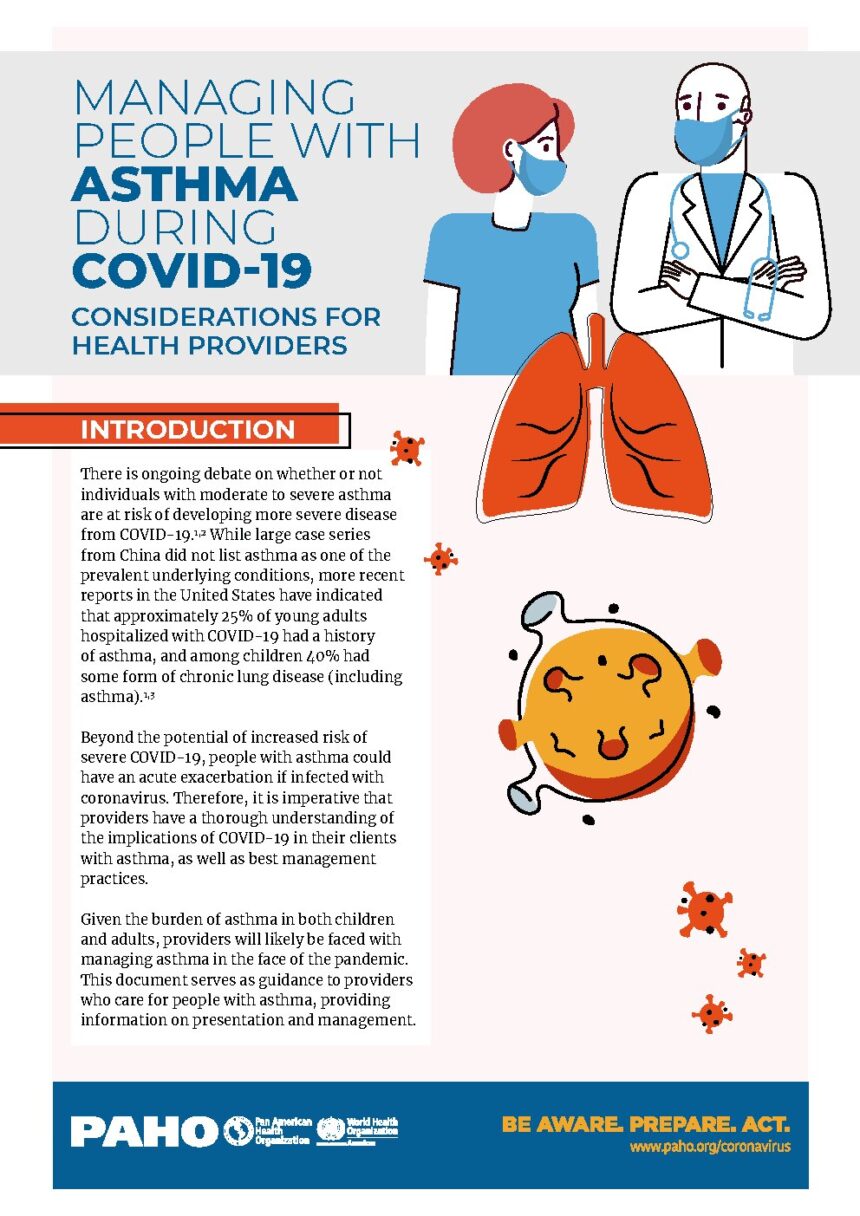
The evidence is mixed. Large case series from China did not list asthma as a prevalent underlying condition, but US reports showed approximately 25% of young adults hospitalised with COVID-19 had asthma history, and 40% of children had chronic lung disease including asthma. People with asthma could also have acute exacerbations if infected with coronavirus.
Should I stop inhaled corticosteroids or immunomodulators during COVID-19?
No. Continue all controller medications including inhaled corticosteroids and immunomodulators (such as omalizumab). There is no evidence these medications increase COVID-19 risk, and maintaining asthma control is most important. Full adherence to controller medication is essential.
Can I use nebulisers for asthma exacerbations during the pandemic?
Nebulisers should be avoided in most cases due to aerosol generation risk. Use metered-dose inhalers with aero-chambers instead (2–6 puffs for under 4 years, 4–10 puffs for over 4 years, every 1–4 hours). Continuous nebulisation should only be considered for severe asthma with hypoxia, low peak expiratory flow, feeble respiratory effort, confusion, or cardiac arrhythmias, and only in isolation rooms with negative pressure and full PPE.
Can I use oral corticosteroids for asthma exacerbations in COVID-19 patients?
Yes. Oral corticosteroids remain the mainstay of treatment for moderate to severe asthma exacerbations even during COVID-19. This must be distinguished from WHO's recommendation against corticosteroids as treatment for COVID-19 itself. Continue managing asthma exacerbations per established guidelines including steroids when needed.
Related on GMJ
Interconnected resources
Dictionary of Public Health
Conditions A–Z
GMJ News coverage
- Asthma Medications During Pregnancy Show Mixed Links to Child Development IssuesJun 2026
- UK flu and COVID-19 surveillance data to May 2027 shows continued monitoring amid seasonal trendsOct 2026
- Community Health Workers Boost COVID-19 Testing Among Formerly Incarcerated PeopleAug 2026
- How Your Immune System Works: A Guide to Its Specialized Cells and FunctionsJul 2026
Quality & accreditation
Other guidelines on this topic
- Technical and Regulatory Aspects of the Use of Pulse Oximeters in Monitoring COVID-19 Patients
- Assessment of infection prevention and control practices for COVID-19 isolation areas in healthcare facilities
- Initial care of persons with acute respiratory illness (ARI) in the context of coronavirus disease (COVID-19) in healthcare facilities: assess the risk, isolate, refer
- Flowchart for the Management of Suspected COVID-19 Patients at the First Level of Care and in Remote Areas in the Region of the Americas
- Ongoing Living Update of Potential COVID-19 Therapeutics: Summary of Rapid Systematic Reviews
- Issuer
- Pan American Health Organization
- Type
- Procedures, manuals, guidelines
- Status
- Current
- Published
- 2020-01-01
- Scope
- Adults and children with asthma during COVID-19 pandemic
- Audience
- Primary care providers, pulmonologists, public health professionals
- Licence
- CC BY-NC-SA 3.0 IGO
- Evidence
- Expert consensus based on emerging COVID-19 evidence and established asthma management guidelines
- Record history
- Created 20 Oct 2026 · updated 20 Oct 2026 · next check Apr 2027
Pan American Health Organization. Managing People with Asthma during COVID-19: Considerations for Health Providers, 3 June 2020. Washington, D.C.: PAHO; 2020. (PAHO/NMH/NV/COVID-19/20-0023).GMJ Guidelines Library records are original summaries written by the GMJ editorial team from the issuer’s published document and reviewed by a physician. They do not replace the full guideline. The document is the copyright of its issuer and is linked, not hosted. Spotted an error or a newer edition? Tell the Guidelines Desk.
Was this article helpful?