Pan American Health Organization · Version 1, 12 April 2020
Interim recommendations for triage, isolation and referral of adults with ARI during COVID-19 pandemic for healthcare workers
- Issuer
- Pan American Health Organization
- Edition
- Version 1, 12 April 2020
- Audience
- Healthcare workers in primary care, emergency departments, and hospital settings
- Evidence
- Expert consensus, interim recommendations
- Reviewed
- 20 Oct 2026 · GMJ
What this guideline says
GMJ summary
This interim guidance from the Pan American Health Organization provides a three-step flowchart-based approach to the initial management of adults (>18 years) presenting with acute respiratory illness (ARI) during the COVID-19 pandemic. The framework—Assess, Isolate, Refer—guides healthcare workers through triage of suspected cases, implementation of appropriate infection prevention and control precautions, and decisions regarding escalation of care based on clinical severity.
The triage step involves assessing vital signs (pulse, respiratory rate, blood pressure, axillary temperature, and SpO₂), evaluating risk factors for complications, and determining whether the patient meets the current case definition for COVID-19. The isolation step requires implementation of standard plus contact and droplet precautions for all suspected cases, with airborne precautions added during aerosol-generating procedures. The referral step provides specific clinical thresholds for ward admission versus intensive care unit (ICU) transfer, based on respiratory parameters, organ dysfunction, and haemodynamic stability.
The guidance emphasizes early recognition of severe disease through specific clinical and laboratory markers, appropriate specimen collection under airborne precautions, and timely escalation to critical care when indicated. It is explicitly preliminary and subject to revision as evidence evolves, and applies only to adults, with separate guidance needed for paediatric and obstetric populations.
Key points
For clinicians — doses and thresholds as stated in the guideline
- Offer surgical mask to patients with ARI on arrival if tolerated, and assess vital signs including pulse, respiratory rate, blood pressure, axillary temperature >37.5°C (99.5°F), and SpO₂
- Implement standard + contact + droplet precautions for all COVID-19 suspected cases; add airborne precautions for aerosol-generating procedures (AGPs)
- Consider ward admission if SpO₂ <94%, respiratory rate >24 bpm, dyspnoea, or abnormal pulmonary sounds are present
- Admit to ICU if any of the following: systolic blood pressure <100 mmHg, impaired consciousness, prolonged capillary refill time, lactate <2 mmol/L, organ dysfunction, or persistent hypoxaemia despite oxygen support
- Collect respiratory samples under airborne precautions; consider testing for respiratory virus panel and other infectious agents
- Laboratory assessment for organ failure should include: haemogram, arterial blood gases, arterial lactate, coagulogram, creatinine/urea, sodium, potassium, AST, ALT, CPK, LDH, D-dimer, ferritin
- Pulmonary imaging (CT scan, X-ray or thoracic ultrasound) indicated when SpO₂ <94%, RR >24 bpm, dyspnoea or abnormal lung sounds are present
- Flag patients as COVID-19 suspected cases and start severe acute respiratory infection (SARI) management protocol for those with abnormal pulmonary imaging, clinical deterioration, or organ failure
From the guideline
Verbatim
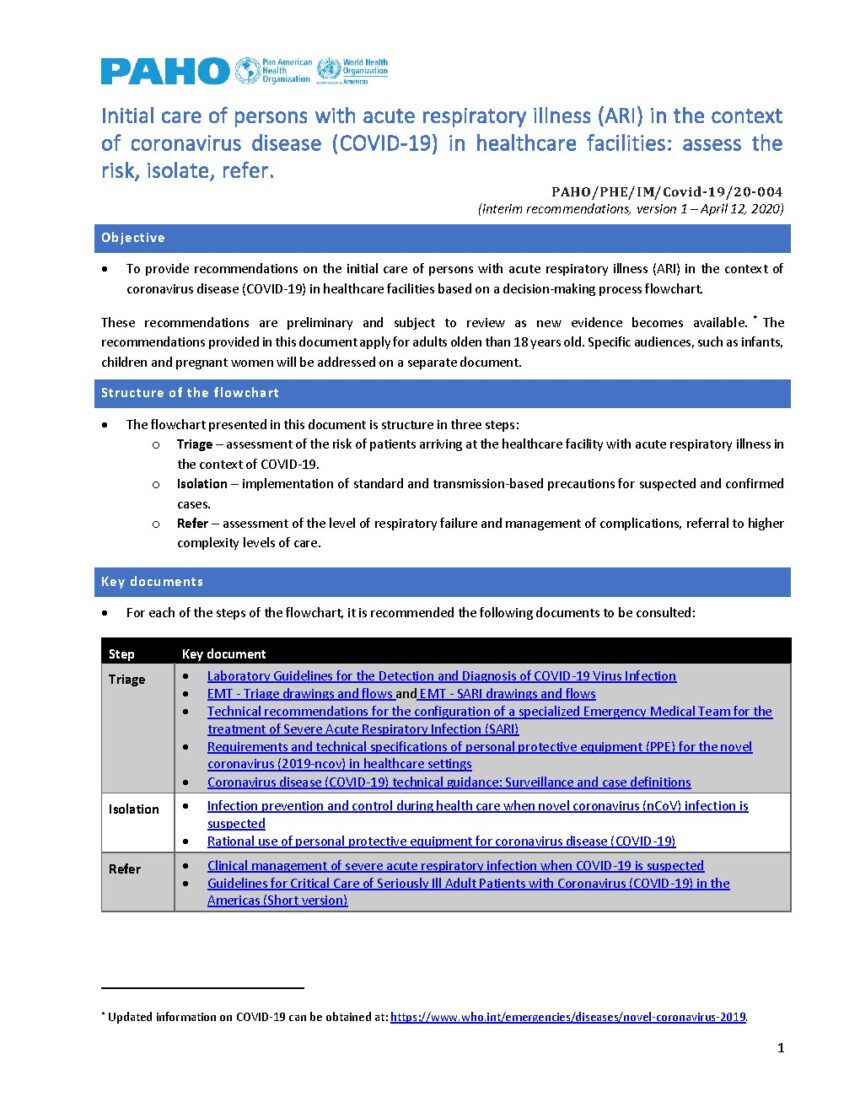
“The flowchart presented in this document is structure in three steps: Triage – assessment of the risk of patients arriving at the healthcare facility with acute respiratory illness in the context of COVID-19. Isolation – implementation of standard and transmission-based precautions for suspected and confirmed cases. Refer – assessment of the level of respiratory failure and management of complications, referral to higher complexity levels of care.”
Editor’s perspective
Why this matters for Georgia and the region
Prof. Giorgi Pkhakadze, MD, MPH, PhD
Editor-in-Chief, Georgian Medical Journal · Chair, Public Health Institute of Georgia · WHO consultant, health and migration
As Chair of the Public Health Institute of Georgia, I recognise this PAHO framework as directly applicable to our national surveillance and referral systems for respiratory pathogens. The three-step assess-isolate-refer structure aligns well with Georgia's tiered healthcare system, but the comprehensive laboratory panel—arterial lactate, D-dimer, ferritin—requires point-of-care or rapid laboratory capacity that may not be uniformly available in regional facilities. I would stress to Georgian clinicians the specific ICU admission thresholds: systolic blood pressure below 100 mmHg and lactate below 2 mmol/L represent objective triggers that should prompt immediate escalation, preventing the delayed transfers we observed during peak COVID-19 surges. The most significant implementation challenge remains ensuring consistent availability of personal protective equipment for the tiered precaution system, particularly in primary care settings where aerosol-generating procedures may occur without dedicated negative-pressure facilities.
ORCID 0000-0001-7609-4515 · Perspective written for the GMJ Guidelines Library, 20 Oct 2026
Applicability
Georgia and the South Caucasus
This interim guidance remains relevant for Georgia and the South Caucasus as a framework for managing respiratory illness surveillance and outbreak preparedness beyond COVID-19. Georgian healthcare facilities would need to adapt the triage thresholds and case definitions to current epidemiological contexts, ensure adequate supplies of personal protective equipment for the three-tier precaution system, and verify that laboratory capacity exists for the comprehensive organ-function testing panel recommended (arterial blood gases, lactate, D-dimer, ferritin). The ICU admission criteria—particularly systolic blood pressure <100 mmHg and lactate thresholds—require integration with national protocols for critical care referral, considering the distribution of intensive care capacity across urban and rural settings in Georgia, Armenia and Azerbaijan.
Questions this guideline answers
Quick answers
What constitutes fever for COVID-19 triage purposes in this guidance?
Axillary temperature >37.5°C (99.5°F) is the threshold used in this guidance, along with shortness of breath and cough, to assess whether a patient meets the case definition for COVID-19.
When should a patient with suspected COVID-19 be admitted to ICU rather than a general ward?
ICU admission is indicated for organ dysfunction, persistent hypoxaemia despite oxygen support, or any of: systolic blood pressure <100 mmHg, impaired consciousness, prolonged capillary refill time, or lactate <2 mmol/L.
What level of infection prevention precautions is needed for suspected COVID-19 cases?
All suspected cases require standard + contact + droplet precautions. If any aerosol-generating procedure (AGP) is performed, upgrade to standard + contact + airborne precautions.
What respiratory parameters trigger consideration for hospital admission?
SpO₂ <94%, respiratory rate >24 breaths per minute, dyspnoea, or changes in pulmonary sounds should prompt consideration for ward admission and further clinical assessment including pulmonary imaging.
Related on GMJ
Interconnected resources
Dictionary of Public Health
GMJ News coverage
- UK flu and COVID-19 surveillance data to May 2027 shows continued monitoring amid seasonal trendsOct 2026
- Community Health Workers Boost COVID-19 Testing Among Formerly Incarcerated PeopleAug 2026
- When Recalibration Reproduces Inequity: The Pulse Oximetry Paradox and Why Device Standards Must Account for MelaninOct 2026
- New drug slows lung decline in idiopathic pulmonary fibrosis, landmark trial showsSep 2026
Quality & accreditation
- ASF Hospital — Standard 5 — Safety & Emergency Preparedness
- ASF Hospital — Standard 11 — Critical Care
- ASF Medical Transport — Standard 6 — Emergency Response During Transport
- ASF Medical Transport — Standard 5 — Infection Prevention & Control
- ASF Laboratory — Standard 7 — Examination: Process & Safety
Other guidelines on this topic
- Recommendations for the Management of Solid Waste
- Considerations for the Use of Hotels during the COVID-19 Pandemic
- Considerations for the Use of Hotels during the COVID-19 Pandemic
- Flowchart for the Management of Suspected COVID-19 Patients at the First Level of Care and in Remote Areas in the Region of the Americas
- Technical recommendations for configuration of a triage area for patients with respiratory symptoms
- Issuer
- Pan American Health Organization
- Type
- Procedures, manuals, guidelines
- Edition
- Version 1, 12 April 2020
- Status
- Current
- Published
- 2020-01-01
- Scope
- Adults >18 years with acute respiratory illness in healthcare facilities during COVID-19 pandemic
- Audience
- Healthcare workers in primary care, emergency departments, and hospital settings
- Licence
- CC BY-NC-SA 3.0 IGO
- Evidence
- Expert consensus, interim recommendations
- Record history
- Created 20 Oct 2026 · updated 20 Oct 2026 · next check Apr 2027
Pan American Health Organization. Initial care of persons with acute respiratory illness (ARI) in the context of coronavirus disease (COVID-19) in healthcare facilities: assess the risk, isolate, refer. Interim recommendations, version 1 (12 April 2020). Washington, D.C.: PAHO; 2020. (PAHO/PHE/IM/Covid-19/20-004).GMJ Guidelines Library records are original summaries written by the GMJ editorial team from the issuer’s published document and reviewed by a physician. They do not replace the full guideline. The document is the copyright of its issuer and is linked, not hosted. Spotted an error or a newer edition? Tell the Guidelines Desk.
Was this article helpful?