World Health Organization · 1st edition, 2026 · 120 pages
Operational manual and risk assessment tool for protecting health at major events under heat stress, for public health authorities and event organizers worldwide.
- Issuer
- World Health Organization
- Edition
- 1st edition, 2026
- Audience
- Public health authorities, event organizers, emergency planners, local governments, venue operators, occupational health professionals, medical services, WASH teams, transport teams, communications teams, crowd management teams, contractors
- Evidence
- Systematic review (companion document), WHO/ILO/WMO guidance, expert consensus, occupational heat stress standards
- Reviewed
- 17 Oct 2026 · GMJ
What this guideline says
GMJ summary
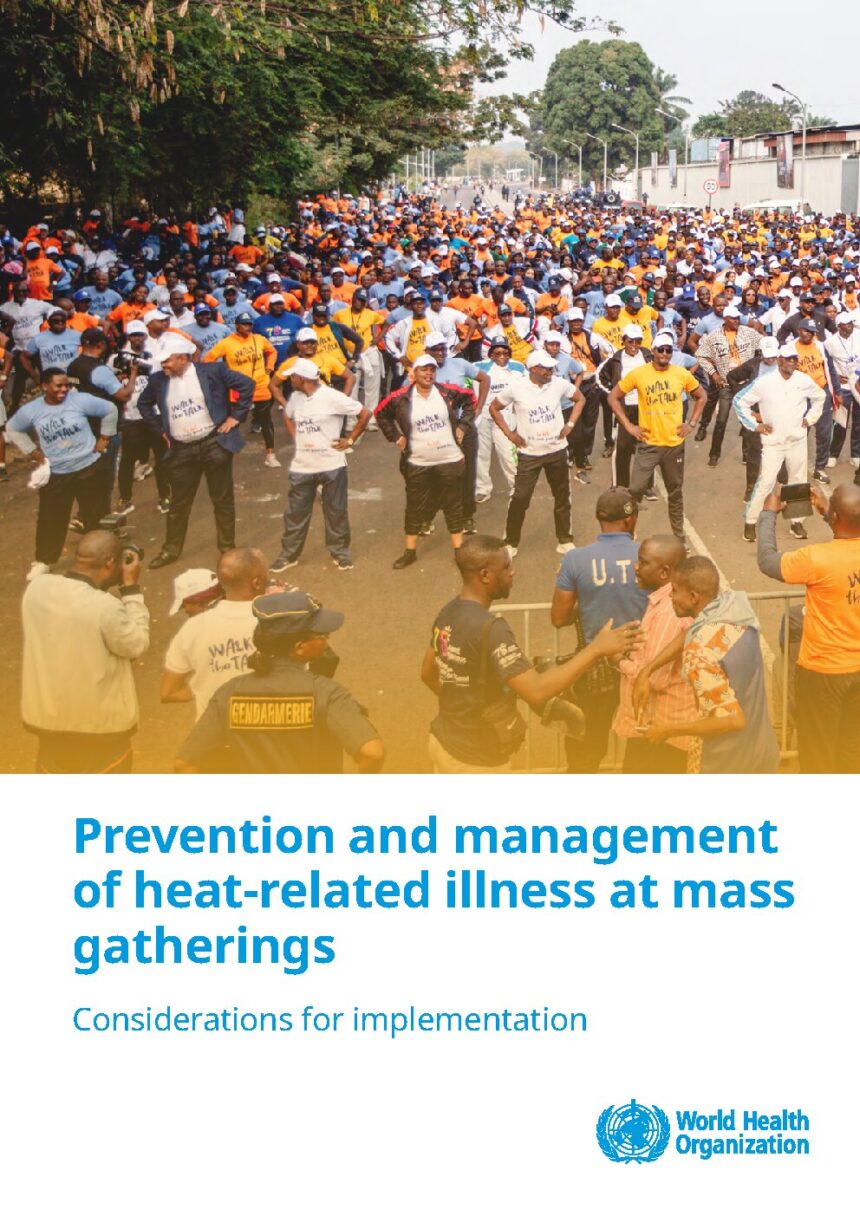
This WHO manual provides a structured, evidence-informed approach to managing heat-related health risks at mass gatherings—sport events, religious pilgrimages, festivals and other settings where large crowds are exposed to heat. Rising global temperatures and more frequent heatwaves are reshaping the conditions under which mass gatherings operate, increasing risks of heat exhaustion, heatstroke, medical surge and service strain.
The document introduces a risk-based framework assessing heat stress through hazard, exposure, vulnerability and capacity. It recommends layered controls: accessible drinking water and cooling infrastructure; scheduling and crowd management to reduce exposure during peak heat; workforce protection through work/rest cycles and task rotation; clinical readiness with trained recognition and rapid cooling; and clear escalation pathways linking forecast or observed heat to predefined actions. Behavioral advice alone is insufficient—messages such as ‘drink water’ or ‘stay cool’ work only when the event environment enables safe access to water, cooling and care.
The manual is accompanied by a standalone Risk Assessment Tool (spreadsheet) designed for rapid, repeatable assessment before and during events. Together, they support documentation of risk tiers, decisions, actions, health presentations and lessons learned, enabling continuous improvement and legacy planning. The approach is applicable across resource settings and emphasizes governance, equity, proportionality and integration with wider event health and emergency plans.
Key points
For clinicians — doses and thresholds as stated in the guideline
- Heat stress risk should be assessed through hazard (heat conditions), exposure (duration, crowd density, activity), vulnerability (age, chronic disease, acclimatization) and capacity (cooling, water, medical readiness).
- Wet bulb globe temperature (WBGT) is the recommended metric for assessing heat stress during physical activity; other validated indices (e.g. UTCI) or local heat-health warning levels may be used where WBGT is not feasible, but thresholds must be defined and documented for the chosen metric.
- Protection must prioritize engineering and administrative controls: accessible safe drinking water, cooling areas, scheduling adjustments to avoid peak heat, queue and crowd management, and work/rest arrangements for staff and volunteers.
- Behavioral advice (hydration, lighter clothing) is a complement, not a substitute—it is effective only when water, cooling and accessible routes are available, affordable and reachable.
- Escalation pathways should link heat risk tiers (low, moderate, high, very high) to predefined actions, decision authority and review intervals; decisions to modify schedules, restrict access, relocate, postpone or cancel should be pre-authorized and documented.
- Vulnerable groups—older people, children, pregnant women, people with chronic disease or disability, unacclimatized visitors, outdoor workers, volunteers, and people in dense crowds or fixed posts—require targeted protection and accessible services.
- Clinical readiness includes trained recognition of heat-related illness, triage, rapid cooling capacity (cold-water immersion where feasible), referral pathways and surge arrangements; on-site medical teams must be briefed on heat illness and linked to operational situation reporting.
- Documentation should record heat conditions or warning levels, risk tiers, decisions, actions, service failures, heat-related presentations, medical transfers, near-misses and lessons learned; the companion Risk Assessment Tool (spreadsheet) supports structured logging and after-action review.
Heat preparedness and mitigation actions for event organizers
Table extracted from the guideline
| Operational area | Actions for event organizers |
|---|---|
| Governance, responsibilities and decision authority | Designate heat risk lead; define who can activate controls, modify schedules, restrict access, relocate, postpone or cancel; test decision pathways through drills |
| Heat stress indicator(s), thresholds and escalation | Select heat metric; define tier thresholds; establish review frequency, escalation and de-escalation criteria; specify how forecast uncertainty will be handled |
| Forecasting, environmental monitoring and situation review | Establish liaison with meteorological services; monitor heat at high-risk locations (queues, routes, workstations, hotspots); review risk at predefined intervals and when conditions change |
| Water, cooling and rest capacity | Provide accessible drinking-water points, refill capacity, contingency supply; provide cooled rest areas; ensure visibility, signposting and accessibility for people with disabilities and exposed groups |
| Venue operations, scheduling and crowd management | Reduce exposure through scheduling, routing, queue management; avoid peak heat where feasible; predefine options for shortening, relocating, postponing or cancelling high-exposure activities |
| Workforce, volunteer and contractor protection | Identify roles with prolonged outdoor exposure or physical exertion; provide training, work/rest arrangements, task rotation, cooling breaks, safe water access; include heat protection in contractor arrangements |
| Higher-risk groups and constrained settings | Identify populations and settings with increased risk (older people, children, pregnant women, chronic disease, disability, unacclimatized visitors, dense queues, fixed posts); ensure targeted protection and accessible services |
| Clinical readiness, referral and surge capacity | Ensure on-site medical teams trained in heat illness recognition and management; confirm triage, rapid cooling, supplies, referral pathways, ambulance access, surge arrangements; locate medical resources near high-risk areas |
| Surveillance, reporting and documentation | Establish heat-relevant surveillance (presentations, clusters, near-misses, medical utilization, ambulance transfers, water/cooling failures); maintain decision logs recording triggers, actions, responsible authority, timing and next review |
| Risk communication and public information | Prepare tier-linked messages before the event; communications timely, practical, multilingual and accessible; identify available services (water points, cooling areas, medical posts); behavioural advice as complement to structural protection |
| Recovery, after-action review and post-event learning | Document conditions, measures, barriers/failures, health and operational indicators; assign owners and timelines for corrective actions; identify legacy elements for future planning and routine heat-health preparedness |
Source: World Health Organization, Prevention and management of heat-related illness at mass gatherings: considerations for implementation. Reproduced in summary form.
From the guideline
Verbatim
“Protection cannot rely on individual behaviour alone. Behavioural advice is essential, but it is most effective when supported by structural and organizational measures that make safe choices possible.”
Editor’s perspective
Why this matters for Georgia and the region
Prof. Giorgi Pkhakadze, MD, MPH, PhD
Editor-in-Chief, Georgian Medical Journal · Chair, Public Health Institute of Georgia · WHO consultant, health and migration
As Editor-in-Chief of the Georgian Medical Journal and Chair of the Public Health Institute of Georgia, I see this WHO manual as timely for our region, where summer heat in Tbilisi, Batumi and other cities increasingly affects outdoor events, religious processions and sport gatherings. The recommendation I would stress to Georgian colleagues is the escalation matrix (Box 23): defining in advance who has authority to modify schedules, restrict access or cancel high-risk activities, linked to agreed heat thresholds, removes decision paralysis under pressure. One realistic caveat for Georgia is the limited availability of on-site WBGT measurement equipment outside major sport venues; organizers should work with the National Environment Agency and Public Health Institute to identify feasible heat metrics and validate local thresholds before events, rather than adopting international cut-offs without contextual review. The Risk Assessment Tool can be piloted for major events in 2026 and integrated into national mass gathering preparedness protocols under the Ministry of Health emergency response framework.
ORCID 0000-0001-7609-4515 · Perspective written for the GMJ Guidelines Library, 17 Oct 2026
Applicability
Georgia and the South Caucasus
For Georgia and the South Caucasus, this guidance is directly relevant for major sport events (e.g. football tournaments, athletics, marathons), religious gatherings, festivals and outdoor public events during summer months when temperatures in Tbilisi, Batumi and other urban areas can exceed 35°C. Heat island effects in Georgian cities and limited green space may amplify exposure. The manual’s emphasis on accessible drinking water, cooling infrastructure and workforce protection aligns with national occupational health standards and Ministry of Health emergency preparedness frameworks. National event organizers should adapt the escalation matrix to local heat-health warning systems (if available) or to regionally validated WBGT or UTCI thresholds. The Risk Assessment Tool can be piloted for high-attendance events and integrated into the Public Health Institute of Georgia’s surveillance and emergency response protocols. Capacity for on-site WBGT measurement may be limited outside major venues; organizers should identify feasible heat metrics and define thresholds in collaboration with meteorological services and public health authorities before events.
Questions this guideline answers
Quick answers
What heat metric should be used to assess risk during mass gatherings?
Wet bulb globe temperature (WBGT) is recommended where physically active groups (participants, staff, volunteers, pilgrims) are exposed and measurement or calculation is feasible, as it integrates temperature, humidity, radiant heat and wind. Where WBGT is not feasible, use another validated index (e.g. universal thermal climate index, UTCI) or locally used heat-health warning indicators. Define thresholds, risk tiers and actions for the selected metric. Do not transfer thresholds between different indices without documented justification.
What are the most effective measures to protect people from heat at mass gatherings?
The strongest package combines: (1) cooling infrastructure and accessible drinking water at queues, routes, transport nodes, workstations and medical posts; (2) scheduling, routing, queue management and gate operations to reduce time in direct sun or peak heat; (3) work/rest arrangements, task rotation and cooling breaks for staff, volunteers and contractors; (4) trained recognition of heat-related illness, rapid cooling capability and clear referral pathways; and (5) clear escalation pathways linking forecasts, on-site measurements and health presentations to predefined actions, including possible schedule modification, relocation, postponement or cancellation. Behavioural advice is a complement, not a substitute—it works only when water, cooling and accessible routes are available.
Who is most at risk of heat-related illness during mass gatherings?
Higher-risk groups include older people, children, pregnant women, people with chronic disease (cardiovascular, renal, diabetes) or disability, people taking medicines that impair thermoregulation (diuretics, anticholinergics, beta-blockers), unacclimatized visitors from cooler climates, outdoor workers and volunteers with prolonged exposure or physical exertion, and people in dense crowds, long queues, fixed posts, enclosed spaces or transport bottlenecks with limited ability to relocate or access water and cooling. Targeted protection, accessible services and tailored communication are required for these groups.
What documentation is required before, during and after the event?
At a minimum: (1) before the event—heat risk register, heat action plan with escalation matrix and decision authority, monitoring and surveillance plan, resource and capacity inventory, roles and responsibilities map, and training records; (2) during the event—environmental monitoring logs (heat metric, time, location), decision logs (triggers, evidence, decision-maker, actions, timing), implementation tracking (availability and accessibility of water, cooling, controls), health surveillance (heat-related presentations, referrals, near-misses), incident reports and communication logs; (3) after the event—after-action review consolidating evidence, lessons learned register, corrective actions with owners and timelines, and legacy plan identifying durable improvements. The Risk Assessment Tool (spreadsheet) supports structured logging across all phases.
Related on GMJ
Interconnected resources
Dictionary of Public Health
GMJ News coverage
Quality & accreditation
Other guidelines on this topic
- Prevention and management of heat-related illness at mass gatherings: developing evidence-based communication messages
- Prevention and management of heat-related illness at mass gatherings: risk assessment tool
- Resilient Hospitals: An inter-regional guidance on strengthening resilience to health emergencies and disasters in health facilities
- EVAC-H: Evacuation of hospitals and their critical areas
- Water and Sanitation Technologies for Health-care Facilities: Selecting Options for Adoption and Scale-up in the Western Pacific Region
- Issuer
- World Health Organization
- Type
- Manual
- Edition
- 1st edition, 2026
- Status
- Current
- Published
- 2026-09-30
- Languages
- English
- Scope
- Global; all mass gatherings (sport, religious, cultural) with heat exposure
- Audience
- Public health authorities, event organizers, emergency planners, local governments, venue operators, occupational health professionals, medical services, WASH teams, transport teams, communications teams, crowd management teams, contractors
- Pages
- 120
- Licence
- CC BY-NC-SA 3.0 IGO
- ISBN
- 9789240124332
- Evidence
- Systematic review (companion document), WHO/ILO/WMO guidance, expert consensus, occupational heat stress standards
- Record history
- Created 17 Oct 2026 · updated 17 Oct 2026 · next check Apr 2027
Prevention and management of heat-related illness at mass gatherings: considerations for implementation. Geneva: World Health Organization; 2026. Licence: CC BY-NC-SA 3.0 IGO.GMJ Guidelines Library records are original summaries written by the GMJ editorial team from the issuer’s published document and reviewed by a physician. They do not replace the full guideline. The document is the copyright of its issuer and is linked, not hosted. Spotted an error or a newer edition? Tell the Guidelines Desk.
Was this article helpful?