World Health Organization · 1st edition, 2026 · 56 pages
A standardised set of health and climate indicators for tracking heat-related MNCH outcomes in routine surveillance and climate adaptation programmes.
- Issuer
- World Health Organization
- Edition
- 1st edition, 2026
- Audience
- MNCH programme managers, public health surveillance staff, meteorological services, climate and health officers, implementing partners, researchers
- Evidence
- Expert consensus following structured indicator prioritization process, informed by systematic literature review and multi-country stakeholder consultation
- Reviewed
- 22 Oct 2026 · GMJ
What this guideline says
GMJ summary
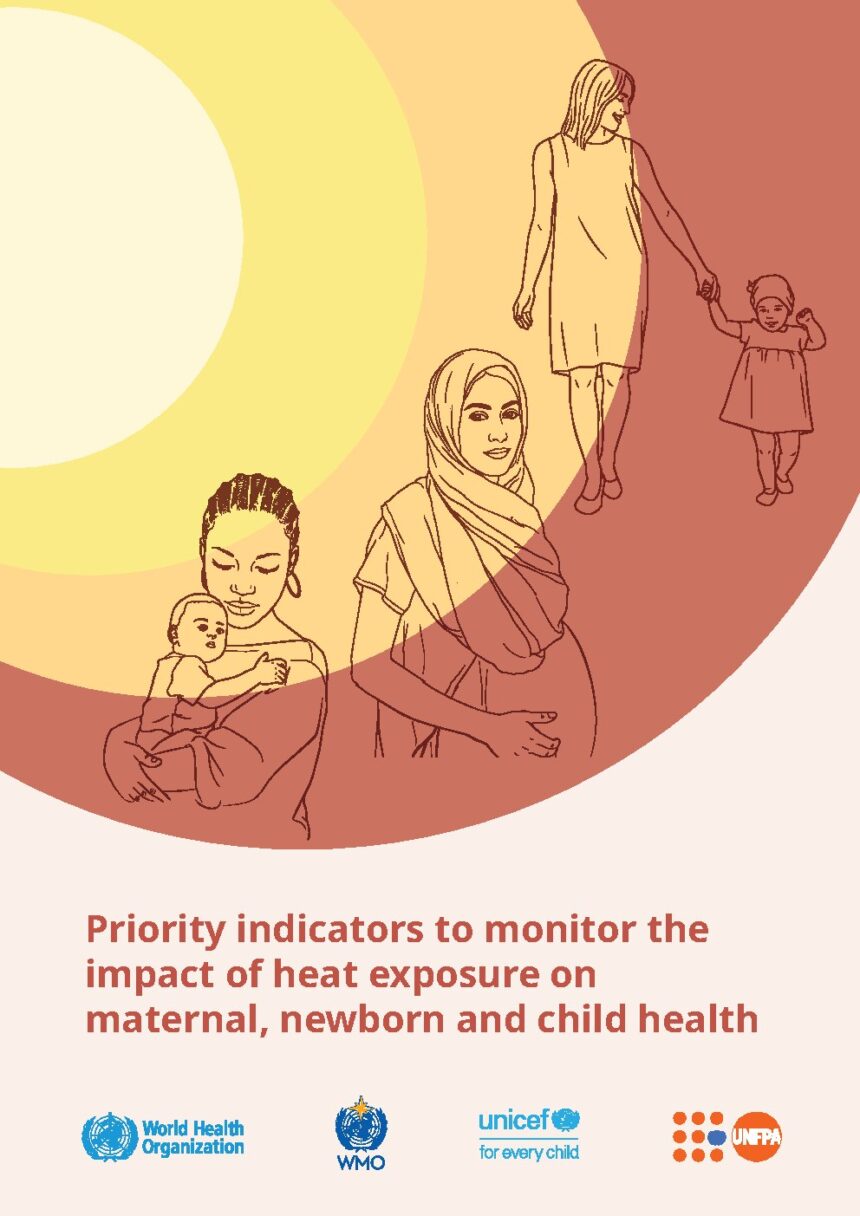
This WHO/WMO/UNICEF/UNFPA technical document establishes a priority set of indicators for monitoring the impact of extreme heat on maternal, newborn and child health (MNCH). Developed through structured expert consensus and multi-country consultation, it addresses the critical information gap in tracking heat exposure impacts on vulnerable populations as climate change intensifies.
The framework organises indicators into four domains: routine MNCH monitoring (core: preterm birth and outpatient attendance; additional: hypertension in pregnancy, late stillbirths, low birth weight, under-five mortality in facilities, school attendance); public health surveillance (mortality and emergency visits disaggregated by age/sex); climate and health sector response (integration of MNCH into national climate–health mechanisms, early warning systems, training, surveillance); and heat exposure data (air temperature as core, with Heat Index, UTCI and WBGT as additional measures).
The indicators are intended to flag potential heat-related impacts and trigger further investigation rather than establish causality. Countries should analyse health data alongside meteorological observations at appropriate temporal (daily/weekly/monthly) and spatial (facility/district) scales, establishing baselines to detect deviations during heat events and inform anticipatory action.
Key points
For clinicians — doses and thresholds as stated in the guideline
- Core routine MNCH indicators: preterm birth rate in facilities (<37 completed weeks gestation) and outpatient attendance rate, analysed monthly or more frequently during heat events
- Additional routine indicators: hypertension in pregnancy (≥140/90 mmHg), late stillbirths (≥28 weeks), low birth weight (<2500 g), under-five mortality in facilities, and average daily school attendance
- Public health surveillance indicators: mortality rate and emergency room visits, both disaggregated by age (newborns 0–6 days and 7–<28 days; children 1 month–4 years and 5–9 years; women 15–49 years) and sex
- Core heat exposure measure: air temperature (daily maximum and minimum); additional composite indices: Heat Index, Universal Thermal Climate Index (UTCI), and wet-bulb globe temperature (WBGT)
- Climate sector integration: ministries of health should include MNCH in climate–health task forces, vulnerability assessments, early warning distribution to subnational authorities, training programmes, and surveillance systems with meteorological information
- Data analysis approach: align health and heat data temporally and spatially, establish baselines from recent years without extreme heat, compare observed versus expected values, identify concurrent deviations, and interpret as signals requiring investigation
- All indicators should be analysed alongside heat exposure data using spatial and temporal analyses; concurrent increases in preterm births or outpatient visits with elevated temperatures flag potential heat impacts
- National meteorological services are the preferred source for temperature and climate data; ERA5 reanalysis may supplement where observational data are unavailable but limitations should be acknowledged
Core and additional indicators for routine monitoring of MNCH
Table extracted from the guideline
| Life stage | Priority | Indicator name | Data source |
|---|---|---|---|
| Maternal, newborn | Core | Preterm birth (<37 weeks) in facilities | RHIS, medical records |
| Maternal, newborn, child | Core | Outpatient attendance | RHIS, OPD register |
| Maternal | Additional | Hypertension in pregnancy (≥140/90 mmHg) | RHIS, antenatal register |
| Newborn | Additional | Late stillbirths in facilities (≥28 weeks) | RHIS, birth register |
| Newborn | Additional | Low birth weight (<2500 g) | RHIS, medical records |
| Newborn, child | Additional | Under-five mortality rate in facilities | RHIS |
| Child | Additional | Average % daily attendance at primary school | School records |
Source: World Health Organization, Priority indicators to monitor the impact of heat exposure on maternal, newborn and child health. Reproduced in summary form.
From the guideline
Verbatim
“The proposed indicators reflect critical associations between heat exposure and MNCH identified in the literature, and are intended to flag potential impacts and to trigger further investigation and response.”
Editor’s perspective
Why this matters for Georgia and the region
Prof. Giorgi Pkhakadze, MD, MPH, PhD
Editor-in-Chief, Georgian Medical Journal · Chair, Public Health Institute of Georgia · WHO consultant, health and migration
As Chair of the Public Health Institute of Georgia and WHO consultant on health and migration, I recognise the urgency of operationalising heat–MNCH surveillance as the South Caucasus experiences more frequent extreme heat events. Georgia's DHIS2 system and vital registration infrastructure provide the technical foundation for implementing the core indicators—preterm birth monitoring and outpatient attendance—at facility and district levels. The key recommendation I would stress to Georgian colleagues is establishing formal coordination between the Ministry of Health and the National Environment Agency to enable automated integration of daily temperature data into health surveillance dashboards, with early warning distribution to all rayon-level health authorities. The realistic implementation caveat is that accurate gestational age assessment in antenatal care remains inconsistent, particularly in rural areas, so we may initially need to rely on low birth weight as a proxy while strengthening antenatal documentation and provider training on Ballard or New Ballard Score assessment.
ORCID 0000-0001-7609-4515 · Perspective written for the GMJ Guidelines Library, 22 Oct 2026
Applicability
Georgia and the South Caucasus
Georgia and the South Caucasus face increasing heat exposure as part of broader climate change impacts affecting the Eastern Mediterranean and European regions. National MNCH programmes with established DHIS2 or similar routine health information systems can implement these indicators by integrating meteorological data from national hydrometeorological services. Georgia’s existing maternal and perinatal death surveillance (MPDSR) system and birth registration infrastructure provide foundations for tracking preterm births, stillbirths and facility-based mortality alongside temperature data. The Public Health Institute would need to establish formal data-sharing agreements between the Ministry of Health and the National Environment Agency to enable routine heat–health monitoring, ensure subnational health authorities receive heat warnings, and integrate MNCH considerations into national climate adaptation planning. Accurate gestational age assessment in antenatal care and complete reporting from both public and private facilities remain prerequisites for reliable preterm birth monitoring.
Questions this guideline answers
Quick answers
Why focus specifically on maternal, newborn and child populations for heat monitoring?
Pregnant and postpartum women, newborns and children have unique anatomical, developmental and physiological vulnerabilities to heat. Pregnant women have increased metabolic heat production and reduced thermoregulatory capacity. Infants and young children have higher surface-area-to-mass ratios, immature thermoregulation, and depend on caregivers for adaptive behaviours. Evidence links heat exposure to preterm birth, stillbirth, low birth weight, hypertensive disorders in pregnancy, and increased morbidity and mortality in children. These populations serve as sentinels for climate health impacts.
Can we use these indicators if we don't have complete facility data or accurate gestational age recording?
The document acknowledges reporting challenges. Where gestational age is unreliable, low birth weight (<2500 g) can serve as a proxy for preterm birth. Routine health information system data often under-represent populations without health system contact and may exclude private facilities. Programme managers should verify data availability and quality before analysis, restrict analysis to facilities with consistent reporting, and transparently document limitations. Even incomplete data can signal trends if analysed consistently over time within the same facilities.
Which heat exposure measure should we use—air temperature or composite indices like UTCI?
Air temperature (daily maximum and minimum) is designated as the core measure because it is simple, widely available from meteorological services, and commonly used in heat warning systems. Composite indices like Universal Thermal Climate Index (UTCI), Heat Index or wet-bulb globe temperature better reflect thermal load by incorporating humidity, wind and radiation, and may show greater sensitivity in humid regions. However, these indices were not developed or validated for MNCH populations. In practice, different measures produce broadly similar associations in many settings. National meteorological services can advise on data availability and suitability for local conditions.
How do we establish baselines and detect heat-related impacts in our routine data?
Establish baselines from recent years when temperatures did not exceed climatological normals, ideally using multiple years to account for seasonal variation. During or after heat events, compare observed indicator values (e.g., preterm births, outpatient visits) against expected values from the baseline period, aligned temporally (daily, weekly or monthly) and spatially (facility or district level). Visualise data using combination charts overlaying health indicators and temperature. Concurrent increases in both signal potential heat impacts requiring further investigation. Programme managers should consider reporting completeness, seasonal disease patterns, and contextual factors when interpreting deviations.
Related on GMJ
Interconnected resources
Dictionary of Public Health
GMJ News coverage
- Preventing Heat Illness in Children: Evidence-Based Strategies for Parents and CaregiversOct 2026
- Cervical Length Screening Could Prevent Thousands of Preterm Births, Meta-Analysis ShowsJun 2026
- Gonorrhea burden in sub-Saharan Africa remains stubbornly high: new meta-analysis reveals 3.2% general population prevalenceSep 2026
Quality & accreditation
- ASF Hospital — Standard 18 — Sustainable Care
- ASF Hospital — Standard 4 — Care & Treatment
- ASF Hospital — Standard 6 — Aftercare & Follow-up
- ASF Hospital — Standard 5 — Safety & Emergency Preparedness
- ASF Hospital — Standard 11 — Critical Care
- ASF Medical Transport — Standard 6 — Emergency Response During Transport
Other guidelines on this topic
- Special situations in multidrug-resistant and rifampicin-resistant tuberculosis treatment — MSF Tuberculosis
- Endemic goitre and iodine deficiency — MSF Clinical guidelines
- Special situations in drug-susceptible tuberculosis treatment — MSF Tuberculosis
- Depression — MSF Clinical guidelines
- Abnormal uterine bleeding (in the absence of pregnancy) — MSF Clinical guidelines
- Issuer
- World Health Organization
- Type
- Standards
- Edition
- 1st edition, 2026
- Status
- Current
- Published
- 2026-10-21
- Languages
- English
- Scope
- Global, applicable to all WHO regions with context-specific implementation
- Audience
- MNCH programme managers, public health surveillance staff, meteorological services, climate and health officers, implementing partners, researchers
- Pages
- 56
- Licence
- CC BY-NC-SA 3.0 IGO
- ISBN
- 978-92-4-012506-3
- Evidence
- Expert consensus following structured indicator prioritization process, informed by systematic literature review and multi-country stakeholder consultation
- Next review
- Recommended review in coming years as evidence accumulates
- Record history
- Created 22 Oct 2026 · updated 22 Oct 2026 · next check Apr 2027
Priority indicators to monitor the impact of heat exposure on maternal, newborn and child health. Geneva: World Health Organization; 2026. Licence: CC BY-NC-SA 3.0 IGO.GMJ Guidelines Library records are original summaries written by the GMJ editorial team from the issuer’s published document and reviewed by a physician. They do not replace the full guideline. The document is the copyright of its issuer and is linked, not hosted. Spotted an error or a newer edition? Tell the Guidelines Desk.
Was this article helpful?