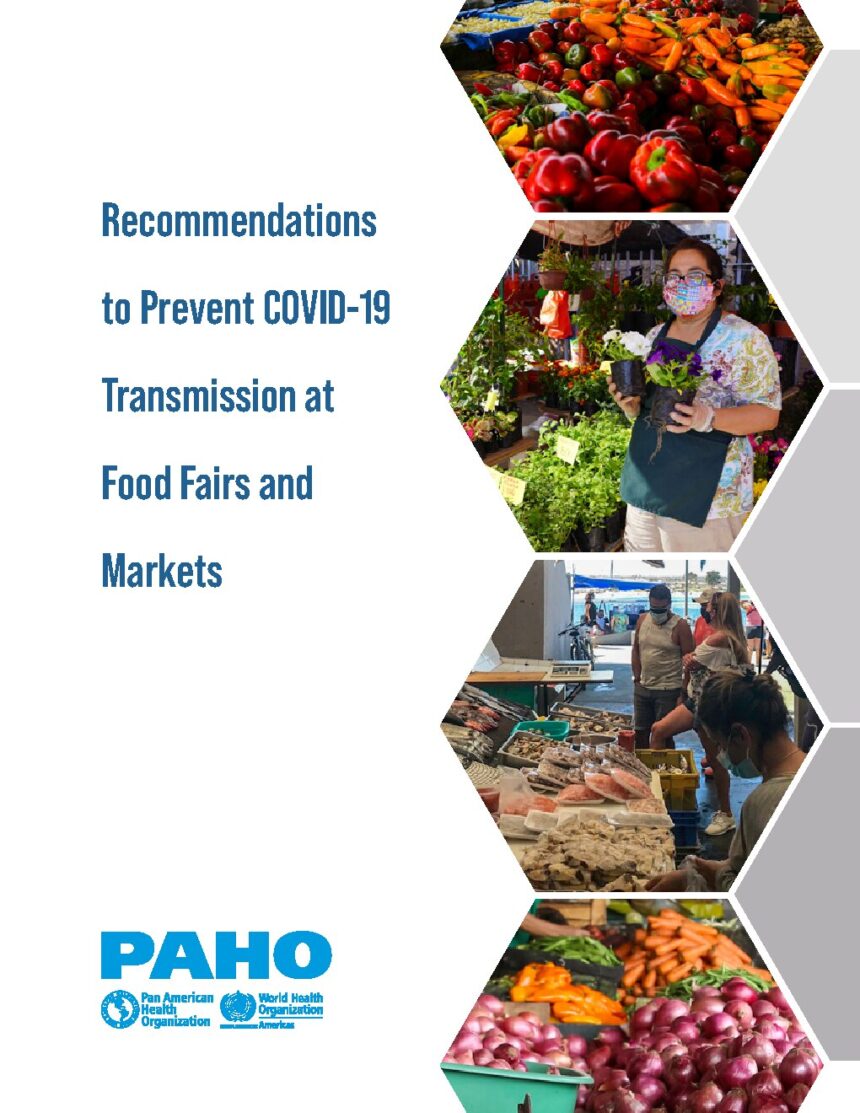
Pan American Health Organization · 2021
Guidance for authorities, market operators, workers and visitors to ensure safe operation of food markets during the pandemic
- Issuer
- Pan American Health Organization
- Edition
- 2021
- Audience
- National and local government authorities, market operators, market workers, public health professionals
- Evidence
- Expert consensus based on country experiences and scientific literature review
- Reviewed
- 18 Oct 2026 · GMJ
What this guideline says
GMJ summary
This Pan American Health Organization (PAHO) handbook provides comprehensive recommendations to prevent SARS-CoV-2 transmission in food fairs and markets across Latin America while maintaining food security. The document addresses a critical tension: these markets are essential for food access—especially for vulnerable populations—yet present significant infection risk due to crowding and aerosol generation.
The guidance is structured around four stakeholder groups: national and local authorities (responsible for coordination, situation assessment, training and risk communication); market operators (managing physical space, operations, hygiene and capacity); workers (personal hygiene, customer care, symptom monitoring); and visitors (physical distancing, mask use, organized shopping). Key measures include relocating markets to large outdoor spaces like stadiums, maintaining at least 1.5 m physical distancing, implementing one-way pedestrian flow, controlling capacity, providing hand-washing stations, and ensuring social protection for informal workers who might otherwise attend work while ill.
The document emphasizes that food markets are vital economic and social infrastructure—in Chile alone, 1,114 registered fairs operate 113,112 stalls serving over 2 million weekly shoppers—and that their safe operation requires intersectoral coordination, adequate resourcing, enforcement of protocols, and protection of the predominantly informal workforce.
Key points
For clinicians — doses and thresholds as stated in the guideline
- Maintain physical distance of at least 1.5 m between people inside markets and fairs at all times
- Relocate markets to large outdoor spaces (stadiums, sports fields) to allow better distancing and ventilation; avoid enclosed spaces that promote aerosol generation
- Implement one-way pedestrian flow with separate entrance and exit points; restrict vehicle access and adjust operating hours to prevent crowding
- Establish hand hygiene stations with soap and water at entrances; require correct mask use covering nose and mouth throughout visits
- Workers with respiratory symptoms or COVID-19-compatible illness must not attend work and should seek medical testing immediately
- Prevent customers from directly handling products; use prepackaged items and avoid direct contact during transactions
- Form intersectoral emergency committees at national and local levels including health, agriculture, social development, and market stakeholders
- Provide social protection for informal and self-employed market workers to prevent attendance while ill or as contacts of confirmed cases
Recommendations for national and local authorities
Table extracted from the guideline
| Area | Recommendations |
|---|---|
| Intersectorality | Convene intersectoral emergency committee (productive sector, businesses, health/agriculture/social ministries, academia); declare fair activities as essential services to maintain food system function |
| Situation assessment | Map all formal/informal fairs with data on stall numbers, size, operating dates/hours, worker residence, products sold; assess structural and economic needs for optimal health measures |
| Participatory action plan | Develop intersectoral plan addressing infection risk, crowding, and cases; implement national/local emergency regulations; avoid unnecessary closures; monitor compliance; provide social protection for self-employed/informal workers |
| Training | Organize training with specialized entities for authorities and key market players who contribute knowledge and monitor compliance |
| Communication and risk perception | Funded communications strategy adapted to pandemic evolution; mass media and digital campaigns on prevention; messages in all public appearances by authorities |
Source: Pan American Health Organization, Recommendations to Prevent COVID-19 Transmission at Food Fairs and Markets. Reproduced in summary form.
From the guideline
Verbatim
“Food markets and fairs present a major risk of SARS-CoV-2 infection and there is considerable evidence of highly infectious lethal outbreaks in the countries studied.”
Editor’s perspective
Why this matters for Georgia and the region
Prof. Giorgi Pkhakadze, MD, MPH, PhD
Editor-in-Chief, Georgian Medical Journal · Chair, Public Health Institute of Georgia · WHO consultant, health and migration
As someone who has advised on health systems strengthening across the region, I recognise that Georgia's traditional markets face identical challenges to those described for Latin America: concentrated crowds, informal employment, and reliance on direct product handling. The most critical recommendation for our context is the call for social protection mechanisms that allow informal stallholders to stay home when ill—without such support, compliance with isolation protocols becomes nearly impossible regardless of how well-designed the physical measures are. The guidance's emphasis on intersectoral coordination through formal emergency committees resonates with Georgia's experience managing TB and hepatitis C programmes, where multi-stakeholder engagement proved essential. One realistic caveat: relocating established urban markets to stadiums or sports fields, while epidemiologically sound, will face significant resistance from both vendors and customers accustomed to traditional locations, requiring sustained community engagement and perhaps phased implementation rather than abrupt changes.
ORCID 0000-0001-7609-4515 · Perspective written for the GMJ Guidelines Library, 18 Oct 2026
Applicability
Georgia and the South Caucasus
For Georgia and the South Caucasus, these recommendations are directly applicable to traditional markets (bazroba) that remain central to food distribution, particularly for fresh produce, in Tbilisi and regional centres. The guidance addresses challenges highly relevant to the region: high proportion of informal workers in market settings, reliance on cash transactions, and cultural shopping patterns involving direct product handling and social interaction. National programmes would need to assess the capacity of municipal authorities to enforce distancing measures, availability of alternative large outdoor venues for market relocation, and mechanisms to provide income support for informal stallholders during illness—a particular challenge given limited social protection systems. The emphasis on maintaining food security while managing infection risk aligns with Georgia’s broader public health priorities and its experience balancing economic and health concerns during the pandemic.
Questions this guideline answers
Quick answers
What physical distancing is required in food markets during COVID-19?
A minimum distance of 1.5 metres must be maintained between all people (workers, sellers, and shoppers) inside markets and fairs at all times. Markets should be relocated to large outdoor spaces like stadiums or sports fields to facilitate this distancing, and one-way pedestrian flow should be implemented with separate entrance and exit points.
What should market workers do if they have respiratory symptoms?
Workers with respiratory or other symptoms compatible with COVID-19 must not attend work. They should seek medical attention immediately to have necessary tests performed and receive preventive guidance. This requires social protection systems to support informal workers financially during illness to prevent them from working while infectious.
How should products be handled to reduce transmission risk?
Customers should be prevented from having direct access to products to prevent handling. Sellers should use prepackaged bags and plastic wrapping, prepare boxes containing common weekly shopping items, and select products for customers rather than allowing direct handling. Transactions should be conducted without direct contact wherever possible.
What role should authorities play in keeping markets safe?
Authorities should convene intersectoral emergency committees (health, agriculture, social sectors, market stakeholders), map all markets with operational data, develop funded action plans with enforcement mechanisms, organize training for market operators, implement risk communication campaigns, and crucially, provide social protection for informal workers so they can stay home when ill without losing income.
Related on GMJ
Interconnected resources
Dictionary of Public Health
GMJ News coverage
Quality & accreditation
Other guidelines on this topic
- Guidance on Indoor Environmental Quality in Health Care Facilities
- Respiratory Protection Program for Healthcare Workers
- Risk Communication and Community Engagement for Contact Tracing in the Context of COVID-19 in the Region of the Americas
- Root cause analysis of a yellow fever outbreak: user manual and questionnaire
- User manual for the Member State Rapid Risk Assessment (MS-RRA) tool
- Issuer
- Pan American Health Organization
- Type
- Procedures, manuals, guidelines
- Edition
- 2021
- Status
- Current
- Published
- 2022-01-01
- Languages
- Spanish, English
- Scope
- Food fairs and markets selling fresh natural foods from small-scale producers
- Audience
- National and local government authorities, market operators, market workers, public health professionals
- Licence
- CC BY-NC-SA 3.0 IGO
- Evidence
- Expert consensus based on country experiences and scientific literature review
- Record history
- Created 18 Oct 2026 · updated 18 Oct 2026 · next check Apr 2027
Pan American Health Organization. Recommendations to Prevent COVID-19 Transmission at Food Fairs and Markets. Washington, D.C.: PAHO; 2021. (PAHO/IMS/FPL/COVID-19/21-0005).GMJ Guidelines Library records are original summaries written by the GMJ editorial team from the issuer’s published document and reviewed by a physician. They do not replace the full guideline. The document is the copyright of its issuer and is linked, not hosted. Spotted an error or a newer edition? Tell the Guidelines Desk.
Was this article helpful?