World Health Organization · 1st edition, 2024 · 83 pages
Clinical and operational guidance for Burn Assessment Teams and Burn Specialist Teams responding to mass burn events
- Issuer
- World Health Organization
- Edition
- 1st edition, 2024
- Audience
- Emergency Medical Teams, burn care specialists, emergency physicians, surgeons, anaesthetists, nurses, rehabilitation specialists, ministries of health, disaster response coordinators, humanitarian organizations
- Evidence
- Clinical recommendations developed using GRADE methodology with systematic reviews; technical standards based on expert consensus, literature review, and field experience from mass burn incidents 2017–2023
- Reviewed
- 23 Oct 2026 · GMJ
What this guideline says
GMJ summary
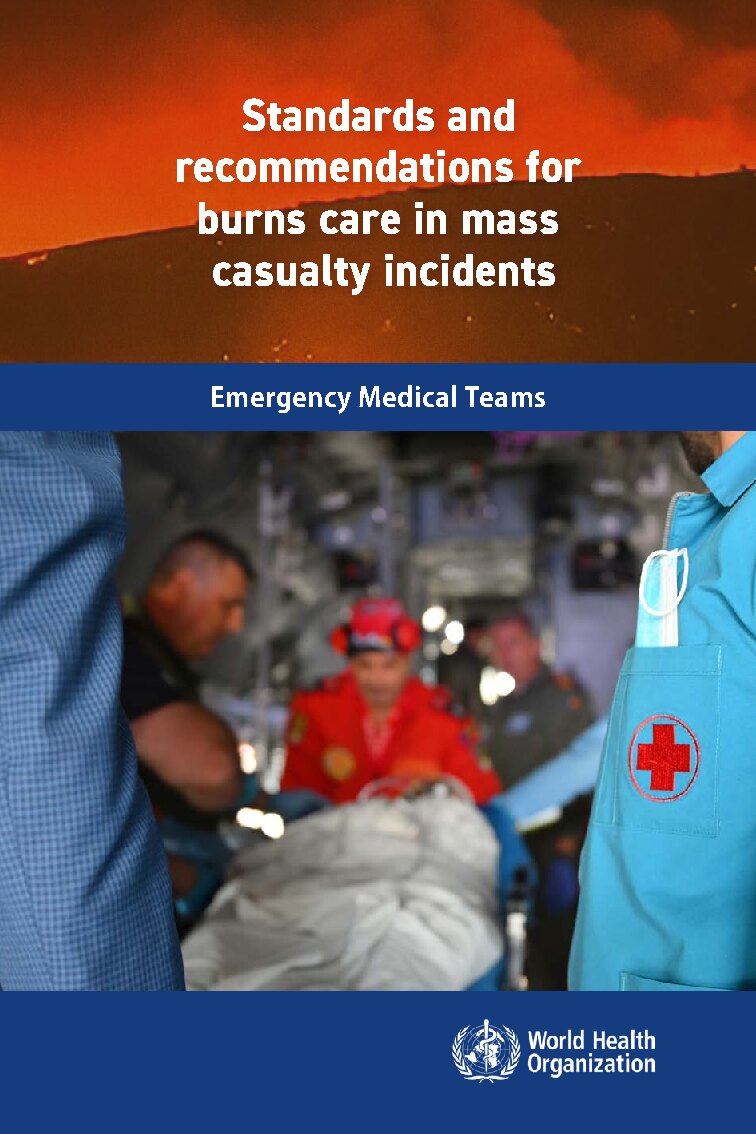
This 2024 WHO guideline establishes minimum standards and clinical recommendations for burns care during mass casualty incidents (MCIs). It defines two specialized team types: Burn Assessment Teams (BATs) for rapid deployment within hours to provide advisory, clinical and coordination functions; and Burn Specialist Teams (BSTs) for sustained deployment (six weeks) to deliver advanced burn care and capacity building. The document covers the complete patient journey from on-scene triage through rehabilitation.
Key clinical recommendations address fluid management, the most resource-intensive aspect of major burns care. The guideline recommends oral fluid resuscitation where possible, supplemented by IV fluids based on patient need and resources. A three-phase triage approach is mandated: on-scene using conventional MCI triage with %TBSA estimation, on-arrival at first receiving hospital, and definitive triage after surgical scrub. Standard formulae should be used for fluid calculation, with fluids initiated as early as possible.
The guidance emphasizes that countries should include specific provisions for mass burn incidents in disaster plans, ideally creating national BATs or regional agreements. Burns rehabilitation should commence once vital functions are stable, with active exercises, positioning, splinting and compression therapy to minimize scarring and contractures.
Key points
For clinicians — doses and thresholds as stated in the guideline
- Three-phase triage: (1) on-scene using conventional MCI systems plus %TBSA estimation via Wallace Rule of Nines; (2) on-arrival at first receiving hospital; (3) definitive after surgical scrub/wound cleaning
- Oral fluid resuscitation preferred where feasible, using Oral Rehydration Salts with potable water; supplement with IV crystalloids based on standard formulae (e.g., Parkland 4 mL/kg/%TBSA over 24 hours, half in first 8 hours)
- Burn cooling: 10 minutes to 3 hours post-injury using potable water at room or cool temperature (avoid hypothermia)
- Patients with >20% TBSA burns and/or deep dermal or special area burns (face, neck, perineum, genitalia, joints, hands, feet) require evaluation by burn specialist and transfer to tertiary centre
- Decision to assign 'expectant/non-survivable' category should occur at first receiving hospital, not on-scene, ideally under expert guidance
- Antibiotics should NOT be given prophylactically unless specifically clinically indicated
- Rehabilitation (active/passive exercises, positioning, splinting, compression therapy and massage) should start once vital functions stable, with adequate analgesia administered prior to interventions
- BATs deploy within hours for 2 weeks; BSTs deploy within days for 6 weeks; both must be self-sufficient for minimum 2 weeks (BATs) to 2 weeks prior to resupply (BSTs)
Guide to %TBSA-based burn specific triage
Table extracted from the guideline
| Triage Category | Estimated %TBSA burn | Additional comments |
|---|---|---|
| Priority 3 | <20% | |
| Priority 2 | 20–40% | Circumferential limb burns; special area burns |
| Priority 1 | >40% | Inhalational injuries; circumferential chest wall burns irrespective of %TBSA |
Source: World Health Organization, Standards and recommendations for burns care in mass casualty incidents. Reproduced in summary form.
From the guideline
Verbatim
“As part of their mass casualty or disaster plan, it is recommended that Member States include specific provisions for a potential mass burn incident.”
Editor’s perspective
Why this matters for Georgia and the region
Prof. Giorgi Pkhakadze, MD, MPH, PhD
Editor-in-Chief, Georgian Medical Journal · Chair, Public Health Institute of Georgia · WHO consultant, health and migration
The September 2023 Armenia fuel depot explosion that killed 170 people occurred barely 200 kilometres from Tbilisi, reminding us that mass burn incidents respect no borders. As WHO consultant on health and migration, I have seen how rapidly such events overwhelm even well-resourced systems. This guideline's most valuable contribution for Georgia is the actionable framework for establishing a national Burn Assessment Team—a modest investment of training six specialists who can deploy within hours to coordinate response, perform early triage using the three-phase approach, and determine whether international assistance is needed. The recommendation for oral fluid resuscitation is particularly relevant for our district hospitals, where IV capacity may be limited during mass casualty situations; however, implementation will require pre-positioning adequate supplies of Oral Rehydration Salts and ensuring clean water access, which should be integrated into our national disaster stockpiles. The guidance on not assigning 'expectant' status on-scene but waiting for expert assessment at hospital is ethically important and operationally sound. One implementation challenge for Georgia will be developing the specialized burn rehabilitation capacity recommended in the document—we have relatively few physiotherapists trained in acute burn care, splinting techniques, and scar management, suggesting a need for targeted training partnerships, potentially with regional burn centres in Turkey or European programmes.
ORCID 0000-0001-7609-4515 · Perspective written for the GMJ Guidelines Library, 23 Oct 2026
Applicability
Georgia and the South Caucasus
Georgia and the South Caucasus region face specific mass burn incident risks including industrial accidents, conflicts (as demonstrated by recent regional hostilities), and earthquake potential. The September 2023 Armenia fuel depot explosion—with 170 fatalities and nearly 300 burn injuries—occurred in Georgia’s immediate neighbourhood, with WHO establishing an EMT Coordination Cell in Yerevan and international BSTs deploying. This guideline is directly applicable: Georgia should develop a national BAT as recommended, potentially within existing emergency medical service structures or the National Center for Disease Control and Public Health emergency operations framework. Regional cooperation among Georgia, Armenia and Azerbaijan for BST sharing would be cost-effective given the rarity but high impact of such events. The guidance on oral fluid resuscitation is particularly relevant for pre-hospital and district hospital settings where IV capacity may be limited. National disaster preparedness plans should integrate these burn-specific provisions, including pre-positioned supplies of Oral Rehydration Salts, crystalloid fluids, and burn dressings. The rehabilitation recommendations align with Georgia’s developing physical medicine and rehabilitation services but highlight the need for specialized burn rehabilitation training for physiotherapists and occupational therapists.
Questions this guideline answers
Quick answers
When should IV fluids be used instead of oral fluids for burn patients in a mass casualty incident?
Oral fluid resuscitation with ORS and potable water is preferred where feasible. Supplement with IV crystalloids (using standard formulae like Parkland: 4 mL/kg/%TBSA over 24 hours) based on patient need, clinical resources and provider discretion. Children unable to follow instructions, patients with compromised mental status, those with high %TBSA burns, and those not tolerating oral intake require IV fluids. The recommendation acknowledges that IV fluid is standard of care when resources are available.
How do I estimate burn size on-scene during a mass casualty incident?
Use the %TBSA estimation tool most familiar to first responders, but if guidance is needed, apply the Wallace Rule of Nines: for adults, 9% for head/neck, 9% for each arm (18% both), 18% for anterior torso, 18% for back, 18% for each leg (36% both), 1% perineum. For children use the modified version (18% head, 13.5% each leg). Do NOT assess depth on-scene—focus only on %TBSA. Re-estimate on arrival at hospital and again after surgical scrub, as initial estimates are often inaccurate.
Which burn patients can be discharged home versus transferred to a specialist centre?
Patients with <20% TBSA superficial/partial thickness burns and no special area burns may be discharged with adequate outpatient support, clear care pathway, and social/community support. Patients with >20% TBSA and/or deep dermal burns and/or special area burns (face, neck, perineum, genitalia, joints, hands, feet) should be evaluated by an experienced burn specialist as they may require ongoing inpatient care and transfer to a specialist burn centre. Transfer only after patient is clinically stable and appropriate communication has occurred.
What is the difference between a BAT and a BST, and which does my country need?
Burn Assessment Teams (BATs) are small (6 members: team leader, burn surgeon, anaesthetist, nurse, logistician, rehabilitation specialist) rapid-response teams deploying within hours for 2 weeks, providing advisory, clinical and coordination functions. Burn Specialist Teams (BSTs) are larger multidisciplinary teams deploying within days for 6 weeks, focused on clinical care and capacity building. All countries should create a national BAT or have regional agreements for BAT access. BSTs may be best shared regionally among multiple countries given the rarity of mass burn incidents and difficulty assembling teams for long deployments.
Related on GMJ
Interconnected resources
Dictionary of Public Health
GMJ News coverage
ASF accreditation standards
Other guidelines on this topic
- Using the Package of Interventions for Rehabilitation in Georgia
- Falls: assessment and prevention in older people and in people 50 and over at higher risk
- Suspected sepsis in under 16s: recognition, diagnosis and early management (NG254)
- Suspected sepsis in people aged 16 or over: recognition, assessment and early management
- Instrumental delivery — MSF Essential obstetric and newborn care
- Issuer
- World Health Organization
- Type
- Guideline
- Edition
- 1st edition, 2024
- Status
- Current
- Published
- 2024-11-25
- Languages
- English
- Scope
- Mass burn incidents (multiple casualties with burn injuries requiring surge response); covers operational standards for BATs and BSTs, clinical care from scene through rehabilitation, and specific recommendations on fluid management
- Audience
- Emergency Medical Teams, burn care specialists, emergency physicians, surgeons, anaesthetists, nurses, rehabilitation specialists, ministries of health, disaster response coordinators, humanitarian organizations
- Pages
- 83
- Licence
- CC BY-NC-SA 3.0 IGO
- ISBN
- 9789240100237
- Evidence
- Clinical recommendations developed using GRADE methodology with systematic reviews; technical standards based on expert consensus, literature review, and field experience from mass burn incidents 2017–2023
- Record history
- Created 23 Oct 2026 · updated 23 Oct 2026 · next check Apr 2027
World Health Organization. Standards and recommendations for burns care in mass casualty incidents. Geneva: WHO; 2024. (Emergency Medical Teams). Licence: CC BY-NC-SA 3.0 IGO.GMJ Guidelines Library records are original summaries written by the GMJ editorial team from the issuer’s published document and reviewed by a physician. They do not replace the full guideline. The document is the copyright of its issuer and is linked, not hosted. Spotted an error or a newer edition? Tell the Guidelines Desk.
Was this article helpful?