Updated 13/09/2026
Photo: Baby bottle clipart, object illustration, by None · Public domain / CC0 · Source
Plain-language summary of research published in the Georgian Medical Journal. Written for the general public by the GMJ News editorial team.
Infant formula is among the most tightly regulated food products in the world — yet a 2025–2026 multi-country contamination event, involving the cereulide toxin, spread across nearly one hundred countries with over 100 suspected and confirmed infant illness cases. A commentary in the Georgian Medical Journal argues this wasn’t a freak accident, but a predictable outcome of how global infant formula safety is currently governed.

A Pattern, Not an Anomaly
The commentary situates the cereulide outbreak within a longer sequence of recurring crises: the 2008 melamine contamination in China, the 2017–2018 Salmonella outbreak in France, and the 2022 Cronobacter-related disruption in the United States. Across all of these events, the same structural failures recur: upstream supply chain opacity, fragmented recall systems, delayed detection and communication, and contaminated products persisting at the household level even after a recall is announced.
What That Repetition Reveals
The pattern’s consistency is the commentary’s central argument: infant formula contamination isn’t an isolated anomaly to be treated case by case, but a predictable outcome of fragmented, reactive global food safety systems — meaning the fix has to be structural and preventive, not another one-off response to the next crisis after it’s already happened.
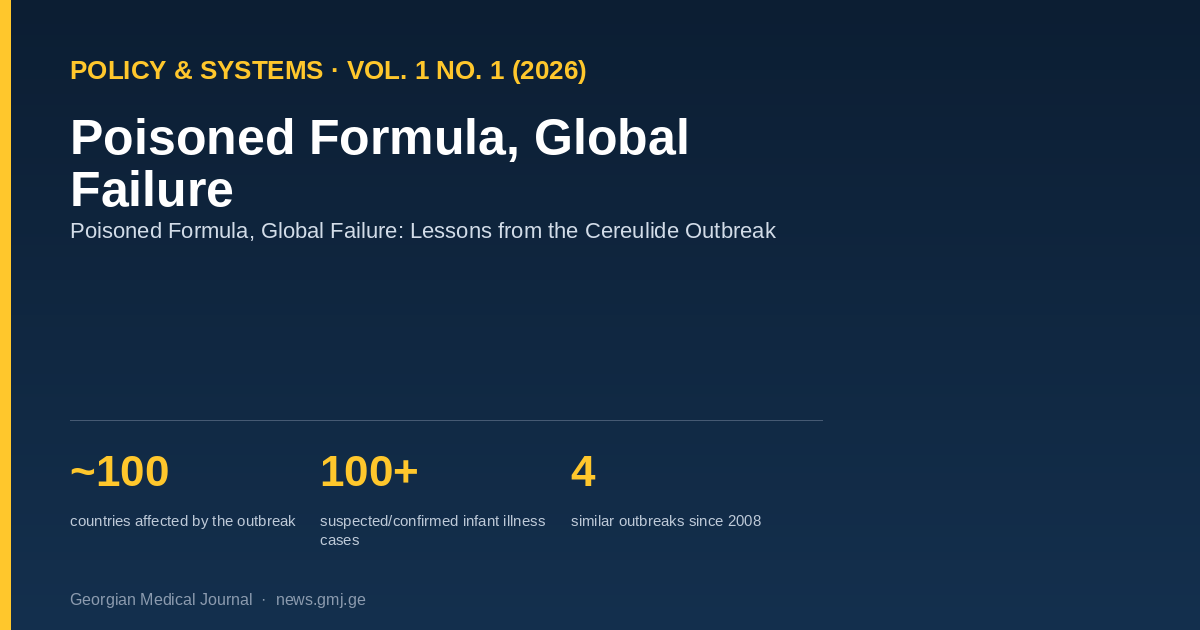
At a glance — the headline figures.
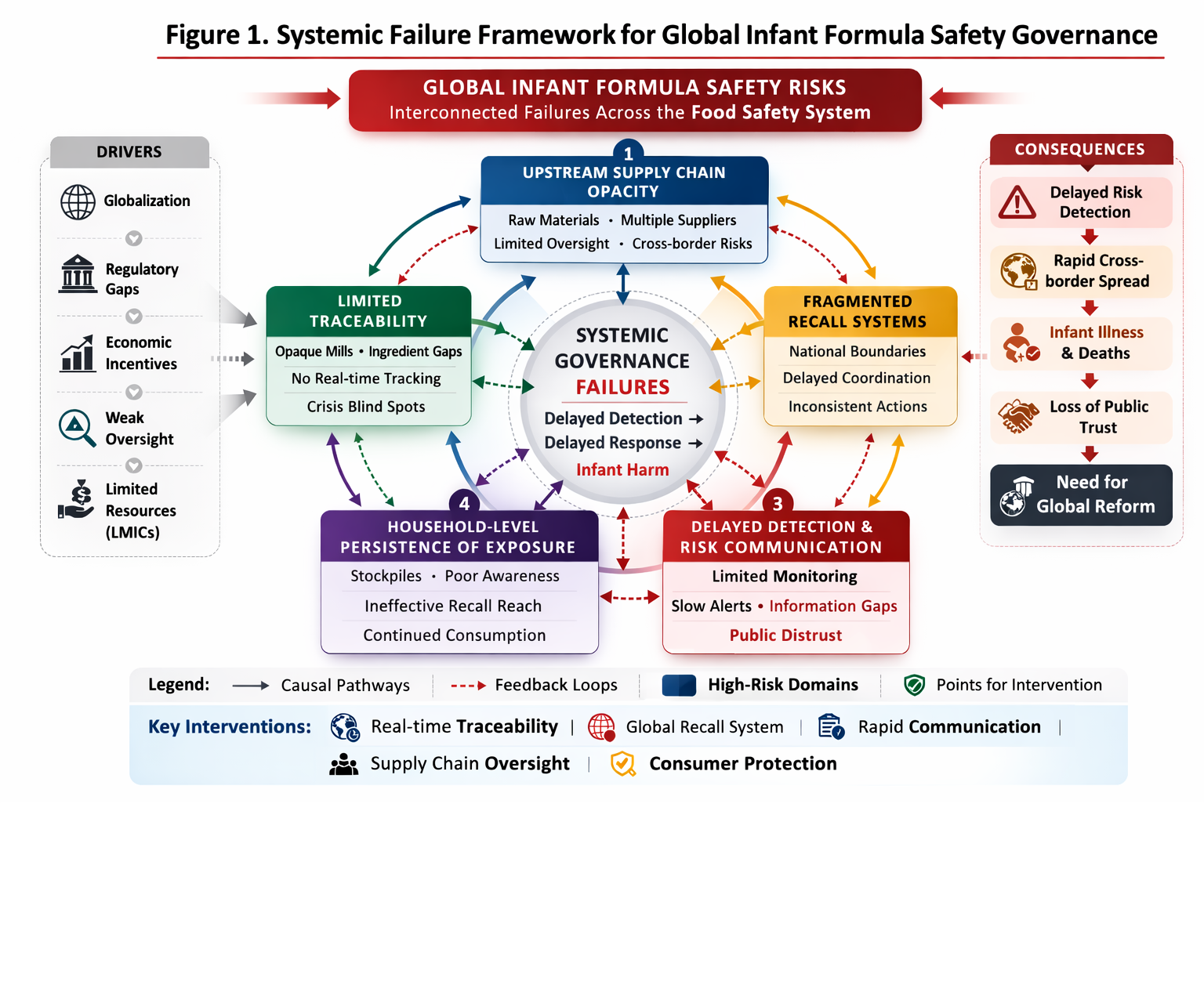
A systemic failure framework mapping the drivers, governance gaps, and consequences of global infant formula safety failures. Figure from the commentary. Source: Georgian Medical Journal, Vol. 1 No. 1 (2026), DOI: 10.5281/zenodo.19113543.
The commentary’s point lands hardest as a warning about timing: every one of these outbreaks was preventable in hindsight, and every one prompted the same round of after-the-fact recalls and inquiries rather than the kind of prevention-first governance that would stop the next one before it starts. This piece was published alongside a companion paper — see below — that proposes exactly that kind of precautionary blueprint.
🗺️ Find certified Georgian healthcare providers: sheniekimi.ge — Georgia Health Map · 998 clinics · 6,600+ doctors · 2,296 pharmacies
Read the Original Research
Original article: Poisoned Formula, Global Failure: Lessons from the Cereulide Outbreak
Published in: Georgian Medical Journal, Vol. 1 No. 1 (2026)
DOI: 10.5281/zenodo.19113543
📄 Read the full article at gmj.ge →
Georgian Medical Journal (GMJ) · ISSN 3088-4322 · gmj.ge · Open Access CC BY 4.0 · Published by the Public Health Institute of Georgia (PHIG). This summary is an independent editorial product of GMJ News; for clinical decisions, consult the original peer-reviewed article and a qualified professional.
Was this article helpful?
Disclaimer. This article is health journalism intended for general information and education. It is not medical advice and is not a substitute for professional diagnosis or treatment. Always consult a qualified healthcare provider about your individual circumstances. Full disclaimer →
Related Coverage




Editorial standards. This article was produced under the GMJ News editorial process, with oversight by the GMJ Editorial Board. Our editorial process. Spotted an error? Contact the editorial team.