By using this site, you agree to the Privacy Policy and Terms of Use.
Accept
GMJ NewsGMJ NewsGMJ News
  • Latest News
  • Research Digest
    • New Studies
    • Georgian Research
    • Data & Numbers
  • Policy & Systems
    • Health Policy
    • Quality & Safety
    • Migration & Health
    • Global Health
  • Practice
    • Clinical Updates
    • Case Discussions
    • Pharmacy & Prescribing
  • Perspectives
    • Editorial
    • Explainers
    • Voices
    • Letters
  • Podcast & Media
    • Podcast Episodes
    • Video
    • Infographics
  • GMJ Articles
    • Vol. 1 Issue 2 (2026)
    • Vol. 1 Issue 1 (2026)
    • Pre-Launch Articles (2025)
  • Read the Journal →
Notification Show More
Font ResizerAa
GMJ NewsGMJ News
Font ResizerAa
  • Latest News
  • Research Digest
    • New Studies
    • Georgian Research
    • Data & Numbers
  • Policy & Systems
    • Health Policy
    • Quality & Safety
    • Migration & Health
    • Global Health
  • Practice
    • Clinical Updates
    • Case Discussions
    • Pharmacy & Prescribing
  • Perspectives
    • Editorial
    • Explainers
    • Voices
    • Letters
  • Podcast & Media
    • Podcast Episodes
    • Video
    • Infographics
  • GMJ Articles
    • Vol. 1 Issue 2 (2026)
    • Vol. 1 Issue 1 (2026)
    • Pre-Launch Articles (2025)
  • Read the Journal →
Follow US
GMJ News > Practice > Clinical Updates > Spinal Nerve Network Controls Body Functions Beyond Back Pain, Research Shows
Clinical UpdatesPractice

Spinal Nerve Network Controls Body Functions Beyond Back Pain, Research Shows

GMJ
Last updated: 05/24/2026 02:47
By
GMJ News Desk
Share
6 Min Read
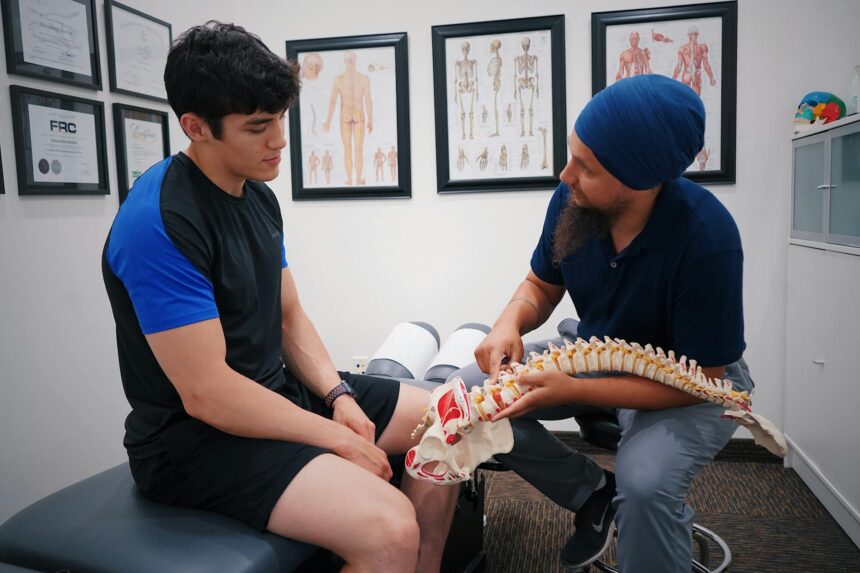
Anatomical diagram showing spinal nerve branches controlling different body systems and organs
New research reveals the spine functions as the body's central wiring harness, with each vertebral level controlling specific organs and body regions. Understanding these nerve connections explains why spinal health affects far more than just back pain. — Photo: World Sikh Organization of Canada / Pexels
SHARE

The human spine functions as the body’s central wiring harness, with each vertebral level sending out nerve branches that control specific regions and organs throughout the body. Recent neuroanatomical research demonstrates that spinal health affects far more than back pain, influencing everything from digestion to respiratory function.

Contents
      • Spinal nerve control by vertebral region
  • Cervical spine affects more than neck movement
  • Thoracic nerves influence organ function
  • Lumbar and sacral nerves control lower body systems
    • Key takeaways
  • Frequently asked questions
    • Can spine problems really affect organ function?
    • Why does neck pain sometimes cause headaches?
    • How does posture affect nerve function?
31 pairs
of spinal nerves branch from the spinal cord to control body functions

Spinal nerve control by vertebral region

Body systems controlled by different spine levels

8
cervical nerves
neck/arms
12
thoracic nerves
chest/abdomen
11
lumbar/sacral
pelvis/legs

Source: Neuroanatomy Research | Georgian Medical Journal News

Cervical spine affects more than neck movement

The cervical spine’s eight nerve pairs control far more than neck rotation. According to anatomical studies published in Clinical Neuroanatomy, the C3-C5 nerve roots form the phrenic nerve, which controls diaphragmatic breathing. Compression at these levels can affect respiratory function, not just arm sensation.

Submit Your Paper
GMJ_Submit_Banner

Research from the Journal of Neurosurgery demonstrates that cervical nerve irritation frequently manifests as headaches, shoulder pain, or arm weakness. Poor posture that compresses these nerve pathways can create symptoms far from the spine itself. For more insights on spinal health research, visit our clinical updates section.

Thoracic nerves influence organ function

The twelve thoracic nerve pairs don’t just control back muscles—they form the sympathetic nervous system pathways that regulate heart rate, digestion, and immune responses. Studies in Autonomic Neuroscience show that thoracic spine dysfunction can alter these autonomic signals.

Dr. Michael Griessenauer, a neurosurgeon at Geisinger Health System, notes in Neurosurgical Focus that thoracic nerve compression affects not only intercostal muscle function but can influence cardiovascular and digestive processes. This explains why some patients with mid-back issues report digestive complaints. Our research digest covers emerging spine-organ connection studies.

Lumbar and sacral nerves control lower body systems

The lumbar spine’s five nerve pairs and sacrum’s five pairs control leg movement, bladder function, and reproductive organ innervation. Research published in The Spine Journal demonstrates that L4-S2 nerve root compression can affect not only leg strength but also bladder and bowel control.

According to findings in European Spine Journal, sedentary behaviors reduce blood flow to spinal tissues, increasing inflammation around nerve roots. This creates a cascade where poor spinal health affects the organs and muscles those nerves serve. Understanding these connections is crucial for comprehensive patient care, as discussed in our clinical explainers.

“The spinal cord and its nerve roots form an integrated network where dysfunction at one level can create symptoms throughout the body, not just localized back pain.”

— Dr. James Weinstein, Spine Specialist, Dartmouth College (The New England Journal of Medicine, 2020)

Key takeaways

  • Each spinal level controls specific body regions through 31 pairs of spinal nerves
  • Cervical spine dysfunction can affect breathing, arm function, and cause headaches
  • Thoracic nerve compression influences heart rate, digestion, and immune responses
  • Lumbar and sacral nerves control leg movement, bladder, and reproductive functions
  • Poor posture and sedentary habits reduce nerve signaling quality throughout the body

Frequently asked questions

Can spine problems really affect organ function?

Yes, research shows spinal nerves carry signals between the brain and organs. When these pathways are compressed or irritated, the affected organs may not function optimally, though this doesn’t mean spine alignment controls disease.

Why does neck pain sometimes cause headaches?

The upper cervical nerves (C1-C3) share pathways with trigeminal nerve fibers that supply the head. Irritation of these cervical nerves can trigger referred pain patterns that manifest as tension headaches.

How does posture affect nerve function?

Poor posture compresses nerve pathways and reduces blood flow to spinal tissues. This compression alters nerve signaling quality and can create symptoms in the organs and muscles those nerves control, from breathing difficulties to digestive issues.

Future research continues exploring the spine-organ connection, with particular focus on how spinal health interventions might support overall systemic function. Understanding the spine as a neural communication highway, rather than just structural support, opens new possibilities for treating conditions previously considered unrelated to spinal health. This integrated approach may reshape how clinicians assess and treat patients with complex, multi-system symptoms.

Source: Your spine isn't just a backbone, it's your body's "wiring harness"


TAGGED:nerve compressionneurological healthspinal anatomyspinal nervesvertebral function
Share This Article
Facebook Copy Link Print
Leave a Comment Leave a Comment

Leave a Reply Cancel reply

Your email address will not be published. Required fields are marked *

Submit Your Paper →

Georgia's peer-reviewed open-access medical journal. No APC until January 2027.
Submit Manuscript →
Brain Signal After Exercise May Determine Fitness Gains, Study Finds

New research identifies SF1 neurons in the brain that activate for one…

Largest Genetic Study Reveals Any Level of Alcohol Consumption Increases Dementia Risk

Genetic analysis of 2.4 million participants reveals any level of alcohol consumption…

Disrupted Circadian Rhythms Trigger Gut Barrier Breakdown and Digestive Dysfunction

New research reveals that disrupted circadian rhythms fundamentally alter gut function, weakening…

Submit Your Paper to GMJ

No APC until January 2027.
Submit Manuscript →

You Might Also Like

Medical professionals reviewing drug approval documents in regulatory meeting
Clinical UpdatesPractice

EU and US Drug Regulators Split Over AstraZeneca’s New Breast Cancer Treatment

By
GMJ News Desk
Medical research showing new antibiotic treatments for urinary tract infections
Clinical Updates

New antibiotic combinations show promise against resistant urinary tract infections

By
GMJ News Desk
Clinical laboratory showing advanced cell and gene therapy preparation in a controlled environment
Clinical Updates

New guidance on advanced therapy clinical trials: What researchers need to know

By
GMJ News Desk
Dexcom continuous glucose monitor sensor showing real-time glucose data readout
Clinical Updates

Dexcom Signals Expansion Beyond Diabetes as CGM Technology Reshapes Health Monitoring

By
GMJ News Desk
Facebook Twitter Youtube Instagram
Company
  • Privacy Policy
  • Contact US
  • GMJ Journal
  • Submit Manuscript
  • Editorial Team
  • Register at GMJ
  • Terms of Use

Sign Up For Free

Subscribe to our newsletter and don't miss out on our programs, webinars and trainings.

[mc4wp_form]

Join Community
Made by ThemeRuby using the Foxiz theme. Powered by WordPress
© 2026 Georgian Medical Journal (GMJ). Published by the Public Health Institute of Georgia (PHIG). All rights reserved.
Welcome Back!

Sign in to your account

Username or Email Address
Password

Lost your password?

Not a member? Sign Up