Updated 13/09/2026
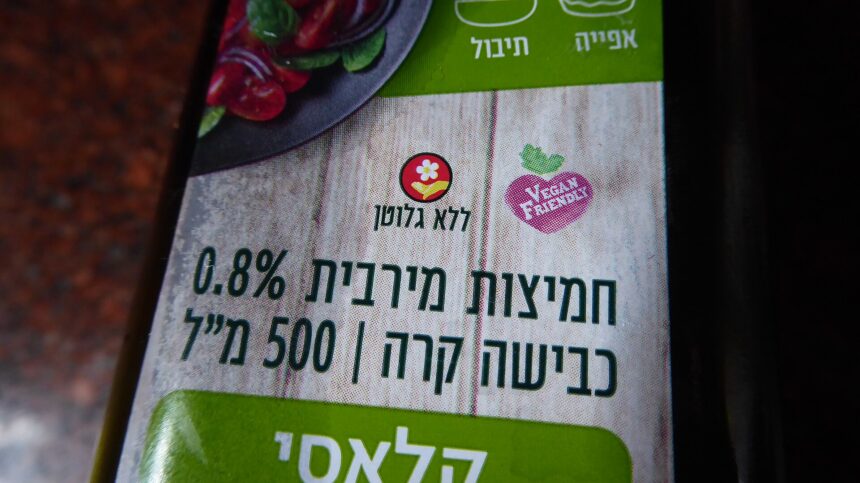
Three small words on a supplement box carry a surprising amount of weight for the people who need them. “Gluten-free” is a medical necessity for someone with coeliac disease. “Vegan” is an ethical or religious commitment, and occasionally an allergy matter. “Cruelty-free” is a statement about a supply chain the buyer will never see. All three are easy to print and hard to prove, and the difference between a claim that means something and a claim that means nothing comes down to one question: who checked, and can you see the paper?
Three levels of assurance
Level 1 — the badge. A leaf icon, a crossed-out wheat ear, a rabbit silhouette. Unless it belongs to a named certification scheme, a badge is graphic design. It has no defined standard behind it and nobody outside the company has verified it. Level 2 — the signed declaration. A document on company letterhead, signed by a named responsible person (quality manager, managing director), stating that the product meets a defined standard — for example, “contains no ingredients of animal origin and no animal-derived processing aids; gluten content below 20 mg/kg as tested by ELISA on lot X.” This is legally meaningful: a false signed declaration is misrepresentation, and it names an accountable individual. But it is still self-certification. Level 3 — audited third-party certification. An independent body with a published standard inspects the formulation, the supply chain and the factory, tests products where relevant, and licenses the use of its mark under a contract that allows withdrawal. The strongest schemes are themselves accredited to ISO/IEC 17065 (the standard for bodies certifying products), meaning the certifier is audited too. Each level is worth more than the one below it, and a buyer’s first task is simply to work out which level a given claim sits at.
Gluten-free: the one claim with a legal number
Gluten-free is unusual because the law defines it quantitatively. The Codex standard (CXS 118-1979) and EU Implementing Regulation 828/2014 set the threshold at 20 mg/kg (20 ppm); the US FDA adopted the same limit in 21 CFR 101.91. A “gluten-free” claim is therefore a testable factual statement, and the relevant paper is a laboratory result — usually a sandwich ELISA (R5 or G12 antibody) with a limit of quantification around 5 ppm — for the finished product, ideally lot-specific. Market surveys show the claim is mostly but not always honest: an FDA laboratory survey of 275 labelled gluten-free products found about 1% over 20 ppm (Sharma et al. 2015), while an independent analysis found that around 5% of “gluten-free” labelled foods exceeded the limit, with oats-containing products the commonest offenders (Lee et al. 2014). For supplements the risk sits in excipients — wheat-derived maltodextrin, starches, some fillers — and in shared manufacturing lines. A signed declaration should name the excipients and state the test; a certification mark should come from a scheme that requires periodic testing.

Vegan: no legal definition, one voluntary standard
There is no legally binding definition of “vegan” in EU or US food law; the term is governed only by the general prohibition on misleading claims. The closest thing to a standard is ISO 23662:2021, which defines “suitable for vegans” as foods and ingredients not of animal origin and in which no animal products, by-products or animal-derived processing aids have been used at any stage. For supplements, the traps are specific and worth naming: vitamin D3 is usually made from lanolin (sheep wool) unless specified as lichen-derived; omega-3 is fish or krill unless algal (the microalgal alternative); capsules are gelatin (bovine or porcine) unless declared as HPMC or pullulan; magnesium stearate and glycerin can be animal- or plant-derived; vitamin A palmitate may be synthetic or derived from fish liver; some probiotics are grown on dairy media. A credible vegan declaration therefore has to go ingredient by ingredient and include processing aids and carriers — not just the actives. A certification from a scheme that audits the supplier chain does that work for the buyer.
Cruelty-free: a claim about the past and about suppliers
“Cruelty-free” generally means no animal testing of the finished product or its ingredients, by the company or on its behalf. In the EU, animal testing of cosmetics and their ingredients has been banned since 2013 under Regulation 1223/2009 — so for cosmetics the claim describes the legal baseline. For food supplements there is no equivalent ban, and the claim is purely voluntary. Its weaknesses are structural: it usually refers to a fixed cut-off date after which no testing occurred (earlier safety data may derive from animal studies); it depends on supplier declarations about ingredients the brand did not make; and it may be silent on whether the product is sold in markets that require animal testing for import. The meaningful version is certification by a scheme with a published standard, supplier audits, a fixed cut-off date and a recertification cycle — and, for the buyer, a statement from the company of which scheme and which certificate number. An unnamed rabbit logo is a level-1 badge.
How to ask for the paper
The request is simple and a serious manufacturer will not be offended by it. For gluten-free: “Please send the gluten test result (method and ppm) for lot X, and confirm the excipient sources.” For vegan: “Please send a signed declaration listing each ingredient, capsule, carrier and processing aid with its origin, or the certificate number of your vegan certification.” For cruelty-free: “Which certification scheme, what certificate number, and what is the fixed cut-off date?” The answer tells you what level you are dealing with. A company that can produce a lot-specific test, a signed ingredient-by-ingredient declaration and a verifiable certificate number has done the work. A company that replies with a picture of its own logo has not. The same discipline applies to every other claim on the box — GMP, “lab-tested,” “pharmaceutical grade” (what GMP and ISO certificates actually cover; how to read a certificate of analysis): the claim is only as strong as the document behind it, and the document is only as strong as the person or body that signed it.
The clinical bottom line
A badge proves nothing, a signed declaration proves that a named person is legally accountable for the statement, and an audited third-party certification proves that someone independent checked. Gluten-free is the one claim with a legal number (20 ppm) and a lab test behind it; vegan has a voluntary standard (ISO 23662) and a list of supplement-specific traps in D3, omega-3, capsules and excipients; cruelty-free is voluntary for supplements and meaningful only with a named scheme and cut-off date. Ask for the paper, and judge the claim by what comes back.
Primary sources
- Codex Alimentarius Commission. Standard for foods for special dietary use for persons intolerant to gluten. CXS 118-1979 (rev. 2008). fao.org
- Commission Implementing Regulation (EU) No 828/2014 on the requirements for the provision of information to consumers on the absence or reduced presence of gluten in food. eur-lex.europa.eu
- Sharma GM, Pereira M, Williams KM. Gluten detection in foods available in the United States — a market survey. Food Chem. 2015;169:120–126. doi:10.1016/j.foodchem.2014.07.134
- Lee HJ, Anderson Z, Ryu D. Gluten contamination in foods labeled as “gluten free” in the United States. J Food Prot. 2014;77(10):1830–1833. doi:10.4315/0362-028X.JFP-14-149
- International Organization for Standardization. ISO 23662:2021 — Definitions and technical criteria for foods and food ingredients suitable for vegetarians or vegans and for labelling and claims. iso.org
- International Organization for Standardization. ISO/IEC 17065:2012 — Conformity assessment: requirements for bodies certifying products, processes and services. iso.org
- Regulation (EC) No 1223/2009 of the European Parliament and of the Council on cosmetic products (Article 18 — animal testing). eur-lex.europa.eu
Educational information on supplement quality and consumer protection, not medical advice.
🗺️ Find certified Georgian healthcare providers: sheniekimi.ge — Georgia Health Map · 998 clinics · 6,600+ doctors · 2,296 pharmacies
Was this article helpful?
Related Coverage
Editorial standards. This article was produced under the GMJ News editorial process, with oversight by the GMJ Editorial Board. Our editorial process. Spotted an error? Contact the editorial team.