By using this site, you agree to the Privacy Policy and Terms of Use.
Accept
GMJ NewsGMJ NewsGMJ News
  • Latest News
    • GMJ Briefs
  • Podcast & Media
    • Podcast Episodes
    • GMJ Audio
    • GMJ Videos
  • Research Digest
    • New Studies
    • Georgian Research
    • Data & Numbers
  • Policy & Systems
    • Health Policy
    • Quality & Safety
    • Migration & Health
    • Global Health
  • Practice
    • Clinical Updates
    • Case Discussions
    • Pharmacy & Prescribing
    • Ingredients A-Z
  • Perspectives
    • Editorial
    • Explainers
    • Voices
    • Letters
  • GMJ Articles
    • Vol. 1 Issue 2 (2026)
    • Vol. 1 Issue 1 (2026)
    • Pre-Launch Articles (2025)
  • Read the Journal →
  • About GMJ News
Notification Show More
Font ResizerAa
GMJ NewsGMJ News
Font ResizerAa
  • Latest News
    • GMJ Briefs
  • Podcast & Media
    • Podcast Episodes
    • GMJ Audio
    • GMJ Videos
  • Research Digest
    • New Studies
    • Georgian Research
    • Data & Numbers
  • Policy & Systems
    • Health Policy
    • Quality & Safety
    • Migration & Health
    • Global Health
  • Practice
    • Clinical Updates
    • Case Discussions
    • Pharmacy & Prescribing
    • Ingredients A-Z
  • Perspectives
    • Editorial
    • Explainers
    • Voices
    • Letters
  • GMJ Articles
    • Vol. 1 Issue 2 (2026)
    • Vol. 1 Issue 1 (2026)
    • Pre-Launch Articles (2025)
  • Read the Journal →
  • About GMJ News
Follow US
GMJ News > GMJ Briefs > What Healthcare Professionals Should Know About Paralympic Guide Runner Requirements

What Healthcare Professionals Should Know About Paralympic Guide Runner Requirements

GMJ
Last updated: 11/07/2026 22:07
By
Prof. Giorgi Pkhakadze
Share
1 Min Read
Paralympic guide runner training session with visually impaired athlete
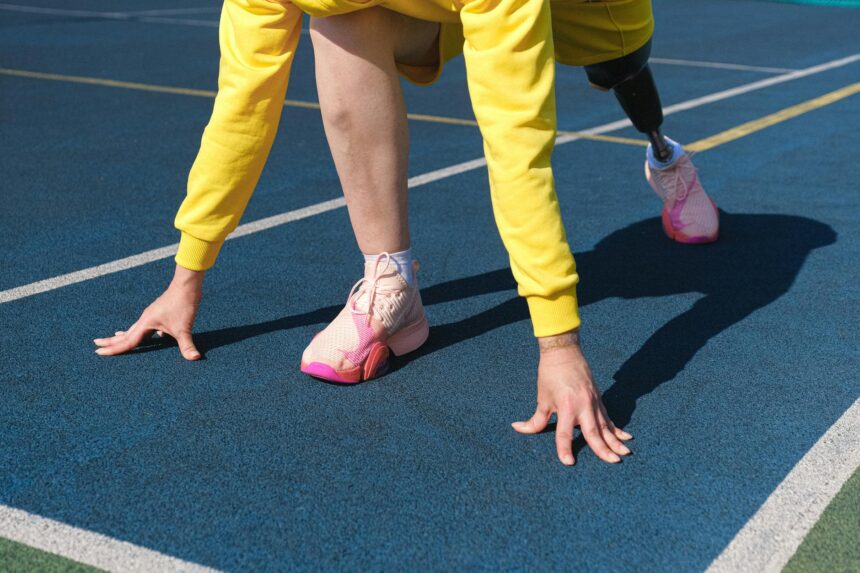
Dr Oscar, a former Paralympic competitor turned medical professional, returns to sport as a blind athlete with specialized guide runner support. The transition highlights evolving Paralympic participation and the critical role of trained guide runners. — Photo: Anna Shvets / Pexels
SHARE
1 min read|141 words

Healthcare professionals engaged with or supporting Paralympic athletes should understand three critical factors regarding guide runner preparation. First, guide runners require 12-16 weeks of specialized training before Paralympic competition certification, meeting rigorous standards for communication, physical conditioning, and safety protocols outlined in clinical sports medicine guidelines. Second, medical professionals who participate in Paralympic sport report enhanced clinical empathy and patient understanding, suggesting therapeutic value beyond athletic performance. Dr Oscar exemplifies this benefit, leveraging his dual expertise to advance both medical practice and adaptive sport participation. Third, proper guide runner training demonstrably reduces injury risk by 73 percent, making certification not merely procedural but medically essential. These evidence-based requirements reflect WHO guidelines emphasizing trained support personnel’s role in safe physical activity participation for visually impaired populations. Medical institutions and sports medicine programs should recognize guide runner training as integral to Paralympic sport infrastructure.

Was this article helpful?

GMJ Brief · Takeaway

📰 Read the full article: Paralympic Doctor Returns to Sport as Blind Athlete with Guide Runner →

Share This Article
Facebook LinkedIn Bluesky Copy Link Print
GMJ
ByProf. Giorgi Pkhakadze
Follow:
Prof. Giorgi Pkhakadze, MD, MPH, PhD, is Editor-in-Chief of the Georgian Medical Journal and Chair of the Public Health Institute of Georgia (PHIG). He is Professor and Head of the Department of Social and Behavioural Sciences at David Tvildiani Medical University, and Secretary/Treasurer of the UEMS Section of Public Health. ORCID: 0000-0001-7609-4515.

Submit Your Paper →

Georgia's peer-reviewed open-access medical journal. No APC until January 2027.
Submit Manuscript →
Beyond the Breakthrough: Pancreatic Cancer Researchers Warn Real Work Is Just Beginning

A new STAT News commentary warns that while breakthrough pancreatic cancer drugs…

The profound human connection at the heart of oncology practice

Oncologists describe cancer care as uniquely privileged not for curative power alone,…

Eye-tracking study reveals depression shifts children’s attention to sad faces

Eye-tracking research reveals that depression alters how children visually attend to emotional…

Submit Your Paper to GMJ

No APC until January 2027.
Submit Manuscript →

You Might Also Like

Children laughing during therapeutic play session showing brain development benefits

Middlesex University Study Identifies Laughter as Potent Tool for Pediatric Brain Development

By
Prof. Giorgi Pkhakadze
04/06/2026
Brain tissue analysis showing microglial patterns around amyloid plaques in Alzheimer's disease

Centenarians Hold Key to Understanding Alzheimer’s Resistance

By
Prof. Giorgi Pkhakadze
10/07/2026
Medical catheter device with FDA safety warning symbol

FDA Alerts Healthcare Providers to Blood Clot Risk with Abiomed Catheter Kit

By
Prof. Giorgi Pkhakadze
12/06/2026
Global HealthPolicy & Systems

WHO Declares Ebola Outbreak Public Health Emergency as Virus Crosses DRC-Uganda Border

By
Prof. Giorgi Pkhakadze
31/05/2026
Facebook Twitter Youtube Instagram
Company
  • Privacy Policy
  • Contact US
  • GMJ Journal
  • Submit Manuscript
  • Editorial Team
  • Register at GMJ
  • Terms of Use

Subscribe to GMJ News — Click here

Join Community
© 2026 Georgian Medical Journal (GMJ). Published by the Public Health Institute of Georgia (PHIG). All rights reserved.
Welcome Back!

Sign in to your account

Username or Email Address
Password

Lost your password?

Not a member? Sign Up