By using this site, you agree to the Privacy Policy and Terms of Use.
Accept
GMJ NewsGMJ NewsGMJ News
  • Latest News
    • GMJ Briefs
  • Podcast & Media
    • Podcast Episodes
    • GMJ Audio
    • GMJ Videos
  • Research Digest
    • New Studies
    • Georgian Research
    • Data & Numbers
  • Policy & Systems
    • Health Policy
    • Quality & Safety
    • Migration & Health
    • Global Health
  • Practice
    • Clinical Updates
    • Case Discussions
    • Pharmacy & Prescribing
    • Ingredients A-Z
  • Perspectives
    • Editorial
    • Explainers
    • Voices
    • Letters
  • Health Topics
  • GMJ Articles
    • Vol. 1 Issue 2 (2026)
    • Vol. 1 Issue 1 (2026)
    • Pre-Launch Articles (2025)
  • Read the Journal →
  • About GMJ News
Notification Show More
Font ResizerAa
GMJ NewsGMJ News
Font ResizerAa
  • Latest News
    • GMJ Briefs
  • Podcast & Media
    • Podcast Episodes
    • GMJ Audio
    • GMJ Videos
  • Research Digest
    • New Studies
    • Georgian Research
    • Data & Numbers
  • Policy & Systems
    • Health Policy
    • Quality & Safety
    • Migration & Health
    • Global Health
  • Practice
    • Clinical Updates
    • Case Discussions
    • Pharmacy & Prescribing
    • Ingredients A-Z
  • Perspectives
    • Editorial
    • Explainers
    • Voices
    • Letters
  • Health Topics
  • GMJ Articles
    • Vol. 1 Issue 2 (2026)
    • Vol. 1 Issue 1 (2026)
    • Pre-Launch Articles (2025)
  • Read the Journal →
  • About GMJ News
Follow US
GMJ News > GMJ Briefs > Three Essential Lessons from Sierra Leone’s Community Blood Donation Success

Three Essential Lessons from Sierra Leone’s Community Blood Donation Success

GMJ
Last updated: 10/08/2026 20:52
By
Prof. Giorgi Pkhakadze
Share
1 Min Read
Community health worker conducting voluntary blood donation in rural Sierra Leone
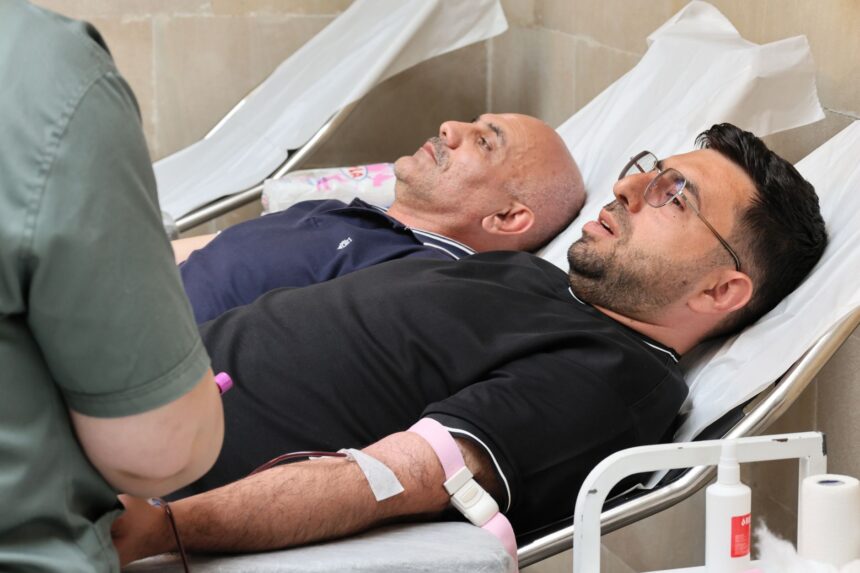
A community-led blood donation programme in rural Sierra Leone reduced costs by 40% while establishing a sustainable voluntary donor base, with 43% of participants returning to donate again. The Gi4SaveLife initiative demonstrates that local ownership and peer education can transform blood supply in resource-limited settings. — Photo by Tahir Xəlfə on Pexels (Pexels License)
SHARE
1 min read|157 words

The Gi4SaveLife programme offers three actionable insights for health systems seeking to build sustainable blood supply chains in under-resourced regions. First, community leadership outperforms external mobilisation: the 43% repeat donation rate achieved through peer education demonstrates that local ownership generates commitment conventional campaigns cannot. When trusted community members lead recruitment, barriers of mistrust dissolve and participation becomes normative.

Second, cost-effectiveness follows from genuine community investment. The 40% savings versus NGO-led models reflect reduced overhead and improved retention—not decreased quality. Third, understand what truly motivates donors in your setting. In rural Sierra Leone, altruism (71%) and social recognition (52%) proved far more powerful than payment, inverting the assumptions that underpin many blood supply models in low-income countries.

These findings, published in BMJ Global Health, suggest that sustainable blood security requires listening to communities, not imposing external solutions. The implications extend beyond Sierra Leone to health systems across sub-Saharan Africa facing similar supply challenges.

Read the full article on GMJ Newsroom.

Submit Your Paper
GMJ_Submit_Banner

Was this article helpful?

GMJ Brief · Takeaway

📰 Read the full article: Community-led blood donation model cuts costs by 40% in rural Sierra Leone →

Share This Article
Facebook LinkedIn Bluesky Copy Link Print
GMJ
ByProf. Giorgi Pkhakadze
Follow:
Prof. Giorgi Pkhakadze, MD, MPH, PhD, is Editor-in-Chief of the Georgian Medical Journal and Chair of the Public Health Institute of Georgia (PHIG). He is Professor and Head of the Department of Social and Behavioural Sciences at David Tvildiani Medical University, and Secretary/Treasurer of the UEMS Section of Public Health. ORCID: 0000-0001-7609-4515.

Submit Your Paper →

Georgia's peer-reviewed open-access medical journal. No APC until January 2027.
Submit Manuscript →
Informal healthcare providers drive untracked antibiotic use across low- and middle-income countries

A scoping review in BMJ Global Health reveals that informal healthcare providers…

Why Pool Closures in Canada Signal a Broader Public Health Crisis

Pool closures across Canada threaten public health by eliminating access to critical…

Uninsured Gunshot Wound Patients Discharged Faster From Florida Hospitals, Data Shows

Analysis of Florida hospitalisation data by KFF Health News and The Trace…

Submit Your Paper to GMJ

No APC until January 2027.
Submit Manuscript →

You Might Also Like

EBOLA OUTBREAK: Cross-Border Transmission DRC-Uganda with WHO PHEIC Declaration

By
Prof. Giorgi Pkhakadze
31/05/2026
Sudanese students in classroom setting representing educational access challenges

UNICEF Advocates for Universal Exam Access as Sudan’s Educational Crisis Deepens

By
Prof. Giorgi Pkhakadze
03/07/2026
Illustration of brain waves showing L-theanine effect on alpha and beta frequency patterns

Announcement: L-Theanine Shifts Brain Waves Toward Calm Focus Without Sedation, Research Shows

By
Prof. Giorgi Pkhakadze
09/08/2026
WHO certification document for Turks and Caicos Islands mother-to-child transmission elimination

What Turks and Caicos Teaches the World: Eliminating Mother-to-Child HIV and Hepatitis B is Achievable

By
Prof. Giorgi Pkhakadze
13/07/2026
Facebook Twitter Youtube Instagram
Company
  • Privacy Policy
  • Contact US
  • GMJ Journal
  • Submit Manuscript
  • Editorial Team
  • Register at GMJ
  • Terms of Use

Subscribe to GMJ News — Click here

Join Community
© 2026 Georgian Medical Journal (GMJ). Published by the Public Health Institute of Georgia (PHIG). All rights reserved.
Welcome Back!

Sign in to your account

Username or Email Address
Password

Lost your password?

Not a member? Sign Up