By using this site, you agree to the Privacy Policy and Terms of Use.
Accept
GMJ NewsGMJ NewsGMJ News
  • Latest News
    • GMJ Briefs
  • Podcast & Media
    • Podcast Episodes
    • GMJ Audio
    • GMJ Videos
  • Research Digest
    • New Studies
    • Georgian Research
    • Data & Numbers
  • Policy & Systems
    • Health Policy
    • Quality & Safety
    • Migration & Health
    • Global Health
  • Practice
    • Clinical Updates
    • Case Discussions
    • Pharmacy & Prescribing
    • Ingredients A-Z
  • Perspectives
    • Editorial
    • Explainers
    • Voices
    • Letters
  • Health Topics
  • GMJ Articles
    • Vol. 1 Issue 2 (2026)
    • Vol. 1 Issue 1 (2026)
    • Pre-Launch Articles (2025)
  • Read the Journal →
  • About GMJ News
Notification Show More
Font ResizerAa
GMJ NewsGMJ News
Font ResizerAa
  • Latest News
    • GMJ Briefs
  • Podcast & Media
    • Podcast Episodes
    • GMJ Audio
    • GMJ Videos
  • Research Digest
    • New Studies
    • Georgian Research
    • Data & Numbers
  • Policy & Systems
    • Health Policy
    • Quality & Safety
    • Migration & Health
    • Global Health
  • Practice
    • Clinical Updates
    • Case Discussions
    • Pharmacy & Prescribing
    • Ingredients A-Z
  • Perspectives
    • Editorial
    • Explainers
    • Voices
    • Letters
  • Health Topics
  • GMJ Articles
    • Vol. 1 Issue 2 (2026)
    • Vol. 1 Issue 1 (2026)
    • Pre-Launch Articles (2025)
  • Read the Journal →
  • About GMJ News
Follow US
GMJ News > Perspectives > Explainers > Astaxanthin, the Membrane-Spanning Antioxidant: Why Molecular Shape Is the Whole Story
ExplainersNew Studies

Astaxanthin, the Membrane-Spanning Antioxidant: Why Molecular Shape Is the Whole Story

GMJ
Last updated: 20/08/2026 05:30
By
GMJ Perspectives Desk
Share
6 Min Read
Astaxanthin spans the lipid bilayer, protecting both membrane surfaces simultaneously
SHARE
🎧 Listen to this article5:07 min · 719 words · GMJ Audio
4 min read|719 words

Antioxidant chemistry is usually told as a story about reactivity — which molecule quenches which radical how fast. Astaxanthin’s story is different: it is a story about geography. Where an antioxidant physically sits determines which radicals it can ever meet, and astaxanthin’s peculiar architecture parks it in the one location that matters most for membrane protection: stretched across the entire lipid bilayer, anchored at both surfaces simultaneously. That single structural fact organises everything else known about the molecule — including the cardiovascular-oriented review by Pashkow and colleagues (Am J Cardiol, 2008) that put its mechanism on the clinical-literature map.

Contents
  • The membrane, briefly: a sea with two shores
  • What ‘lipophilic and hydrophilic simultaneously’ means
  • Why beta-carotene cannot do this — and what ATBC taught everyone
  • From structure to the human findings
  • The clinical bottom line
  • Primary sources

The membrane, briefly: a sea with two shores

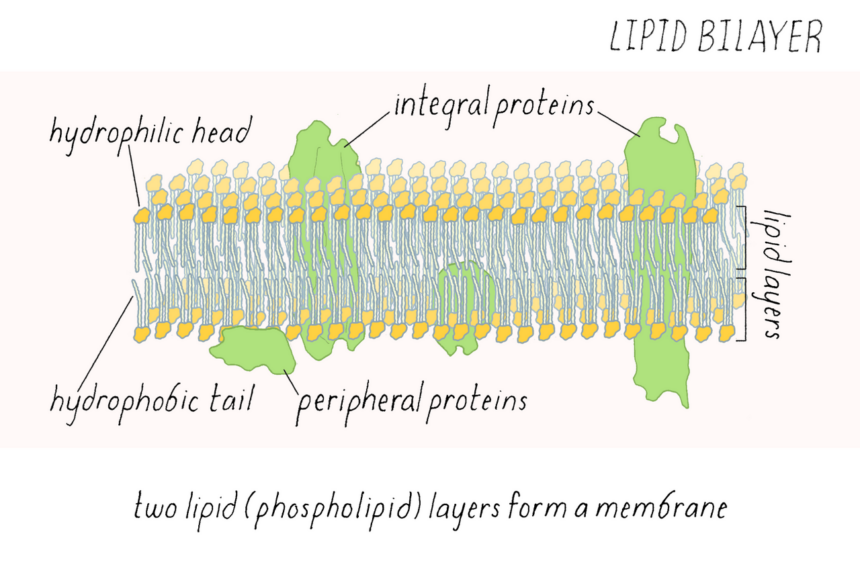
Every cell membrane is a phospholipid bilayer: two sheets of molecules with water-loving (polar) heads facing outward and fat-loving (nonpolar) tails facing inward, forming an oily interior roughly 3–4 nanometres thick between two watery surfaces. Oxidative attack happens at both depths — water-borne radicals strike the surfaces; lipid-peroxidation chain reactions propagate through the fatty core, where one initiating radical can damage hundreds of lipids in a chain. A protective molecule therefore faces a placement dilemma: polar antioxidants (vitamin C) patrol the water but cannot enter the core; purely nonpolar ones sink into the core but abandon the surfaces.

What ‘lipophilic and hydrophilic simultaneously’ means

Astaxanthin resolves the dilemma by being both at once, in the right places. Its midsection is a long, rigid polyene chain — thirteen alternating double bonds, fully nonpolar, at home in the membrane core and electronically built to absorb radical energy along its conjugated backbone. Each end terminates in an ionone ring carrying both a keto and a hydroxyl group — polar oxygen chemistry that seeks the watery interface. The molecule’s end-to-end length happens to match bilayer thickness. The consequence is unique positioning: rings anchored at the two polar surfaces, chain spanning the hydrophobic interior — one molecule guarding the shores and the sea between them. Biophysical studies add a bonus: this transmembrane strut orientation preserves membrane rigidity and order under oxidative stress, rather than disturbing packing the way core-dissolved molecules do.

Why beta-carotene cannot do this — and what ATBC taught everyone

Beta-carotene shares the polyene chain but ends in unsubstituted, fully nonpolar rings. With no polar anchors, it dissolves horizontally within the membrane core, leaving surfaces unguarded. Worse, carotenoid radicals formed in the core have documented conditions — high oxygen tension chief among them — where beta-carotene switches to pro-oxidant behaviour, propagating rather than terminating chains. That chemistry is a leading mechanistic explanation for the sobering ATBC and CARET trial results, where high-dose beta-carotene increased lung-cancer incidence in smokers — the cautionary tale of antioxidant supplementation. Astaxanthin’s anchored geometry and its keto-group electronics make it resistant to this failure mode: across studied conditions it shows no comparable pro-oxidant switch, a distinction Pashkow’s review emphasises and one reason the molecule attracted cardiovascular interest despite the carotenoid family’s mixed reputation.

Submit Your Paper
GMJ_Submit_Banner

From structure to the human findings

The placement story predicts exactly the endpoints where astaxanthin trials report effects. UV protection: ultraviolet photons generate singlet oxygen and lipid radicals within skin-cell membranes — astaxanthin quenches singlet oxygen with exceptional efficiency and intercepts chain reactions where they run, matching the raised minimal-erythema-dose findings. Skin barrier and elasticity: membrane-lipid integrity underlies barrier function measured as transepidermal water loss — the parameter repeatedly improved in the dermatology RCTs. Cardio-metabolic markers: LDL particles are, structurally, lipid membranes in miniature; astaxanthin incorporates into lipoproteins and lengthens LDL oxidation lag time — the mechanism Pashkow’s cardiovascular review builds upon. None of this substitutes for outcome trials, and we grade the human evidence honestly elsewhere; but it means the trial signals sit on a coherent structural foundation rather than marketing metaphor.

The clinical bottom line

Astaxanthin’s defining feature is placement: polar-tipped, membrane-length, rigid — the only common dietary carotenoid that spans the bilayer and defends both surfaces and core at once, without the pro-oxidant switch that haunts beta-carotene. Structure is why the same molecule shows up in UV-threshold, skin-barrier and LDL-oxidation research: they are all membrane stories, and astaxanthin is a membrane specialist.

Primary sources

  • Pashkow FJ, Watumull DG, Campbell CL. Astaxanthin: a novel potential treatment for oxidative stress and inflammation in cardiovascular disease. Am J Cardiol. 2008;101(10A):58D-68D
  • The ATBC Cancer Prevention Study Group. The effect of vitamin E and beta carotene on the incidence of lung cancer. N Engl J Med. 1994;330:1029-35
  • GMJ: Astaxanthin and skin health — the clinical trials
  • GMJ: Astaxanthin and mitochondria — the aging research

Was this article helpful?

Disclaimer. This article is health journalism intended for general information and education. It is not medical advice and is not a substitute for professional diagnosis or treatment. Always consult a qualified healthcare provider about your individual circumstances. Full disclaimer →

Related Coverage

Can laughter improve health? Researchers launch study to find outAug 21, 2026
Vegan, Gluten-Free, Cruelty-Free: What a Manufacturer's Declaration Is WorthAug 20, 2026
Astaxanthin Doses in the Clinic: What 6–12 mg Actually ShowedAug 20, 2026
Vitamin E: Why 9 in 10 Fall Short — and Why the Natural Form Is Retained BetterAug 20, 2026
Explore more on this topic:🧭 Rheumatoid Arthritis hub
🔥 Most read this week
1High-Dose Zinc Supplements May Create Copper Deficiency, Warn Nutrition Experts
2Evidence-Based Hydration Protocol: How Much Fluid and Sodium Athletes Actually Need
3L-Theanine Improves Sleep Quality Without Drowsiness, Systematic Review Finds
4How Coffee Brewing Method Affects Cholesterol: The Science Behind Diterpenes and Filters
Related reference
  • Astaxanthin · Ingredient
  • Lung Cancer · Condition
  • Vitamin C · Ingredient
  • Vitamin E · Ingredient
  • SAMe · Ingredient
PG
Editorial oversight
Prof. Giorgi Pkhakadze, MD, MPH, PhD
Editor-in-Chief, GMJ News
Full profile →  ·  ORCID 0000-0001-7609-4515
Medical disclaimer. This article is health journalism intended for general information. It is not medical advice and is not a substitute for consultation with a qualified healthcare professional. Always seek your physician's advice regarding any medical condition.
Editorial standards. This article was produced under the GMJ News editorial process, with oversight by the GMJ Editorial Board. Our editorial process. Spotted an error? Contact the editorial team.
📬 GMJ Health Digest
Evidence-based medical news, once a week. Free, no spam, unsubscribe anytime.
Share This Article
Facebook LinkedIn Bluesky Copy Link Print
GMJ
ByGMJ Perspectives Desk
Follow:
GMJ Perspectives Desk is part of GMJ News, the newsroom of the Georgian Medical Journal (gmj.ge), published by the Public Health Institute of Georgia. Every article is editorially reviewed before publication.
Leave a Comment Leave a Comment

Leave a Reply Cancel reply

Your email address will not be published. Required fields are marked *

Submit Your Paper →

Georgia's peer-reviewed open-access medical journal. No APC until January 2027.
Submit Manuscript →
Medicare Advantage Insurer Elevance Health Pays $342 Million to Settle Billing Dispute with CMS

Elevance Health, a major Medicare Advantage insurer, has agreed to pay $342…

UK Updates Hepatitis B Screening and Neonatal Immunisation Pathway for Pregnant Women

The UK has released comprehensive guidance on antenatal hepatitis B screening and…

Europe reports 949 avian flu cases in birds across 30 countries in first half of 2026

Europe documented 949 highly pathogenic avian influenza A(H5) cases in birds across…

Submit Your Paper to GMJ

No APC until January 2027.
Submit Manuscript →

You Might Also Like

Microscopic image of developing nerve cells with color-coded mitochondrial activity markers
New Studies

SSRIs show distinct metabolic effects on developing brain cells, Karolinska study reveals

By
GMJ Research Desk
20/05/2026
Scientific illustration showing DNA repair mechanisms being disrupted in cancer cellsIllustrative image · Photo by Ivan S on Pexels (Pexels License)
New StudiesResearch Digest

Scientists Disrupt Cancer Cell DNA Repair to Overcome Drug Resistance

By
GMJ Research Desk
27/06/2026
Graph showing plasma EPA+DHA levels in healthy adults after 4 weeks supplementation with krill oil, fish oil triglyceride, and fish oil ethyl esterIllustrative image · Photo by Sebastian Pena Lambarri on Unsplash (Unsplash License)
New StudiesPharmacy & PrescribingPracticeResearch Digest

Krill Oil vs Fish Oil: What the Evidence Shows About Bioavailability Claims

By
GMJ Research Desk
15/08/2026
Diagram of insulin receptor signalling pathway highlighting magnesium's role as essential cofactor in kinase activationIllustrative image · Photo by Leeloo The First on Pexels (Pexels License)
Clinical UpdatesNew StudiesPracticeResearch Digest

Magnesium’s Hidden Role in Insulin Signalling: Why the Mineral Matters More Than We Thought

By
GMJ Practice Desk
19/07/2026
Facebook Twitter Youtube Instagram
Company
  • Privacy Policy
  • Contact US
  • GMJ Journal
  • Submit Manuscript
  • Editorial Team
  • Register at GMJ
  • Terms of Use

Subscribe to GMJ News — Click here

Join Community
© 2026 Georgian Medical Journal (GMJ). Published by the Public Health Institute of Georgia (PHIG). All rights reserved.
Welcome Back!

Sign in to your account

Username or Email Address
Password

Lost your password?