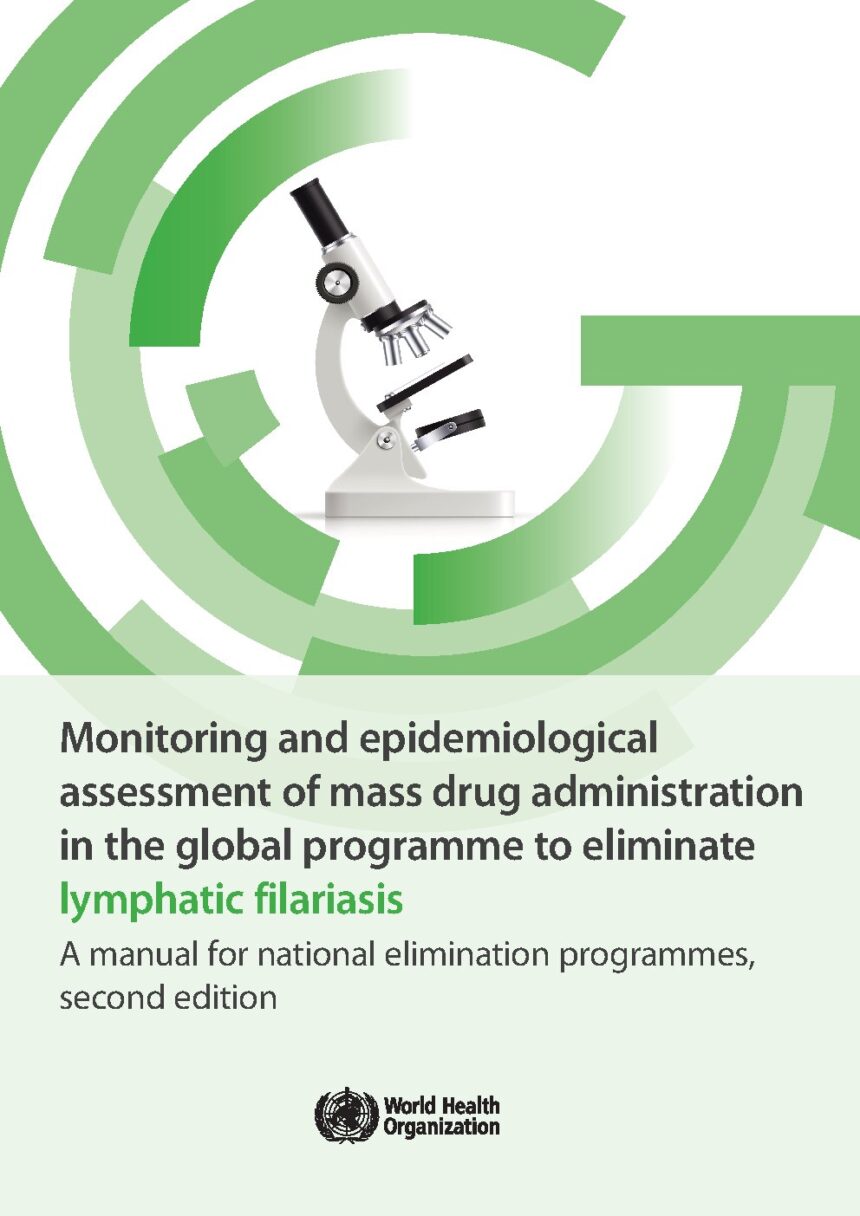
World Health Organization · 2nd edition, 2025 · 156 pages
Operational manual for national programmes on when to start, stop and survey lymphatic filariasis MDA, including new IDA regimen guidance.
- Issuer
- World Health Organization
- Edition
- 2nd edition, 2025
- Audience
- National lymphatic filariasis elimination programme managers, district programme staff, technical agencies, nongovernmental organizations, regional programme review groups
- Evidence
- Expert consensus and operational research evidence; developed through WHO consultations with technical advisory group review and peer review
- Reviewed
- 17 Oct 2026 · GMJ
What this guideline says
GMJ summary
This manual provides comprehensive guidance for national lymphatic filariasis (LF) elimination programmes on monitoring and evaluating mass drug administration (MDA) to interrupt transmission. It outlines five programmatic steps: mapping to determine where MDA is required, implementing and monitoring MDA coverage, conducting epidemiological monitoring surveys (EMS) and transmission assessment surveys (TAS) to decide when to stop MDA, post-treatment surveillance for 4–6 years, and post-validation surveillance after WHO validation.
Key updates since the 2011 edition include: a new confirmatory mapping survey protocol, strengthened EMS using random sampling of adults aged ≥20 years with a <1% microfilariae threshold, revised TAS with a uniform <1% antigen/antibody threshold for all vector species in children aged 6–7 years, and a new IDA impact survey (IIS) for areas using the triple-drug ivermectin-diethylcarbamazine-albendazole regimen. All surveys now use smaller evaluation units (<500,000 population) formed by homogeneous risk factors to improve sensitivity for detecting ongoing transmission.
The manual emphasizes that MDA requires ≥65% coverage of the total population (though programmes should aim for 100% of eligible individuals), provides detailed protocols for following up positive cases with targeted treatment, and recommends at least 10 years of post-validation surveillance using integrated platforms such as health facility screening, existing surveys, or molecular xenomonitoring.
Key points
For clinicians — doses and thresholds as stated in the guideline
- Mapping: confirmatory surveys in children aged 9–14 years; areas with ≥2% antigen (Ag) or antibody (Ab) or ≥1% microfilariae (Mf) require MDA
- MDA coverage: minimum 65% of total population per round; at least 5 effective rounds with two-drug regimens or 2 rounds with IDA before surveys
- EMS (epidemiological monitoring survey): random sampling of ≥300 adults aged ≥20 years per site; threshold <2% Ag or <1% Mf in each sentinel and spot-check site to proceed to TAS/IIS
- TAS (transmission assessment survey): systematic or cluster sampling of children aged 6–7 years; <1% Ag (W. bancrofti) or <1% Ab (Brugia spp.) threshold for all vector species; critical cut-off values in Table 11 determine pass/fail
- IIS (IDA impact survey): 30-cluster sampling of adults aged ≥20 years; average Mf <1% (Anopheles/Culex/Mansonia) or <0.5% (Aedes) plus cluster-level thresholds
- Evaluation units (EUs): <500,000 population, formed by grouping contiguous implementation units with similar baseline prevalence, coverage, vector density, and risk factors
- Follow-up of positives: treat all positive individuals and household members with IDA; targeted MDA for clusters with ≥2 positives, with follow-up EMS 6 months after second targeted round
- Post-validation surveillance: sustained for ≥10 years using at least two platforms (health facility screening, standard surveys, molecular xenomonitoring, or targeted surveys in high-risk populations)
Sample size and critical cut-off values for TAS (transmission assessment survey)
Table extracted from the guideline
| Target population size (children aged 6–7 years) | Systematic sampling: Sample size (n) | Systematic sampling: Critical cut-off (d) | Cluster sampling: Sample size (n) | Cluster sampling: Critical cut-off (d) |
|---|---|---|---|---|
| <399 | Census | <0.01×n | Not recommended | — |
| 400 | 284 | 1 | — | — |
| 1000 | 506 | 1 | 759 | 1 |
| 2000 | 606 | 2 | 909 | 3 |
| 5000 | 696 | 2 | 1392 | 4 |
| 10,000 | 770 | 3 | 1540 | 6 |
| 30,000 | 778 | 3 | 1556 | 6 |
| >50,000 | 846 | 3 | 1692 | 6 |
Source: World Health Organization, Monitoring and epidemiological assessment of mass drug administration in the global programme to eliminate lymphatic filariasis: a manual for national elimination programmes, 2nd ed. Reproduced in summary form.
What changed in this edition
Versus the previous edition
- New confirmatory mapping survey protocol using school-based surveys of children aged 9–14 years with 2% Ag/Ab threshold, replacing previous village-based methods
- EMS (formerly pre-TAS) now targets adults aged ≥20 years (instead of children ≥5 years) using random sampling (instead of convenience sampling), with <1% Mf threshold and conducted 9 months post-IDA (instead of 6 months)
- TAS threshold reduced to <1% Ag/Ab for all vector species (previously <2% for Anopheles/Culex; <1% for Aedes), with lower critical cut-off values and smaller EU size (<500,000 instead of ≤2 million)
- New IDA impact survey (IIS) introduced: 30-cluster survey among adults aged ≥20 years, measuring Mf with <1% threshold (Anopheles/Culex/Mansonia) or <0.5% (Aedes)
- Detailed guidance added for targeted treatment of positive individuals and clusters, including household members and neighbours
- Post-validation surveillance formalized: ≥10 years using integrated platforms (health facility screening, existing surveys, molecular xenomonitoring, targeted surveys)
From the guideline
Verbatim
“The minimum effective coverage of the total population is considered to be 65%, but programmes should attempt to treat all eligible people where MDA is delivered and to exceed this number.”
Editor’s perspective
Why this matters for Georgia and the region
Prof. Giorgi Pkhakadze, MD, MPH, PhD
Editor-in-Chief, Georgian Medical Journal · Chair, Public Health Institute of Georgia · WHO consultant, health and migration
As WHO consultant on health and migration, I recognize that while Georgia is not endemic for lymphatic filariasis, this manual exemplifies the rigorous surveillance architecture that informed our own elimination programmes—hepatitis C since 2015 and our integrated vector-borne disease surveillance platforms. The manual's emphasis on post-validation surveillance for at least 10 years is particularly instructive; we witnessed similar requirements in our measles and rubella elimination verification process. For Georgian clinicians engaged in international technical cooperation or managing migrants from LF-endemic regions, I would stress the importance of recognizing hydrocoele and lymphoedema as potential LF manifestations requiring referral, even in non-endemic settings. The key implementation challenge this manual highlights—achieving truly effective coverage above the 65% minimum, ideally reaching never-treated populations—mirrors our own experience in maintaining high vaccination coverage in hard-to-reach mountain communities and among mobile populations along transport corridors.
ORCID 0000-0001-7609-4515 · Perspective written for the GMJ Guidelines Library, 17 Oct 2026
Applicability
Georgia and the South Caucasus
Georgia is not currently endemic for lymphatic filariasis and is not among the 72 countries considered endemic by WHO. However, this manual is highly relevant for Georgia’s capacity as a WHO European Region member state contributing technical expertise to global health programmes, particularly in neighbouring endemic countries in the Eastern Mediterranean and South-East Asia regions. Georgian public health professionals involved in WHO consultancies, migration health assessments, or technical cooperation would benefit from understanding LF surveillance protocols, especially as climate change may alter vector distributions. National programmes would need to maintain vigilance for imported cases among migrants and establish referral pathways for hydrocoele and lymphoedema management, even in non-endemic settings, as part of comprehensive primary health care under Georgia’s universal health coverage programme.
Questions this guideline answers
Quick answers
When should an endemic area stop MDA for lymphatic filariasis?
After at least 5 effective rounds (≥65% coverage) with two-drug regimens or 2 rounds with IDA, conduct an EMS in sentinel/spot-check sites. If Mf <1% in all sites, proceed to TAS (for two-drug regimens or 1 IDA after >3 two-drug rounds) or IIS (for 2 IDA rounds). Stop MDA only if the survey passes: TAS with ≤critical cut-off Ag/Ab positives (Table 11) or IIS with average Mf <1% (or <0.5% for Aedes) and acceptable cluster-level results.
What is the recommended MDA regimen for lymphatic filariasis?
In areas without onchocerciasis or loiasis: IDA (ivermectin 200 μg/kg + diethylcarbamazine 6 mg/kg + albendazole 400 mg) annually for implementation units with <4 effective prior rounds or persistent transmission; otherwise annual DEC 6 mg/kg + albendazole 400 mg. In areas co-endemic with onchocerciasis: annual ivermectin 200 μg/kg + albendazole 400 mg. In areas co-endemic with loiasis: biannual albendazole 400 mg alone.
How do you form an evaluation unit (EU) for surveys?
EUs should have <500,000 population and be formed by grouping contiguous implementation units (IUs) with: same number of effective MDA rounds, similar baseline prevalence, similar population density (rural vs urban), similar elevation and vector abundance, similar population characteristics affecting coverage, and similar MDA coverage. Divide an IU into multiple EUs if population >500,000 or if LF transmission risk varies widely within the IU.
What should you do if you find positive children during a TAS that otherwise passes?
Treat all positive children and household members immediately (use IDA regimen where onchocerciasis is not endemic). If one cluster has ≥2 positives, provide two rounds of targeted MDA in the community represented by that school/enumeration area. If ≥2 clusters each have ≥2 positives and are geographically grouped, consider dividing the EU and providing targeted MDA. After TAS3, conduct follow-up EMS in targeted communities 6 months after the second targeted treatment round.
Related on GMJ
Interconnected resources
Dictionary of Public Health
Conditions A–Z
GMJ News coverage
Quality & accreditation
Other guidelines on this topic
- Malaria control in emergencies: field manual
- Polio Eradication Strategy 2022–2026: delivering on a promise, extension to 2029
- Malaria surveillance, monitoring and evaluation: a reference manual, 2nd ed.
- Subnational tailoring of malaria strategies and interventions: Reference manual
- National Onchocerciasis Elimination Committees: A Handbook for Expert Advisory Groups in Africa
- Issuer
- World Health Organization
- Type
- Manual
- Edition
- 2nd edition, 2025
- Replaces
- Monitoring and epidemiological assessment of mass drug administration in the global programme to eliminate lymphatic filariasis: a manual for national elimination programmes, 2011
- Status
- Current
- Published
- 2025-07-15
- Languages
- English
- Scope
- Global
- Audience
- National lymphatic filariasis elimination programme managers, district programme staff, technical agencies, nongovernmental organizations, regional programme review groups
- Pages
- 156
- Licence
- CC BY-NC-SA 3.0 IGO
- ISBN
- 978-92-4-010595-9
- Evidence
- Expert consensus and operational research evidence; developed through WHO consultations with technical advisory group review and peer review
- Record history
- Created 17 Oct 2026 · updated 17 Oct 2026 · next check Apr 2027
World Health Organization. Monitoring and epidemiological assessment of mass drug administration in the global programme to eliminate lymphatic filariasis: a manual for national elimination programmes, 2nd ed. Geneva: World Health Organization; 2025. Licence: CC BY-NC-SA 3.0 IGO.GMJ Guidelines Library records are original summaries written by the GMJ editorial team from the issuer’s published document and reviewed by a physician. They do not replace the full guideline. The document is the copyright of its issuer and is linked, not hosted. Spotted an error or a newer edition? Tell the Guidelines Desk.
Was this article helpful?