Pan American Health Organization · Version April 2022
Technical guidance for health facilities on assessing, procuring, and operating PSA oxygen plants for medical oxygen production.
- Issuer
- Pan American Health Organization
- Edition
- Version April 2022
- Audience
- Hospital administrators, clinical engineering staff, biomedical technicians, procurement officers, health system planners
- Evidence
- Expert technical guidance and operational experience
- Reviewed
- 18 Oct 2026 · GMJ
What this guideline says
GMJ summary
This Pan American Health Organization manual provides comprehensive guidance for health facilities considering adoption of pressure swing adsorption (PSA) oxygen generator plants. PSA plants produce medical-grade oxygen (93% ± 3% purity) from ambient air using zeolite adsorbent material that separates nitrogen from oxygen. The technology offers independence from external oxygen suppliers but transforms facilities from consumers to manufacturers of medical oxygen, requiring new administrative, technical, and quality control processes.
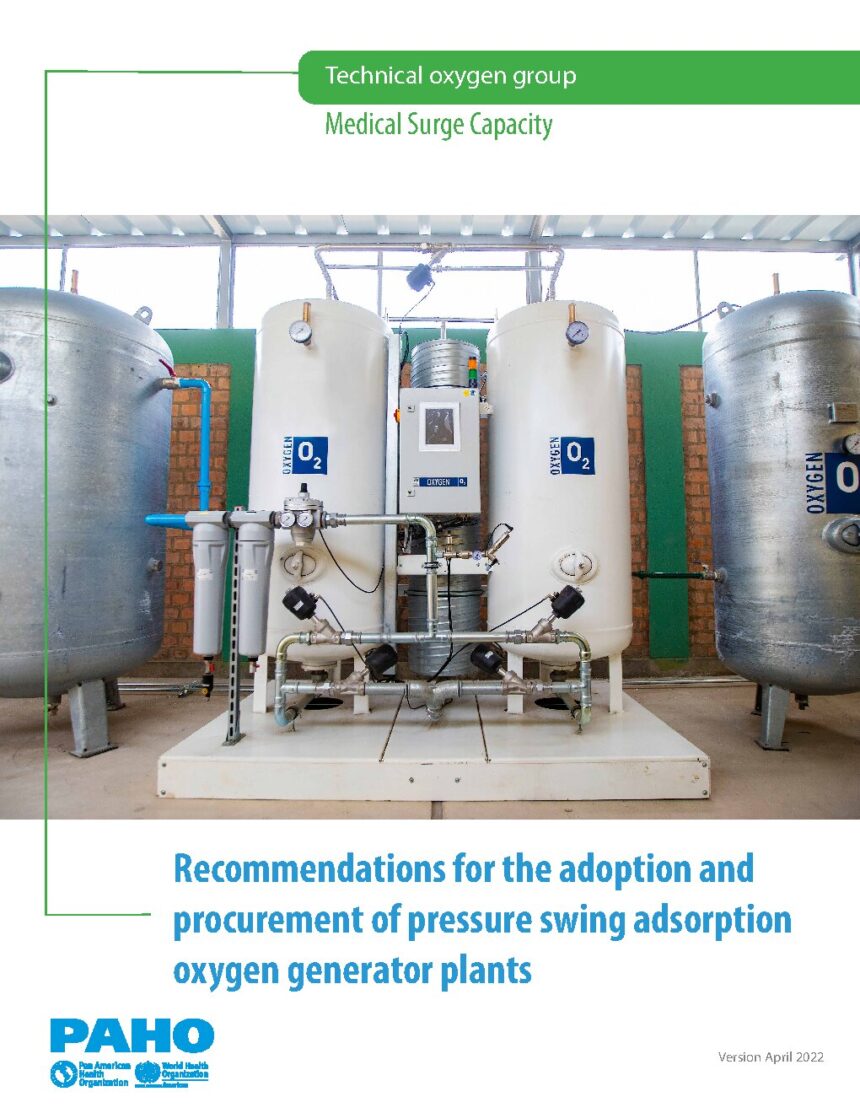
The document details PSA plant components (air compressor, air dryer, filtration systems, adsorption columns with programmable logic controllers, oxygen storage tanks, and optional booster compressors for cylinder filling) and addresses critical implementation considerations including electrical capacity requirements, altitude effects on productivity, staff training needs, maintenance programmes, fire safety protocols, and production cost analysis. A comprehensive procurement checklist covers over 200 technical, administrative, and financial specifications to facilitate vendor comparison.
Key operational requirements include continuous electrical supply with backup generation, compressed air storage at working pressures >750 kPa (7.5 bar/108 psi), distribution network pressure of approximately 50 psi (345 kPa/3.45 bar), continuous oxygen concentration monitoring with alarms for concentrations <90%, and establishment of primary, secondary, and emergency oxygen supply sources. The guide emphasizes that PSA plants have minimum 10-year service lives when properly maintained, with training of clinical engineering staff essential for preventive and corrective maintenance.
Key points
For clinicians — doses and thresholds as stated in the guideline
- PSA oxygen plants produce medical oxygen at 93% ± 3% concentration (not 99.5% purity), with audible and visible alarms required when concentration falls below 90%
- Distribution network pressure should be set to approximately 50 psi (345 kPa; 3.45 bar; 3.52 kgf/cm²) to ensure precise oxygen delivery at flowmeters
- Air compressor working pressure must exceed 750 kPa (7.5 bar or 108 psi) for proper operation
- Plant sizing example: for a 100-bed COVID-19 facility with 75 severe patients (10 L/min) and 25 critical patients (30 L/min), total oxygen requirement is 90 m³/h (2.5 m³/h bulk liquid equivalent)
- Emergency electrical generation capacity must be verified or procured to ensure uninterrupted 24-hour operation, as the air compressor is the highest power consumer
- Three-level supply matrix required: primary supply (e.g., PSA plant), secondary supply of equal capacity (second PSA plant or bulk liquid), and emergency backup supply
- Maintenance training must include evidence of learning and certification; four complexity levels defined from operator maintenance to manufacturer-level repair
- Oxygen concentration must be continuously monitored; portable concentration meters should be provided to clinicians administering therapy, with terminal units labeled "O₂ 93%"
Recommended oxygen consumption for treatment of patients with COVID-19
Table extracted from the guideline
| Severity of illness | Number of patients | Avg. oxygen flow rate per patient | Total | PSA plant size | Bulk liquid equivalent |
|---|---|---|---|---|---|
| Severe | 75 patients | 10 L/min | 75 × 10 × 60 = 45,000 L = 45 m³/h | 45 m³/h | 1.25 m³/h |
| Critical | 25 patients | 30 L/min | 25 × 30 × 60 = 45,000 L = 45 m³/h | 45 m³/h | 1.25 m³/h |
| Total (100-bed facility) | 100 patients | — | 90,000 L/h = 90 m³/h | 90 m³/h | 2.5 m³/h |
Source: Pan American Health Organization, Recommendations for the adoption and procurement of pressure swing adsorption oxygen generator plants. Reproduced in summary form.
From the guideline
Verbatim
“It bears stressing that a complete oxygen supply solution for a health facility is composed of three types of supplies: the primary (main) supply; a secondary supply, of equal capacity to the primary one, to ensure continuity of operations in case the primary supply fails; and an emergency supply, which must take over in case both the primary and secondary fail.”
Editor’s perspective
Why this matters for Georgia and the region
Prof. Giorgi Pkhakadze, MD, MPH, PhD
Editor-in-Chief, Georgian Medical Journal · Chair, Public Health Institute of Georgia · WHO consultant, health and migration
As Georgia continues strengthening district hospital capacity under the Universal Healthcare Programme, this PAHO manual addresses a critical gap exposed during COVID-19: oxygen supply security in facilities distant from Tbilisi-based bulk liquid suppliers. I would stress to Georgian clinical engineering teams the non-negotiable requirement for three-level supply redundancy (primary, secondary, emergency) and the 93% oxygen concentration limitation – our national anaesthesia protocols must be reviewed to determine if PSA oxygen meets surgical requirements or if conventional 99.5% sources remain necessary for operating theatres. The realistic implementation challenge for Georgia is electrical infrastructure: many district hospitals in Kakheti, Racha, or Samtskhe-Javakheti experience power instability, and the capital cost of adequate backup generation (the air compressor is the largest electrical load) plus staff training may exceed short-term bulk liquid contracts, requiring careful health technology assessment and potentially phased regional implementation coordinated through the MoH.
ORCID 0000-0001-7609-4515 · Perspective written for the GMJ Guidelines Library, 18 Oct 2026
Applicability
Georgia and the South Caucasus
For Georgia and the South Caucasus, PSA oxygen plants offer strategic value in facilities distant from Tbilisi or regional centres where bulk liquid oxygen supply chains face logistical challenges due to mountainous terrain or limited supplier networks. Armenian and Azerbaijani facilities in remote regions face similar constraints. National oxygen security planning should assess district hospitals where PSA technology could ensure uninterrupted supply independent of external vendors, particularly important given COVID-19 surge experiences. However, implementation requires upfront investment in electrical infrastructure (many Georgian district hospitals experience power instability requiring generator upgrades), comprehensive training of clinical engineering staff (potentially coordinated through the Georgian National Centre for Disease Control or regional equivalents), and establishment of quality control protocols aligning with national pharmaceutical regulatory frameworks. Facilities should conduct altitude-adjusted sizing calculations for highland installations (relevant for Armenian facilities and Georgia’s mountainous regions) and verify that 93% oxygen concentration meets national clinical protocols, particularly for closed-circuit anaesthesia applications where 99.5% purity may be mandated.
Questions this guideline answers
Quick answers
When should a health facility in Georgia consider adopting a PSA oxygen plant instead of bulk liquid oxygen?
Consider PSA plants when: distance to bulk liquid suppliers creates logistical challenges; suppliers are absent or unreliable in the region; oxygen demand has increased exponentially (e.g., during COVID-19); or bulk liquid/cylinder prices are prohibitively high. The facility must have or be able to install adequate electrical capacity and backup generation, commit to becoming an oxygen manufacturer with quality control processes, and train technical staff in maintenance.
What are the main hidden costs of operating a PSA oxygen plant?
Key ongoing costs include: electricity demand (kW) and consumption (kWh) – the air compressor is the largest power consumer; compressor maintenance (oil changes, parts replacement); general consumables (filters, lubricating oil, leak repairs); oxygen cell/sensor replacement if consumable type; potential adsorbent material replacement; calibration procedures; and preventive/corrective maintenance contracts. Production cost per m³ of oxygen should be calculated and compared to market bulk liquid prices to assess economic performance.
Can PSA oxygen at 93% concentration be used for all patients and procedures?
PSA oxygen at 93% ± 3% is suitable for patients with hypoxemia from COVID-19, COPD, pulmonary edema, and those requiring mechanical ventilation or drug nebulization. However, it may not be appropriate for some serious conditions requiring high-purity oxygen (99.5%), and in some countries cannot be used for closed-circuit inhalational anaesthesia. All clinical staff must be clearly informed of the concentration difference; terminal units should be labeled "O₂ 93%" and portable concentration meters provided to clinicians.
What qualifications and testing must be completed before a PSA plant can be considered fully operational?
Before full operation: (1) Installation qualification ensuring the plant meets all manufacturer requirements; (2) Operational qualification verifying equipment works as designed, using a manufacturer-provided checklist; (3) Performance qualification testing the plant under worst-case/maximum load conditions to verify that oxygen purity, pressure, and flow comply with manufacturer specifications. Only after completing all three qualification stages and staff training should the plant be commissioned for patient care.
Related on GMJ
Interconnected resources
Dictionary of Public Health
GMJ News coverage
- UK flu and COVID-19 surveillance data to May 2027 shows continued monitoring amid seasonal trendsOct 2026
- Community Health Workers Boost COVID-19 Testing Among Formerly Incarcerated PeopleAug 2026
- When Recalibration Reproduces Inequity: The Pulse Oximetry Paradox and Why Device Standards Must Account for MelaninOct 2026
- 655 Million Without Electricity Face Growing Health Crisis, WHO WarnsOct 2026
Quality & accreditation
- ASF Hospital — Standard 5 — Safety & Emergency Preparedness
- ASF Hospital — Standard 11 — Critical Care
- ASF Medical Transport — Standard 6 — Emergency Response During Transport
- ASF Hospital — Standard 7 — Governance & Management
- ASF Hospital — Standard 4 — Care & Treatment
- ASF Hospital — Standard 13 — Radiology
- ASF Laboratory — Standard 4 — Equipment, Reagents & Traceability
Other guidelines on this topic
- Good Practices in the Rational and Effective Use of Oxygen
- Considerations on the Use of Antivirals, Monoclonal Antibodies, and Other Interventions for the Management of COVID-19 Patients in Latin America and the Caribbean
- Guidelines for the Care of Adult Patients with Severe or Critical COVID-19 in the Americas. Abridged version, 4th edition
- Guidelines for the Prophylaxis and Management of Patients with Non-severe COVID-19 in Latin America and the Caribbean
- STAR-H: Strategic Toolkit for Assessing Risks in Health Facilities
- Issuer
- Pan American Health Organization
- Type
- Procedures, manuals, guidelines
- Edition
- Version April 2022
- Status
- Current
- Published
- 2022-01-01
- Languages
- English
- Scope
- PSA oxygen generator plant adoption, procurement, and operation for health facilities
- Audience
- Hospital administrators, clinical engineering staff, biomedical technicians, procurement officers, health system planners
- Licence
- CC BY-NC-SA 3.0 IGO
- Evidence
- Expert technical guidance and operational experience
- Record history
- Created 18 Oct 2026 · updated 18 Oct 2026 · next check Apr 2027
Pan American Health Organization. Recommendations for the adoption and procurement of pressure swing adsorption oxygen generator plants. Version April 2022. Washington, D.C.: PAHO; 2022. (PAHO/PHE/IMS/COVID-19/22-0006). Licence: CC BY-NC-SA 3.0 IGO.GMJ Guidelines Library records are original summaries written by the GMJ editorial team from the issuer’s published document and reviewed by a physician. They do not replace the full guideline. The document is the copyright of its issuer and is linked, not hosted. Spotted an error or a newer edition? Tell the Guidelines Desk.
Was this article helpful?