Pan American Health Organization · July 2020
Guidance for mental health inpatient facilities on infection prevention, safe service delivery, and protecting rights during COVID-19.
- Issuer
- Pan American Health Organization
- Edition
- July 2020
- Audience
- Mental health service managers, clinicians, and public health authorities
- Evidence
- Expert consensus and synthesis of emerging COVID-19 evidence
- Reviewed
- 20 Oct 2026 · GMJ
What this guideline says
GMJ summary
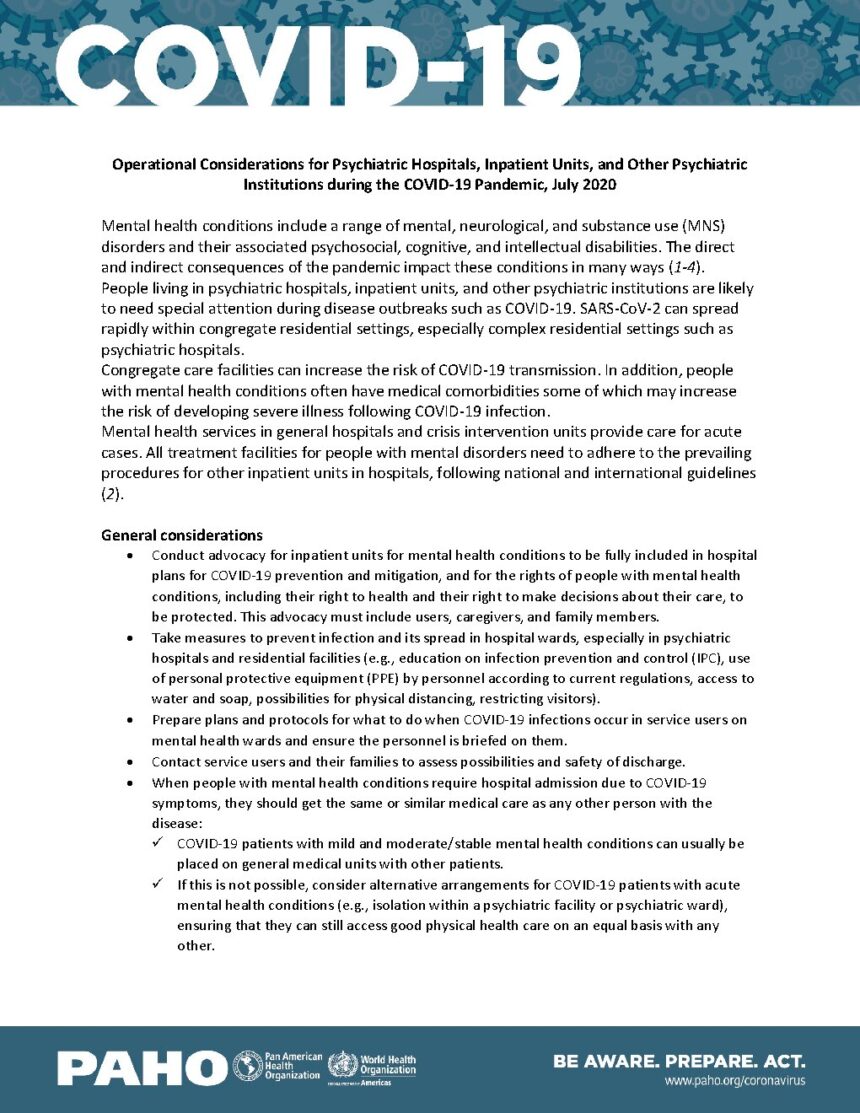
This guidance addresses the heightened vulnerability of psychiatric hospitals and residential mental health facilities during the COVID-19 pandemic. SARS-CoV-2 can spread rapidly in congregate residential settings, and people with mental health conditions often have medical comorbidities that may increase risk of severe COVID-19 illness. The document emphasises that people with mental health conditions requiring hospitalisation for COVID-19 should receive the same medical care as any other person with the disease.
The guidance provides operational recommendations across different transmission scenarios, from no cases to community transmission. Key measures include limiting admissions to urgent cases with pre-admission COVID-19 testing, ensuring infection prevention and control protocols, maintaining access to physical healthcare on an equal basis, facilitating family contact when visits are restricted, and protecting the rights of service users including their right to make decisions about their care.
The document stresses the need to advocate for mental health inpatient units to be fully included in hospital COVID-19 prevention and mitigation plans, and for enhanced monitoring of complaint mechanisms to prevent neglect or human rights violations during the pandemic.
Key points
For clinicians — doses and thresholds as stated in the guideline
- Limit admissions to urgent cases and perform COVID-19 testing prior to admission, ensuring recommended quarantine protocols are followed with full infection prevention and control (IPC) for positive cases
- COVID-19 patients with mild and moderate/stable mental health conditions can usually be placed on general medical units with other patients
- If placement on general medical units is not possible, arrange isolation within a psychiatric facility or ward whilst ensuring equal access to good physical health care
- Enable remote family and social support if visiting is suspended to maintain social connections for hospitalised service users
- Ensure that access to high-quality treatment and criteria for isolation are the same for people with mental, neurological, and substance use conditions as they are for others
- When COVID-19 cases occur in a mental health unit, follow medical advice from health authorities, which may include placing the whole unit in quarantine with a separate isolation area/ward and staff for infected patients
- Consider discharging people with mental health conditions to their families if such discharge would provide a safer setting and if the family can meet the user's needs
- Use accessible formats and familiar communication channels to deliver information about IPC measures for people with psychosocial, intellectual, or cognitive disabilities
Adaptation of MHPSS interventions in different COVID-19 scenarios for hospitals and institutions
Table extracted from the guideline
| Scenarios 1 and 2 (No cases/sporadic cases) | Scenario 3 (Local transmission) | Scenario 4 (Community transmission) |
|---|---|---|
| Review safety and hygiene on unit; assess how basic needs are met | If no COVID-19 cases in unit: Continue essential services with proper safety measures | Similar to scenarios 1, 2, and 3 |
| Advocate to authorities to shield the unit from COVID-19 | Facilitate that hospitalised service users can remain connected with their social networks | |
| Educate staff and patients on safe behaviour | If COVID-19 cases in unit: Follow medical advice from health authorities, which may include placing the whole unit in quarantine with a separate isolation area/ward and staff for infected patients |
Source: Pan American Health Organization, Operational Considerations for Psychiatric Hospitals, Inpatient Units, and Other Psychiatric Institutions during the COVID-19 Pandemic. Reproduced in summary form.
From the guideline
Verbatim
“When people with mental health conditions require hospital admission due to COVID-19 symptoms, they should get the same or similar medical care as any other person with the disease.”
Editor’s perspective
Why this matters for Georgia and the region
Prof. Giorgi Pkhakadze, MD, MPH, PhD
Editor-in-Chief, Georgian Medical Journal · Chair, Public Health Institute of Georgia · WHO consultant, health and migration
As someone who has worked extensively with WHO on vulnerable populations, I recognise that this guidance addresses a critical gap in pandemic preparedness for the South Caucasus region. Our psychiatric institutions, many inherited from the Soviet era, face particular challenges in implementing infection prevention measures due to infrastructure limitations and staffing constraints. The principle that people with mental health conditions must receive equal access to COVID-19 treatment—not be relegated to under-resourced psychiatric wards—is essential but requires active coordination between general hospital and mental health services that may not be well established. For Georgian clinicians, I would stress the recommendation to conduct pre-admission COVID-19 testing and establish clear protocols before cases occur, as reactive responses in congregate settings have historically led to devastating outbreaks. The realistic implementation challenge will be ensuring that rights protections and complaint mechanisms remain functional when facilities are under quarantine, a situation where international monitoring has documented significant violations elsewhere.
ORCID 0000-0001-7609-4515 · Perspective written for the GMJ Guidelines Library, 20 Oct 2026
Applicability
Georgia and the South Caucasus
For Georgia and the South Caucasus, this guidance is directly relevant to psychiatric hospitals and residential mental health facilities throughout the region. National mental health programmes would need to assess existing infection prevention and control capacity in psychiatric institutions, many of which operate in older buildings with limited resources for physical distancing and isolation. Implementation would require coordination between mental health services and general hospital COVID-19 response systems to ensure equal access to testing and treatment. Programmes should consider the specific challenges of maintaining family contact in settings where digital communication infrastructure may be limited, and strengthen complaint mechanisms to monitor potential rights violations during pandemic restrictions in institutional settings.
Questions this guideline answers
Quick answers
Should people with mental health conditions who develop COVID-19 be treated in psychiatric wards or general medical wards?
COVID-19 patients with mild and moderate/stable mental health conditions can usually be placed on general medical units with other patients. If this is not possible, alternative arrangements such as isolation within a psychiatric facility should ensure they can still access good physical health care on an equal basis with any other person.
What should be done when COVID-19 cases occur within a mental health inpatient unit?
Follow medical advice from health authorities, which may include placing the whole unit in quarantine with a separate isolation area/ward and staff for infected patients. Prepare plans and protocols in advance and ensure personnel are briefed on them.
Should admissions to psychiatric facilities be restricted during the pandemic?
Yes, limit admissions to urgent cases only. Perform COVID-19 testing prior to admission, ensuring that recommended quarantine protocols are followed with full infection prevention and control used for positive cases.
How can family contact be maintained if visiting is suspended in psychiatric facilities?
Enable remote family and social support through alternative means of communication. Use accessible formats and familiar communication channels appropriate for people with psychosocial, intellectual, or cognitive disabilities to maintain connections with social networks.
Related on GMJ
Interconnected resources
Dictionary of Public Health
GMJ News coverage
- UK flu and COVID-19 surveillance data to May 2027 shows continued monitoring amid seasonal trendsOct 2026
- Community Health Workers Boost COVID-19 Testing Among Formerly Incarcerated PeopleAug 2026
- Mental Health Conditions and Low Income Create Dual Health Risks, Danish Study RevealsMay 2026
- Surgical patients with mental health conditions show greater medical complexity, study revealsMay 2026
Quality & accreditation
- ASF Hospital — Standard 5 — Safety & Emergency Preparedness
- ASF Medical Transport — Standard 5 — Infection Prevention & Control
- ASF Laboratory — Standard 7 — Examination: Process & Safety
- ASF Hospital — Standard 15 — Psychiatry & Mental Health
- ASF Hospital — Standard 7 — Governance & Management
- ASF Hospital — Standard 4 — Care & Treatment
Other guidelines on this topic
- Assessment of infection prevention and control practices for COVID-19 isolation areas in healthcare facilities
- Recommendations for Environmental Public Health Measures during Drought and Water Conservation
- Initial care of persons with acute respiratory illness (ARI) in the context of coronavirus disease (COVID-19) in healthcare facilities: assess the risk, isolate, refer
- Recommendations for the Management of Solid Waste
- Considerations for the Use of Hotels during the COVID-19 Pandemic
- Issuer
- Pan American Health Organization
- Type
- Procedures, manuals, guidelines
- Edition
- July 2020
- Status
- Current
- Published
- 2020-01-01
- Scope
- Psychiatric hospitals, inpatient mental health units, and residential mental health facilities
- Audience
- Mental health service managers, clinicians, and public health authorities
- Licence
- CC BY-NC-SA 3.0 IGO
- Evidence
- Expert consensus and synthesis of emerging COVID-19 evidence
- Record history
- Created 20 Oct 2026 · updated 20 Oct 2026 · next check Apr 2027
Pan American Health Organization. Operational Considerations for Psychiatric Hospitals, Inpatient Units, and Other Psychiatric Institutions during the COVID-19 Pandemic, July 2020. Washington, D.C.: PAHO; 2020. Report No.: PAHO/NMH/MH/Covid-19/20-0041.GMJ Guidelines Library records are original summaries written by the GMJ editorial team from the issuer’s published document and reviewed by a physician. They do not replace the full guideline. The document is the copyright of its issuer and is linked, not hosted. Spotted an error or a newer edition? Tell the Guidelines Desk.
Was this article helpful?