Pan American Health Organization · 2020
Minimum WASH standards for health care facilities, including water supply, sanitation, waste management and environmental cleaning requirements.
- Issuer
- Pan American Health Organization
- Edition
- 2020
- Audience
- Health facility managers, infection prevention and control staff, public health professionals
- Evidence
- Consensus standards
- Reviewed
- 21 Oct 2026 · GMJ
What this guideline says
GMJ summary
This document establishes minimum standards for water, sanitation, and hygiene (WASH) in health care facilities, with specific requirements adapted for COVID-19 response. It covers water quantity and quality requirements, hand hygiene facilities, sanitation infrastructure, solid waste management, and environmental cleaning protocols.
Water requirements range from 5 L/outpatient visit to 100 L/patient/day for isolation units. The guidance mandates at least one functional hand hygiene facility at critical locations, with a maximum of 5 metres from toilets, and specifies toilet-to-patient ratios for different care settings. Waste must be segregated into six categories with colour-coded containers, and infectious waste storage is limited to 24-72 hours depending on climate.
Environmental cleaning and disinfection protocols are detailed for different areas, with increased frequency (at least twice daily) in facilities with COVID-19 patients. Sodium hypochlorite solutions at concentrations of 0.05% for hands and clothing, 0.1% for surfaces, and 0.5% for body fluid spills are specified for disinfection. Personal protective equipment requirements are defined for waste management and cleaning personnel.
Key points
For clinicians — doses and thresholds as stated in the guideline
- Hospitalized patients require 40–60 L water/patient/day; isolation units for acute respiratory infections require ≥100 L/patient/day
- Water storage reserve must be ≥3 days; free residual chlorine throughout the distribution system should equal 0.5 mg/L
- At least 1 functional hand hygiene facility at critical locations, with ≥2 hand hygiene facilities per 20 beds, located ≤5 metres from toilets
- Hospital services: ≤10 beds per toilet; short-term care: ≤20 beds per toilet; outpatients: ≤20 outpatients per toilet in hospitals, ≤50 in short-term care
- Waste must be segregated into 6 categories (sharps, infectious, pathological, chemical/pharmaceutical, radioactive, common) using minimum 3 colour-coded containers per room
- Maximum infectious waste storage: 72 hours in temperate winter, 48 hours in temperate summer, 48 hours in hot winter, 24 hours in hot summer
- Sodium hypochlorite disinfection: 0.05% for clothes and hands, 0.1% for surfaces and mortuary, 0.5% for body fluid spills
- Facilities with COVID-19 patients: clean and disinfect waiting rooms, triage areas, corridors and bathrooms ≥2 times daily; patient rooms 1–2 times daily; body fluid spills immediately
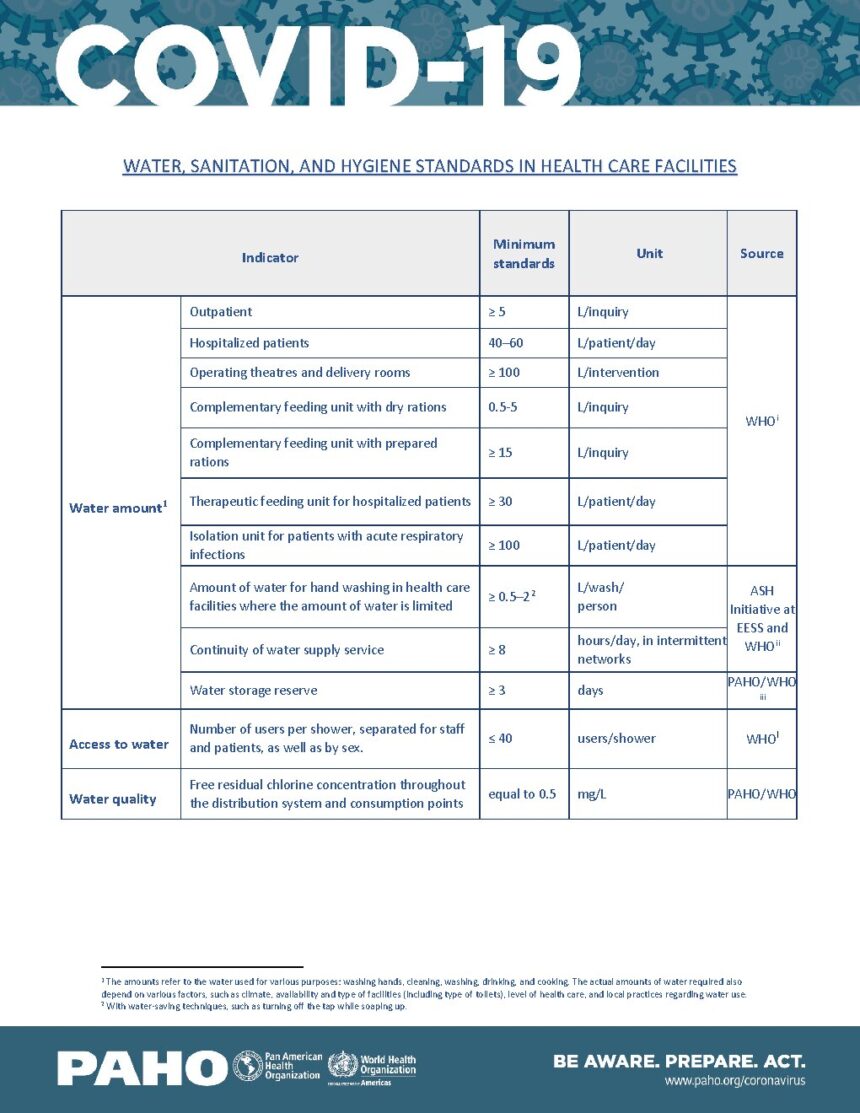
Water Requirements by Health Care Service Type
Table extracted from the guideline
| Service Type | Minimum Water Standard | Unit |
|---|---|---|
| Outpatient | ≥5 | L/inquiry |
| Hospitalized patients | 40–60 | L/patient/day |
| Operating theatres and delivery rooms | ≥100 | L/intervention |
| Therapeutic feeding unit for hospitalized patients | ≥30 | L/patient/day |
| Isolation unit for acute respiratory infections | ≥100 | L/patient/day |
| Hand washing (limited water availability) | ≥0.5–2 | L/wash/person |
Source: Pan American Health Organization, Water, Sanitation, and Hygiene Standards in Health Care Facilities. Reproduced in summary form.
From the guideline
Verbatim
“All healthcare wastes from COVID-19 patients are classified as infectious.”
Editor’s perspective
Why this matters for Georgia and the region
Prof. Giorgi Pkhakadze, MD, MPH, PhD
Editor-in-Chief, Georgian Medical Journal · Chair, Public Health Institute of Georgia · WHO consultant, health and migration
As Chair of the Public Health Institute of Georgia, I recognize that these WASH standards are foundational for infection prevention and control, particularly relevant as we strengthen health system resilience after COVID-19. Georgian facilities should prioritize three areas: ensuring water storage reserves of at least 3 days (critical given intermittent supply in some regions), establishing proper hand hygiene infrastructure with the specified 5-metre maximum distance from toilets, and implementing the 6-category waste segregation system with appropriate storage time limits for our temperate climate (72 hours winter, 48 hours summer). The main implementation challenge will be retrofitting older Soviet-era facilities to meet the toilet-to-bed ratios (≤10 beds per toilet for hospital services) and installing adequate numbers of hand hygiene stations, which will require capital investment and infrastructure planning at the facility level.
ORCID 0000-0001-7609-4515 · Perspective written for the GMJ Guidelines Library, 21 Oct 2026
Applicability
Georgia and the South Caucasus
These standards are directly applicable to Georgian health care facilities, particularly in the context of strengthening infection prevention and control capacity and pandemic preparedness. Georgia’s health system would need to assess current WASH infrastructure against these benchmarks, particularly in rural and regional facilities where water continuity and quality may be challenging. National programmes should prioritise water storage capacity (≥3 days reserve), hand hygiene facility placement, and waste segregation systems. The sodium hypochlorite concentrations specified align with internationally recognized disinfection protocols and can be readily implemented. Given Georgia’s temperate climate, the 72-hour winter and 48-hour summer storage limits for infectious waste should be adopted, with appropriate cold storage infrastructure where needed.
Questions this guideline answers
Quick answers
How much water does a hospital need to provide per patient?
Hospitalized patients require 40–60 L/patient/day for general care, but isolation units for patients with acute respiratory infections require at least 100 L/patient/day. Operating theatres and delivery rooms need at least 100 L per intervention.
What are the minimum requirements for hand hygiene facilities?
At least 1 functional hand hygiene facility (with alcohol-based hand solution or basin with tap, liquid soap, water, and paper towels with wastebasket) must be available at critical locations, with at least 2 facilities per 20 beds, located within 5 metres of toilets.
How should healthcare waste be segregated?
Waste must be segregated at generation into 6 categories: sharps, infectious, pathological/anatomical, chemical and pharmaceutical, radioactive, and common waste. Use minimum 3 colour-coded containers per room (sharps, infectious, common/general), with 20–60 L capacity for general waste (black) and 15–40 L for infectious waste (labelled biohazard).
What sodium hypochlorite concentrations are needed for disinfection?
Use 0.05% sodium hypochlorite for disinfecting clothes and hands, 0.1% for surfaces and mortuary areas, and 0.5% for body fluid spills. Facilities with COVID-19 patients should clean and disinfect waiting rooms, triage, corridors and bathrooms at least twice daily.
Related on GMJ
Interconnected resources
GMJ News coverage
- UK flu and COVID-19 surveillance data to May 2027 shows continued monitoring amid seasonal trendsOct 2026
- Community Health Workers Boost COVID-19 Testing Among Formerly Incarcerated PeopleAug 2026
- 655 Million Without Electricity Face Growing Health Crisis, WHO WarnsOct 2026
- Kwashiorkor: How Severe Protein Deficiency Disrupts Child DevelopmentAug 2026
Quality & accreditation
Other guidelines on this topic
- Recommendations for the Cleaning and Disinfection of Sites Where People are Closely Confined and Deprived of Their Liberty: Penitentiaries, Prisons, and Migrant Detention Centers
- Recommendations for Preparing Disinfecting Solution in Health Establishments, 9 April 2020
- Requirements and technical specifications of personal protective equipment (PPE) for the novel coronavirus (2019-nCoV) in healthcare settings
- Checklist for the Management of Human Resources for Health in Response to COVID-19
- Infection prevention and control practices for care of patients in nontraditional settings with focus to the novel coronavirus (COVID-19)
- Issuer
- Pan American Health Organization
- Type
- Procedures, manuals, guidelines
- Status
- Current
- Published
- 2020-01-01
- Scope
- Health care facilities
- Audience
- Health facility managers, infection prevention and control staff, public health professionals
- Licence
- CC BY-NC-SA 3.0 IGO
- Evidence
- Consensus standards
- Record history
- Created 21 Oct 2026 · updated 21 Oct 2026 · next check Apr 2027
Pan American Health Organization. Water, Sanitation, and Hygiene Standards in Health Care Facilities. Washington, D.C.: PAHO; 2020. (PAHO/CDE/CD/COVID-19/20-0025).GMJ Guidelines Library records are original summaries written by the GMJ editorial team from the issuer’s published document and reviewed by a physician. They do not replace the full guideline. The document is the copyright of its issuer and is linked, not hosted. Spotted an error or a newer edition? Tell the Guidelines Desk.
Was this article helpful?