Pan American Health Organization · 2020
Technical guidance on preparing sodium hypochlorite disinfecting solutions for cleaning and COVID-19 prevention in domestic and sanitary settings.
- Issuer
- Pan American Health Organization
- Edition
- 2020
- Audience
- Sanitary and domestic sector workers, general public
- Reviewed
- 20 Oct 2026 · GMJ
What this guideline says
GMJ summary
This technical note from the Pan American Health Organization provides basic recommendations for preparing and diluting sodium hypochlorite (household bleach) for domestic use. The guidance addresses the need for standardised disinfecting solutions in the context of COVID-19 and other infectious agents.
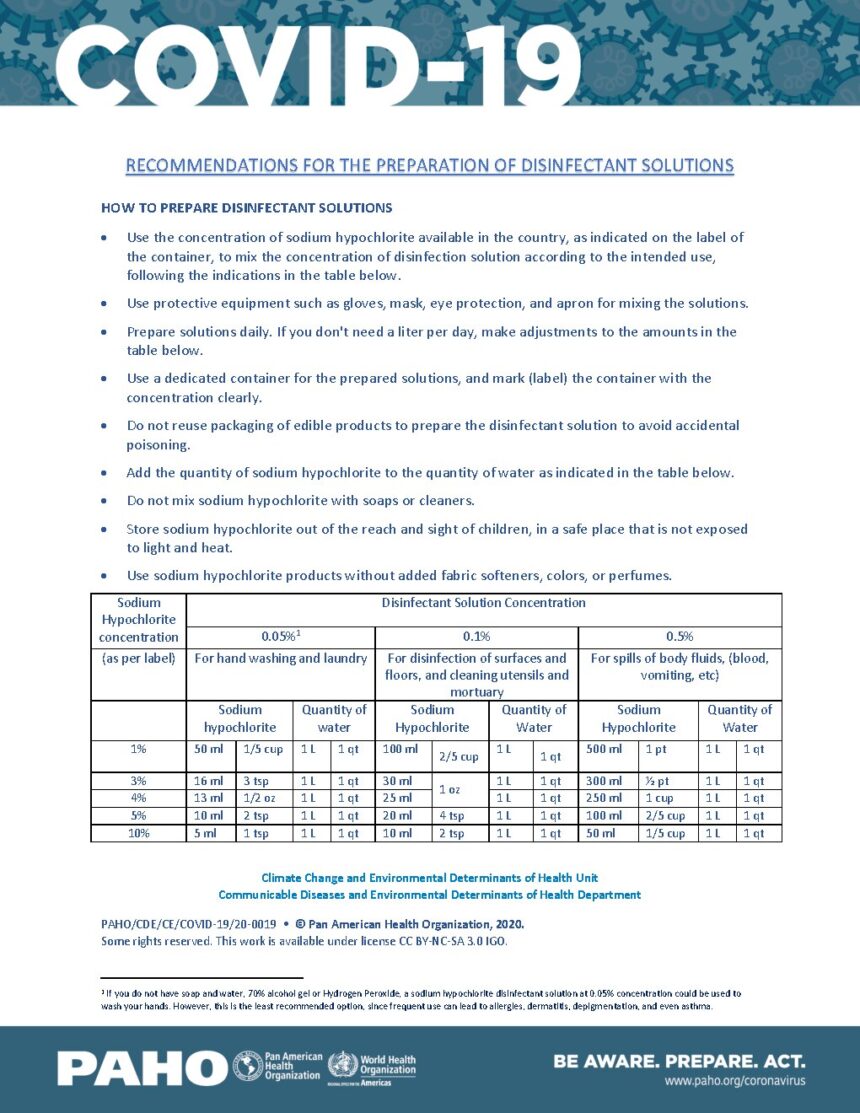
Three specific concentrations are recommended—0.05%, 0.1%, and 0.5%—depending on cleaning and prevention needs. The document is intended for use in the sanitary and domestic sector to ensure appropriate disinfection practices during the pandemic and for routine infection prevention.
Key points
For clinicians — doses and thresholds as stated in the guideline
- Sodium hypochlorite solutions should be prepared at three standardised concentrations: 0.05%, 0.1%, and 0.5%
- The appropriate concentration depends on the specific cleaning and prevention needs
- Solutions are intended for use against COVID-19 and other infectious agents
- Recommendations apply to both domestic and sanitary sector settings
- Proper preparation and dilution techniques are essential for effective disinfection
Editor’s perspective
Why this matters for Georgia and the region
Prof. Giorgi Pkhakadze, MD, MPH, PhD
Editor-in-Chief, Georgian Medical Journal · Chair, Public Health Institute of Georgia · WHO consultant, health and migration
As we continue to strengthen infection prevention capacities across Georgia and the South Caucasus, standardised protocols for preparing disinfectant solutions remain fundamental to both healthcare facility safety and community-level disease prevention. The three-tier concentration approach (0.05%, 0.1%, 0.5%) offers practical guidance that can be adapted to our regional context, though implementation will require clear instructions on diluting locally available bleach products, which vary in baseline concentration. Georgian health facilities and public health programmes should ensure that cleaning staff, community health workers, and the general public receive practical training in proper dilution techniques, as incorrect preparation can result in either ineffective disinfection or unnecessary chemical exposure, both of which I have observed in facility assessments. This PAHO guidance provides a valuable foundation, but national adaptation must address the specific bleach formulations available in our markets and consider literacy levels when developing pictorial dilution instructions for community use.
ORCID 0000-0001-7609-4515 · Perspective written for the GMJ Guidelines Library, 20 Oct 2026
Applicability
Georgia and the South Caucasus
For Georgia and the South Caucasus region, standardised protocols for preparing disinfectant solutions remain highly relevant for infection prevention in healthcare facilities, public spaces, and households. National programmes should consider local availability of sodium hypochlorite products, baseline concentrations of commercially available bleach (which vary by manufacturer), training needs for healthcare workers and cleaning staff in proper dilution techniques, and culturally appropriate methods for disseminating these recommendations to the general public. Integration with existing infection prevention and control programmes in primary healthcare settings would maximise implementation effectiveness.
Questions this guideline answers
Quick answers
What concentrations of sodium hypochlorite solution are recommended?
Three concentrations are recommended: 0.05%, 0.1%, and 0.5%, depending on the specific cleaning and prevention needs.
What is sodium hypochlorite and where can it be found?
Sodium hypochlorite is the active ingredient in household bleach. It must be properly diluted from commercial products to achieve the recommended concentrations for disinfection.
Can these solutions be used against COVID-19?
Yes, the guidance specifically addresses the preparation of disinfecting solutions for prevention against COVID-19 and other infectious agents.
Where should these solutions be used?
The recommendations are intended for both the sanitary sector (healthcare and public facilities) and domestic settings (homes and households).
Related on GMJ
Interconnected resources
Dictionary of Public Health
GMJ News coverage
- UK flu and COVID-19 surveillance data to May 2027 shows continued monitoring amid seasonal trendsOct 2026
- Community Health Workers Boost COVID-19 Testing Among Formerly Incarcerated PeopleAug 2026
- Cumulative Chemical Exposure in Daily Life: A Toxicologist's Evidence-Based Risk Reduction StrategySep 2026
Quality & accreditation
- ASF Hospital — Standard 5 — Safety & Emergency Preparedness
- ASF Medical Transport — Standard 5 — Infection Prevention & Control
- ASF Laboratory — Standard 7 — Examination: Process & Safety
- ASF Hospital — Standard 11 — Critical Care
- ASF Medical Transport — Standard 6 — Emergency Response During Transport
Other guidelines on this topic
- COVID-19: Chloroquine and hydroxychloroquine research
- Promoting health equity, gender and ethnic equality, and human rights in COVID-19 responses: Key considerations
- Considerations on Indigenous Peoples, Afro-Descendants, and Other Ethnic Groups during the COVID-19 Pandemic
- Recommendations for the Management of Municipal Wastewater
- Considerations on the Adjustments of Social Distancing and Travel-Related Measures in the Context of the Response to COVID-19 Pandemic
- Issuer
- Pan American Health Organization
- Type
- Procedures, manuals, guidelines
- Status
- Current
- Published
- 2020-01-01
- Scope
- Domestic and sanitary sector
- Audience
- Sanitary and domestic sector workers, general public
- Licence
- CC BY-NC-SA 3.0 IGO
- Record history
- Created 20 Oct 2026 · updated 20 Oct 2026 · next check Apr 2027
Pan American Health Organization. Recommendations for the preparation of disinfectant solutions, 11 May 2020. Washington, D.C.: PAHO; 2020.GMJ Guidelines Library records are original summaries written by the GMJ editorial team from the issuer’s published document and reviewed by a physician. They do not replace the full guideline. The document is the copyright of its issuer and is linked, not hosted. Spotted an error or a newer edition? Tell the Guidelines Desk.
Was this article helpful?