Pan American Health Organization · 2020
Technical guidance on preventing SARS-CoV- water and sanitation operators.
- Issuer
- Pan American Health Organization
- Edition
- 2020
- Audience
- Water and sanitation operators
- Reviewed
- 20 Oct 2026 · GMJ
What this guideline says
GMJ summary
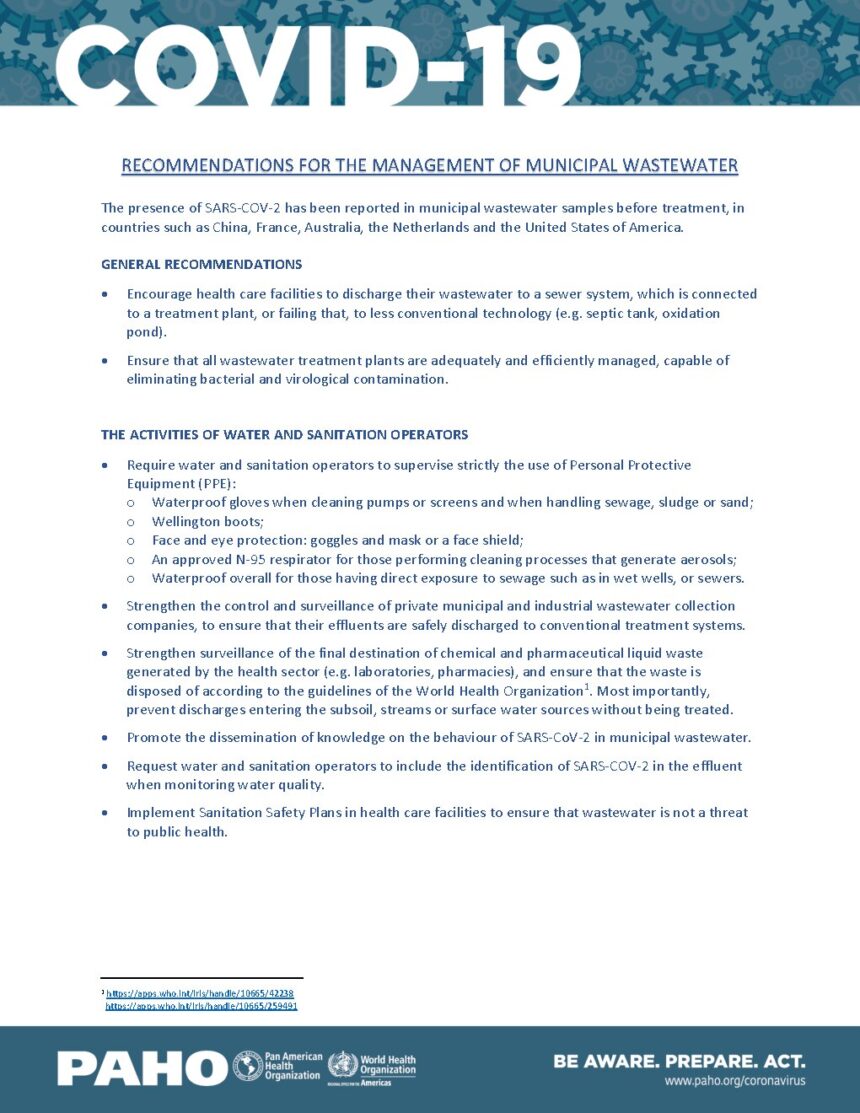
This technical note from the Pan American Health Organization provides general recommendations to prevent the transmission of SARS-CoV-2 through municipal wastewater systems during the COVID-19 pandemic. The document addresses water and sanitation operators specifically, offering guidance on safe operational practices.
The guidance covers treatment and disinfection protocols for wastewater, as well as indications for the safe reuse of treated wastewater. The central message is to ensure that wastewater management systems implement appropriate controls to mitigate potential viral transmission risks through this environmental pathway.
Key points
For clinicians — doses and thresholds as stated in the guideline
- General recommendations provided to avoid SARS-CoV-2 transmission by wastewater
- Specific guidelines for water and sanitation operators on safe operational practices
- Indications for appropriate treatment and disinfection of wastewater
- Guidance on safe reuse of treated wastewater
Editor’s perspective
Why this matters for Georgia and the region
Prof. Giorgi Pkhakadze, MD, MPH, PhD
Editor-in-Chief, Georgian Medical Journal · Chair, Public Health Institute of Georgia · WHO consultant, health and migration
As Chair of the Public Health Institute of Georgia, I recognise that wastewater management is a critical but often overlooked component of communicable disease control, particularly relevant as Georgia continues to strengthen its environmental health infrastructure. The document's focus on water and sanitation operator training and protocols is essential for our municipalities, where wastewater treatment capacity varies considerably between major cities and smaller settlements. While the guidance addresses COVID-19 specifically, the principles apply broadly to preventing waterborne disease transmission. Implementation in Georgia would require assessment of existing treatment facilities, operator training capacity, and investment in disinfection infrastructure, particularly in regions where wastewater reuse in agriculture is practised.
ORCID 0000-0001-7609-4515 · Perspective written for the GMJ Guidelines Library, 20 Oct 2026
Applicability
Georgia and the South Caucasus
For Georgia and the South Caucasus region, this guidance is relevant given varying levels of wastewater infrastructure development across urban and rural areas. National programmes would need to assess the capacity of existing wastewater treatment facilities to implement recommended disinfection protocols, consider the training needs of water and sanitation operators, and evaluate any wastewater reuse practices in agriculture or industry. The guidance is particularly pertinent for municipal authorities managing water systems in Tbilisi, Batumi, Kutaisi and other urban centres, as well as for regional environmental health programmes addressing WASH infrastructure gaps.
Questions this guideline answers
Quick answers
Can SARS-CoV-2 be transmitted through wastewater?
This document provides recommendations to avoid transmission of SARS-CoV-2 by wastewater, indicating that appropriate management practices are necessary to mitigate potential risks in municipal wastewater systems.
Who should implement these recommendations?
The guidelines are specifically designed for water and sanitation operators who manage municipal wastewater treatment and distribution systems.
What aspects of wastewater management does this cover?
The document covers treatment and disinfection of wastewater, as well as indications for the safe reuse of treated wastewater.
Is this guidance still relevant after the acute phase of COVID-19?
The principles of wastewater management and disinfection remain applicable for preventing transmission of waterborne pathogens beyond SARS-CoV-2, making the guidance relevant for ongoing public health practice.
Related on GMJ
Interconnected resources
Dictionary of Public Health
GMJ News coverage
Quality & accreditation
Other guidelines on this topic
- Considerations on the Adjustments of Social Distancing and Travel-Related Measures in the Context of the Response to COVID-19 Pandemic
- Technical recommendations for the configuration of a specialized Emergency Medical Team for the treatment of Severe Acute Respiratory Infection (SARI). Version 3.5
- Crisis Management during an Epidemic: General guidelines for efficient response coordination by national regulatory authorities
- Recommendations for Environmental Public Health Measures during Drought and Water Conservation
- Recommendations for the Management of Solid Waste
- Issuer
- Pan American Health Organization
- Type
- Procedures, manuals, guidelines
- Status
- Current
- Published
- 2020-01-01
- Scope
- Municipal wastewater management during COVID-19
- Audience
- Water and sanitation operators
- Licence
- CC BY-NC-SA 3.0 IGO
- Record history
- Created 20 Oct 2026 · updated 20 Oct 2026 · next check Apr 2027
Pan American Health Organization. Recommendations for the Management of Municipal Wastewater, 11 May 2020. Washington, D.C.: PAHO; 2020. IRIS: 10665.2/52229.GMJ Guidelines Library records are original summaries written by the GMJ editorial team from the issuer’s published document and reviewed by a physician. They do not replace the full guideline. The document is the copyright of its issuer and is linked, not hosted. Spotted an error or a newer edition? Tell the Guidelines Desk.
Was this article helpful?