Pan American Health Organization · 2020
Framework for integrating equity, gender, ethnicity and human rights perspectives into national COVID-19 pandemic responses for policy makers.
- Issuer
- Pan American Health Organization
- Edition
- 2020
- Audience
- National health policy makers, public health professionals
- Evidence
- Expert consensus with reference to international human rights frameworks
- Reviewed
- 20 Oct 2026 · GMJ
What this guideline says
GMJ summary
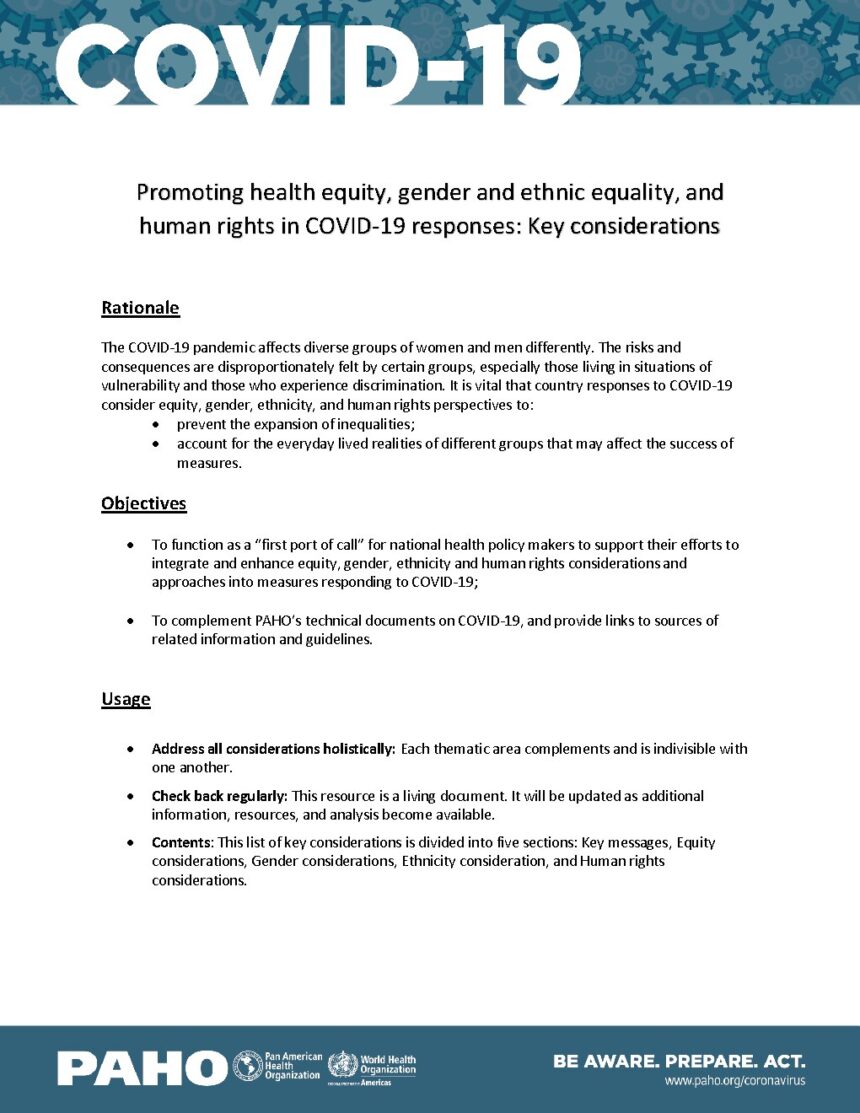
This Pan American Health Organization guidance provides a comprehensive framework for national health policy makers to integrate health equity, gender equality, ethnic equality, and human rights considerations into COVID-19 pandemic responses. The document recognises that COVID-19 affects diverse groups of women and men differently, with disproportionate risks and consequences for populations living in vulnerability and experiencing discrimination.
The guidance is structured around five thematic areas that are complementary and indivisible: key messages for country responses, health equity considerations, gender considerations, ethnicity considerations, and human rights considerations. It emphasises that restrictive measures during public health emergencies must align with international human rights law, specifically the UN Committee on Economic, Social and Cultural Rights General Comment 14 (2000) and the Siracusa Principles (1984), requiring that restrictions be lawful, pursue legitimate aims, be proportionate, and not arbitrary or discriminatory.
Core recommendations include collecting and analysing disaggregated data by sex, age, ethnicity, income and geography; implementing targeted actions to reduce barriers to COVID-19 services for vulnerable populations; addressing financial barriers through measures such as avoiding out-of-pocket payments; providing economic protection including sick leave, safety nets and unemployment mitigation; culturally adapting prevention messages for indigenous and Afro-descendant communities; maintaining sexual and reproductive health services; preventing gender-based violence under stay-at-home policies; and ensuring participation of diverse communities in decision-making processes.
Key points
For clinicians — doses and thresholds as stated in the guideline
- Include health equity as an explicit objective in all COVID-19 responses, identifying populations in conditions of vulnerability for testing, health care, and mitigation measures
- Eliminate financial barriers to COVID-19 health services by avoiding out-of-pocket payments, user fees, and catastrophic expenditure
- Collect disaggregated data by sex, age, ethnicity, income and geography on service access and outcomes (morbidity and mortality) to identify and mitigate health inequalities
- Implement measures to mitigate rent and mortgage burdens, avoid evictions, provide shelter for homeless, and establish sick leave and financial protection for COVID-19
- Translate and culturally adapt COVID-19 prevention messages into indigenous languages with intercultural approaches, ensuring food, water, soap availability and respect for traditional medicine
- Maintain sexual and reproductive health services as essential with attention to hidden costs and additional barriers during the emergency
- Implement specific interventions to prevent and address gender-based violence and sexual exploitation under stay-at-home policies
- Ensure universal access to COVID-19 testing and treatment without discrimination, with clear triage policies based on clinical assessment, medical need, scientific evidence and ethical principles for scarce resource allocation
From the guideline
Verbatim
“Any such restrictive measures should be in accordance with the law; pursue a legitimate aim; proportionate; and not arbitrary or discriminatory.”
Editor’s perspective
Why this matters for Georgia and the region
Prof. Giorgi Pkhakadze, MD, MPH, PhD
Editor-in-Chief, Georgian Medical Journal · Chair, Public Health Institute of Georgia · WHO consultant, health and migration
As a WHO consultant who has worked extensively on health equity and migration in the South Caucasus, I recognise that this framework addresses fundamental challenges our region faces in pandemic response. Georgia's universal health coverage programme, whilst ambitious since 2013, has revealed persistent disparities in access for rural populations, ethnic minorities and informal workers—the very groups this guidance prioritises. The recommendation I would stress most to Georgian colleagues is the imperative to collect disaggregated data by ethnicity, geography and socioeconomic status, which our national surveillance systems have historically under-emphasised compared to age and sex disaggregation. The realistic implementation caveat is that many recommended economic protections—such as comprehensive sick leave for informal workers who constitute approximately 50% of Georgia's workforce, or suspension of mortgage payments—require fiscal capacity and inter-ministerial coordination mechanisms that remain underdeveloped in our context, necessitating phased implementation aligned with available resources and political will.
ORCID 0000-0001-7609-4515 · Perspective written for the GMJ Guidelines Library, 20 Oct 2026
Applicability
Georgia and the South Caucasus
For Georgia and the South Caucasus region, this guidance is directly relevant given the diverse ethnic composition including Armenian and Azerbaijani minorities, internally displaced populations from conflict zones, and disparities between urban and rural areas. National COVID-19 programmes would need to consider translation of health messages into minority languages, address barriers to healthcare access in mountainous rural regions with limited infrastructure, account for informal employment common in the region where workers lack sick leave protections, and ensure participation of minority community leaders in pandemic response planning. The framework for balancing public health restrictions with human rights protections is particularly pertinent for countries in the Eastern Partnership region working to align health policies with European standards whilst managing resource constraints in health systems still undergoing post-Soviet transformation.
Questions this guideline answers
Quick answers
What human rights principles must guide restrictive measures during COVID-19?
According to the Siracusa Principles (1984), restrictive measures must be in accordance with the law, pursue a legitimate aim, be proportionate, and not be arbitrary or discriminatory. They must be strictly necessary to respond to COVID-19 and monitored to ensure alignment with principles of reasonability, proportionality and appropriate duration whilst respecting dignity, human rights and fundamental freedoms per Article 3 of the International Health Regulations (2005).
What specific economic protection measures are recommended for vulnerable populations?
Recommended measures include: avoiding out-of-pocket payments and user fees for COVID-19 services; mitigating rent and mortgage payment burdens and preventing evictions; providing shelter for homeless populations; establishing sick leave and financial protection specifically for COVID-19; creating safety nets for vulnerable households; mitigating unemployment through redistributive actions; and distributing subsidies to populations experiencing economic vulnerability due to loss of formal and informal work.
How should COVID-19 responses address indigenous and Afro-descendant communities?
Responses should: translate prevention messages into indigenous languages with cultural adaptation accounting for different understandings of health and wellbeing; ensure protection of territories and availability of food, water, soap and sanitizer; respect traditional medicine including use of plants in health practices; engage leaders and key community members (women, youth, elderly) in decision-making; involve traditional healers with health authorities on the basis of mutual respect and equality; and conduct analysis of cultural norms to formulate adequate testing, treatment, containment and quarantine approaches.
What gender-specific considerations are essential in COVID-19 response?
Essential considerations include: disaggregating all data by sex to guide responses; addressing women's dual burden as frontline healthcare workers and care providers through improved access to information, personal protective equipment and flexible work arrangements; implementing interventions to prevent gender-based violence under stay-at-home policies; providing direct compensation to informal workers in sectors with over-representation of women; maintaining sexual and reproductive health services as essential; and ensuring women's participation in decision-making, impact analysis and design of recovery actions.
Related on GMJ
Interconnected resources
Dictionary of Public Health
GMJ News coverage
Quality & accreditation
Other guidelines on this topic
- Considerations on Indigenous Peoples, Afro-Descendants, and Other Ethnic Groups during the COVID-19 Pandemic
- Recommendations for the Management of Municipal Wastewater
- Considerations on the Adjustments of Social Distancing and Travel-Related Measures in the Context of the Response to COVID-19 Pandemic
- Technical recommendations for the configuration of a specialized Emergency Medical Team for the treatment of Severe Acute Respiratory Infection (SARI). Version 3.5
- Crisis Management during an Epidemic: General guidelines for efficient response coordination by national regulatory authorities
- Issuer
- Pan American Health Organization
- Type
- Procedures, manuals, guidelines
- Status
- Current
- Published
- 2020-01-01
- Scope
- Pan-American region, applicable globally
- Audience
- National health policy makers, public health professionals
- Licence
- CC BY-NC-SA 3.0 IGO
- Evidence
- Expert consensus with reference to international human rights frameworks
- Record history
- Created 20 Oct 2026 · updated 20 Oct 2026 · next check Apr 2027
Pan American Health Organization. Promoting health equity, gender and ethnic equality, and human rights in COVID-19 responses: Key considerations. Washington, D.C.: PAHO; 2020. Available from: https://iris.paho.org/handle/10665.2/52058GMJ Guidelines Library records are original summaries written by the GMJ editorial team from the issuer’s published document and reviewed by a physician. They do not replace the full guideline. The document is the copyright of its issuer and is linked, not hosted. Spotted an error or a newer edition? Tell the Guidelines Desk.
Was this article helpful?