Pan American Health Organization · 2020
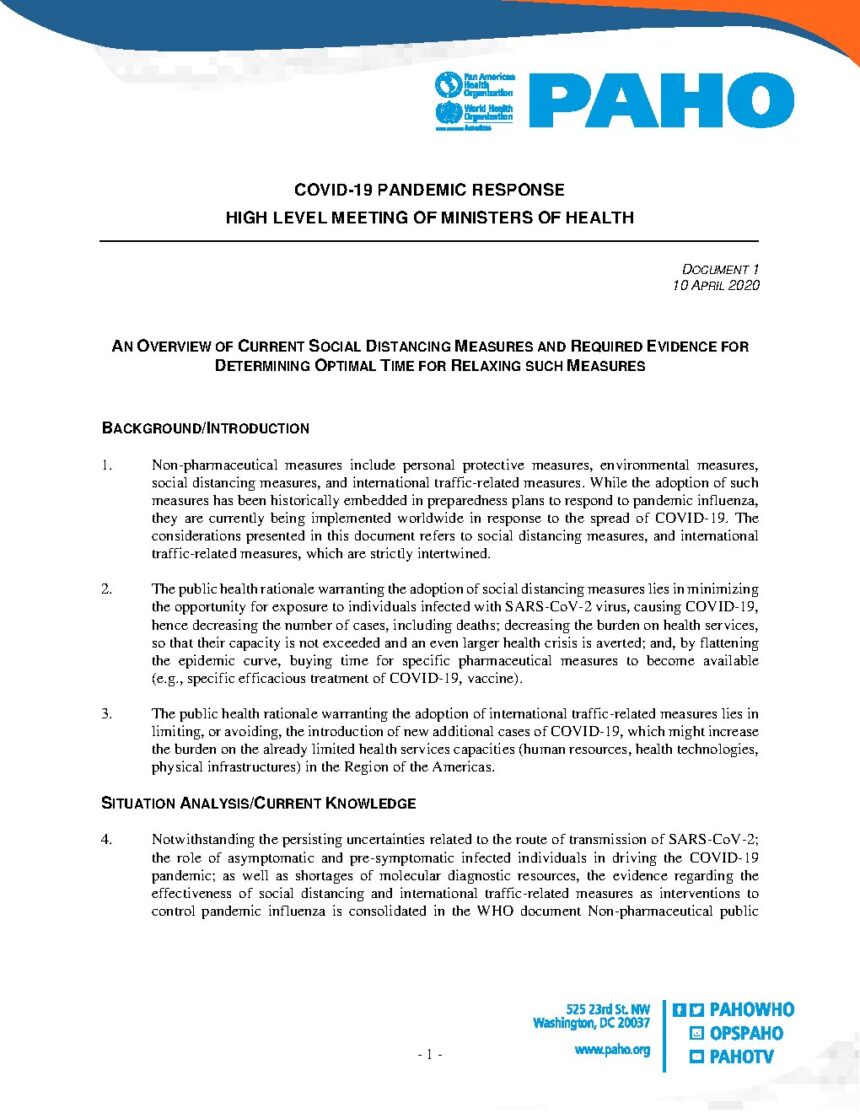
PAHO guidance for ministers of health on implementing and transitioning from COVID-19 social distancing and international traffic measures (April 2020)
- Issuer
- Pan American Health Organization
- Edition
- 2020
- Audience
- Ministers of Health, public health officials, national authorities
- Evidence
- Expert consensus based on empiric observations from multiple countries and mathematical models
- Reviewed
- 20 Oct 2026 · GMJ
What this guideline says
GMJ summary
This document, prepared for a high-level meeting of Ministers of Health in the Americas, provides a framework for implementing and eventually relaxing community-wide social distancing and international traffic-related measures during the COVID-19 pandemic. It explains that such measures aim to minimise exposure to SARS-CoV-2, decrease the burden on health services, and buy time for pharmaceutical interventions to become available.
As of 10 April 2020, 34 of 35 countries in the Americas had implemented stringent measures restricting population movement, closing non-essential businesses and schools, and limiting international travel. The document acknowledges that whilst these measures have allowed most countries to maintain transmission at levels within health service capacity, the socioeconomic impact is creating pressure to transition to less restrictive measures.
The central message is that any transition must be gradual, evidence-based, and conditional on having adequate public health and health service capacities in place. Complete discontinuation of measures is unlikely until critical knowledge gaps are filled, effective treatment becomes available, and—most importantly—a safe and effective vaccine becomes widely available (estimated at least 12 months from April 2020).
Key points
For clinicians — doses and thresholds as stated in the guideline
- Any transition to less stringent measures must be gradual with each step taken 14 days apart (e.g. staggered mobility by car plate number, phased opening of businesses by type, schools by grade)
- Public health and health service capacities must be in place to detect cases through decentralised laboratory testing and contain transmission through isolation of cases and 14-day quarantine of contacts
- Infection prevention and control measures should be applied and enforced in amplifier settings including health care facilities, nursing homes, educational institutions, and prisons
- Points of entry should remain operational for essential goods and humanitarian operations, but re-establishment of non-essential international traffic should be weighed against capacity to manage imported cases and quarantine travellers
- Countries must have capacity to immediately re-institute stringent, nation-wide community-wide social distancing measures if transmission escalates
- Complete discontinuation of community-wide measures is unlikely until a safe and effective vaccine becomes widely available (at least 12 months)
- Quarantine of contacts should be maintained for 14 days following exposure to confirmed cases
- Maintaining current transmission levels—or further curbing them—should be the overall objective, particularly in countries where timely implementation has kept health services operating within capacity
From the guideline
Verbatim
“Any transition must be gradual, prioritized, and planned for (e.g. staggered mobility of productive segments of the population such as by car plates number; staggered opening of businesses by typology; and encouraging social distancing measures, hygiene of surfaces and other measures adapted to each sector opening of schools by grade; etc.). Ideally each step should be taken 14 days apart.”
Editor’s perspective
Why this matters for Georgia and the region
Prof. Giorgi Pkhakadze, MD, MPH, PhD
Editor-in-Chief, Georgian Medical Journal · Chair, Public Health Institute of Georgia · WHO consultant, health and migration
As someone who has advised WHO on health system responses and witnessed Georgia's capacity to implement comprehensive public health programmes, I recognise that this April 2020 framework captures the evidence-based principles that guided our region through the initial pandemic response. The document's emphasis on the 14-day interval between relaxation steps and the requirement for decentralised laboratory capacity proved prescient—Georgia's network of reference laboratories and the National Centre for Disease Control's contact tracing infrastructure were indeed critical to managing subsequent waves. For South Caucasus countries, I would stress the recommendation that capacity to immediately re-institute stringent measures must exist before any relaxation begins; our region learned this lesson when premature relaxation led to autumn 2020 surges. The realistic implementation caveat is that the document's assumption of 'at least 12 months' until vaccine availability underestimated the challenge—equitable vaccine access in middle-income countries like Georgia faced significant delays beyond that timeline, meaning that the transitional framework needed to be sustained far longer than initially envisaged.
ORCID 0000-0001-7609-4515 · Perspective written for the GMJ Guidelines Library, 20 Oct 2026
Applicability
Georgia and the South Caucasus
For Georgia and the South Caucasus region, this April 2020 framework remains historically relevant for understanding the evidence base that guided initial pandemic responses and for preparing future pandemic preparedness plans. National public health programmes should consider the document’s emphasis on gradual, phased transitions from restrictive measures, the critical 14-day interval between relaxation steps, and the need for robust contact tracing and quarantine capacity. Georgia’s experience with universal health coverage since 2013 and its established public health infrastructure through the National Centre for Disease Control and Public Health would need to be leveraged alongside laboratory diagnostic capacity for any future implementation of such graduated transition frameworks. The recommendation for decentralised laboratory testing capacity is particularly relevant for countries with mountainous terrain and dispersed populations characteristic of the South Caucasus.
Questions this guideline answers
Quick answers
How long should we wait between each step of relaxing social distancing measures?
Each step should ideally be taken 14 days apart. This interval allows sufficient time to observe whether new transmission has occurred as a result of the relaxation and to assess the epidemiological impact before proceeding to the next phase.
How long should contacts of COVID-19 cases be quarantined?
Contacts should be quarantined for 14 days following identification. This is part of the essential public health capacity that must be in place before any transition to less stringent measures can be considered.
When can community-wide social distancing measures be completely discontinued?
Complete discontinuation is unlikely until three conditions are met: critical parameters about SARS-CoV-2 transmission are fully elucidated, a safe and effective treatment becomes widely accessible, and—most importantly—a safe and effective vaccine becomes widely available (estimated at least 12 months from April 2020).
What public health capacities must be in place before relaxing measures?
Countries must have capacity to detect cases through decentralised laboratory testing, isolate cases, identify and quarantine contacts for 14 days, enforce infection prevention and control in amplifier settings, communicate changes to the population, and immediately re-institute stringent measures if needed.
Related on GMJ
Interconnected resources
Dictionary of Public Health
GMJ News coverage
Quality & accreditation
Other guidelines on this topic
- Enhancing COVID-19 Mortality Surveillance in Latin America and the Caribbean through All-Cause Mortality Surveillance
- COVID-19: Chloroquine and hydroxychloroquine research
- Regulatory considerations on authorization of the use of convalescent plasma (CP) to address the COVID-19 emergency
- Guidelines for Diagnosing and Managing Disseminated Histoplasmosis among People Living with HIV
- Interpretation of laboratory results for COVID-19 diagnosis
- Issuer
- Pan American Health Organization
- Type
- Procedures, manuals, guidelines
- Status
- Current
- Published
- 2020-01-01
- Scope
- COVID-19 pandemic response
- Audience
- Ministers of Health, public health officials, national authorities
- Licence
- CC BY-NC-SA 3.0 IGO
- Evidence
- Expert consensus based on empiric observations from multiple countries and mathematical models
- Record history
- Created 20 Oct 2026 · updated 20 Oct 2026 · next check Apr 2027
Pan American Health Organization. An Overview of Current Social Distancing Measures and Required Evidence for Determining Optimal Time for Relaxing Such Measures, 10 April 2020. Washington, D.C.: PAHO; 2020. (PAHO/PHE/CPI/COVID-19-20-0026).GMJ Guidelines Library records are original summaries written by the GMJ editorial team from the issuer’s published document and reviewed by a physician. They do not replace the full guideline. The document is the copyright of its issuer and is linked, not hosted. Spotted an error or a newer edition? Tell the Guidelines Desk.
Was this article helpful?