Pan American Health Organization · Rapid review, 6 April 2020
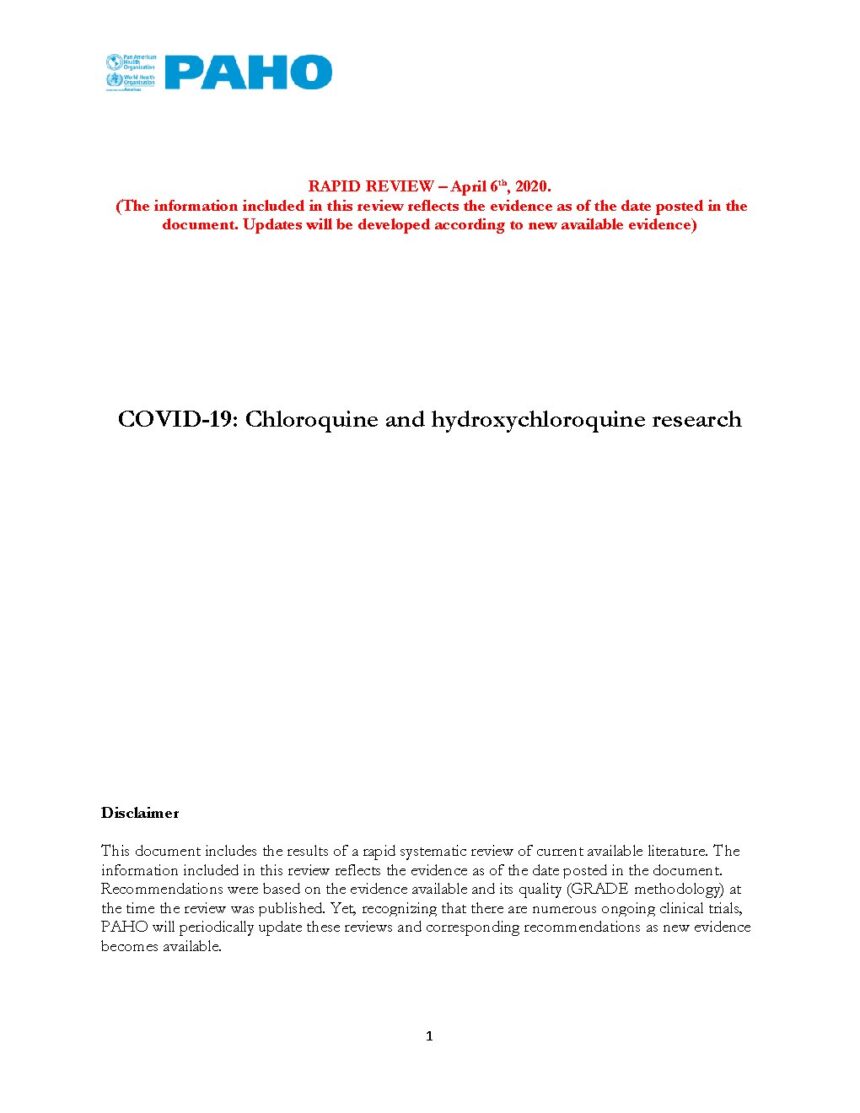
Rapid systematic review of evidence for chloroquine/hydroxychloroquine in COVID-19 treatment for clinicians and public health authorities
- Issuer
- Pan American Health Organization
- Edition
- Rapid review, 6 April 2020
- Audience
- Clinicians, public health professionals, national health authorities, regulatory bodies
- Evidence
- Systematic review with critical appraisal using validated risk-of-bias tools; GRADE methodology referenced
- Reviewed
- 20 Oct 2026 · GMJ
What this guideline says
GMJ summary
This rapid systematic review, published on 6 April 2020, evaluates the available evidence for using chloroquine or hydroxychloroquine in the treatment of COVID-19. At the time of publication, there was a lack of quality evidence to demonstrate that chloroquine and/or hydroxychloroquine are effective in treating COVID-19. The evidence was emerging from small studies with sub-optimal methodologies that were conflicting and at high risk of bias.
The review emphasizes that while in vitro studies showed some antiviral activity, the in vivo human studies were methodologically weak, with small sample sizes, lack of proper randomization, inadequate blinding, and poor reporting. National authorities are urged to control the use of these medicines, prevent self-medication, and prioritize resources on standard-of-care interventions. The use of these drugs outside current guidelines may result in adverse effects, including serious illness and death, particularly cardiac complications such as QT-interval prolongation and potentially lethal arrhythmias.
PAHO emphasizes that robust, high-quality randomized controlled trials are urgently needed before any definitive conclusions can be drawn about benefits and harms. The organization commits to updating recommendations as new evidence from ongoing clinical trials becomes available. Until definitive evidence is available, compassionate use should be approached with extreme caution, particularly given concerns about cardiac toxicity and drug shortages affecting patients with rheumatoid arthritis, lupus, and other conditions where these drugs have proven benefit.
Key points
For clinicians — doses and thresholds as stated in the guideline
- No quality evidence exists as of 6 April 2020 to demonstrate chloroquine or hydroxychloroquine effectiveness in COVID-19 treatment
- One Chinese expert consensus suggested chloroquine phosphate 500 mg twice daily for 10 days, but this is based on very limited and unpublished data
- A French study used hydroxychloroquine 600 mg daily for 10 days, sometimes with azithromycin (500 mg day 1, then 250 mg daily for 4 days), but was judged at high risk of bias
- Cardiac toxicity is a major concern: hydroxychloroquine/azithromycin can prolong QT interval and cause torsade de pointes, a potentially lethal ventricular tachycardia
- In one series of 84 COVID-19 patients treated with hydroxychloroquine/azithromycin, 11% developed QTc >500 ms (high arrhythmia risk)
- National authorities should control availability of these medicines and prevent self-medication, as over-the-counter use may cause serious adverse effects including death
- Priority should be given to standard supportive care interventions; use of chloroquine/hydroxychloroquine should be restricted to ethically approved randomized controlled trials
- Mass purchasing may create shortages affecting patients with malaria, rheumatoid arthritis, lupus, and other conditions where these drugs have proven benefit
Risk of bias assessment for observational studies on hydroxychloroquine/azithromycin in COVID-19
Table extracted from the guideline
| Study | Selection bias | Exposure assessment | Outcome not present at start | Matching/adjustment | Prognostic factors | Follow-up adequate | Interventions similar | Overall risk |
|---|---|---|---|---|---|---|---|---|
| Gautret 2020 (France) observational | Probably no (different care sites, refused treatment as controls) | Probably yes | Probably yes | No (no matching or adjustment) | No (no prognostic information) | Probably yes | Probably no (unclear drop-outs) | High risk of bias |
| Gautret 2020 (France) case series n=80 | NA (single group) | Probably yes | Probably yes | NA (no control group) | No (not randomized, young median age 52) | Probably yes | No (not comparative) | High risk of bias |
| Molina 2020 (France) n=11 consecutive | Probably yes | Probably yes | Probably yes | No (one consecutive group) | No | Yes | Probably yes | High risk of bias |
Source: Pan American Health Organization, COVID-19: Chloroquine and hydroxychloroquine research. Reproduced in summary form.
From the guideline
Verbatim
“As of the date of this document, there is a lack of quality evidence to demonstrate chloroquine and/or hydroxychloroquine are effective in the treatment of COVID-19.”
Editor’s perspective
Why this matters for Georgia and the region
Prof. Giorgi Pkhakadze, MD, MPH, PhD
Editor-in-Chief, Georgian Medical Journal · Chair, Public Health Institute of Georgia · WHO consultant, health and migration
This PAHO rapid review was published at a critical juncture in the pandemic when chloroquine and hydroxychloroquine were receiving intense global attention, including in Georgia where both drugs have been widely available. As someone who has worked with WHO on evidence-based guideline development, I find this review exemplary in its rigorous methodology—the authors used GRADE tools to critically appraise each study and transparently showed why the emerging evidence was at high risk of bias. For Georgian clinicians, the key message is not simply that these drugs lack proven benefit, but that they carry real cardiac risks: QT prolongation leading to potentially fatal arrhythmias is a serious concern, particularly in our population with high cardiovascular disease burden. The review's emphasis on preventing self-medication is especially relevant for Georgia's health system, where pharmaceutical regulation has historically faced challenges. One implementation consideration that Georgian authorities must address is maintaining adequate supplies of hydroxychloroquine for the approximately 15,000–20,000 patients in our country with rheumatoid arthritis and systemic lupus erythematosus who depend on this drug for disease control—panic buying for unproven COVID-19 use could create genuine hardship for these vulnerable patients with established therapeutic need.
ORCID 0000-0001-7609-4515 · Perspective written for the GMJ Guidelines Library, 20 Oct 2026
Applicability
Georgia and the South Caucasus
For Georgia and the South Caucasus, this review underscores the critical importance of evidence-based decision-making during the COVID-19 pandemic. National regulatory authorities in Georgia, Armenia, and Azerbaijan should implement strict controls on chloroquine and hydroxychloroquine availability to prevent self-medication and inappropriate use, particularly if these medicines are available over-the-counter. Public health programmes should prioritize standard supportive care and invest in participation in international randomized controlled trials rather than uncontrolled compassionate use. Special attention is needed to maintain adequate supplies for patients with malaria, rheumatoid arthritis, systemic lupus erythematosus, and other conditions where these drugs have established efficacy. Cardiac monitoring capacity (12-lead ECG, QTc interval assessment) would be essential if any use is contemplated, given the high prevalence of cardiovascular disease in the region. National formulary committees should await high-quality evidence before including these drugs in COVID-19 treatment protocols.
Questions this guideline answers
Quick answers
Is there good evidence that chloroquine or hydroxychloroquine works for COVID-19?
No. As of 6 April 2020, there is a lack of quality evidence to demonstrate that chloroquine or hydroxychloroquine are effective in treating COVID-19. The existing studies are small, poorly designed, and at high risk of bias. Robust randomized controlled trials are urgently needed.
What are the main safety concerns with using these drugs in COVID-19 patients?
The major concern is cardiac toxicity. Hydroxychloroquine and azithromycin can both prolong the QT interval on ECG and cause torsade de pointes, a potentially lethal ventricular arrhythmia. In one series, 11% of COVID-19 patients treated with this combination developed dangerously prolonged QTc intervals (>500 ms). Other concerns include the unknown interaction with COVID-19-associated cardiac complications, which occur in up to 17% of hospitalized patients.
What doses have been studied in the available research?
Various regimens have been reported but not validated: Chinese expert consensus suggested chloroquine phosphate 500 mg twice daily for 10 days; French studies used hydroxychloroquine 600 mg daily (200 mg three times daily) for 10 days; one in vitro modeling study proposed a loading dose of hydroxychloroquine 400 mg twice daily followed by 200 mg twice daily for 4 days. However, none of these regimens are supported by high-quality clinical trial evidence as of this review date.
Should we use these drugs while waiting for better evidence?
PAHO urges extreme caution. Use should be restricted to ethically approved randomized controlled trials with proper informed consent. Compassionate use outside trials may result in adverse effects including serious illness and death, and diverts resources from standard-of-care interventions that are currently recommended. Mass purchasing can also create shortages for patients with malaria, rheumatoid arthritis, lupus, and other conditions where these drugs have proven benefit.
Related on GMJ
Interconnected resources
Dictionary of Public Health
Drugs A–Z
Conditions A–Z
GMJ News coverage
- UK flu and COVID-19 surveillance data to May 2027 shows continued monitoring amid seasonal trendsOct 2026
- Community Health Workers Boost COVID-19 Testing Among Formerly Incarcerated PeopleAug 2026
- Cambridge researchers identify three distinct severe pneumonia subtypes, opening path to personalised treatmentSep 2026
- Machine Learning Model Predicts Child Pneumonia Hospitalisation Risk in Malawi Primary CareJun 2026
Quality & accreditation
Other guidelines on this topic
- Promoting health equity, gender and ethnic equality, and human rights in COVID-19 responses: Key considerations
- Guidelines for Critical Care of Seriously Ill Adult Patients with Coronavirus (COVID-19) in the Americas (Short Version)
- Considerations on Indigenous Peoples, Afro-Descendants, and Other Ethnic Groups during the COVID-19 Pandemic
- Managing People with Asthma during COVID-19: Considerations for Health Providers
- Recommendations for the Management of Municipal Wastewater
- Issuer
- Pan American Health Organization
- Type
- Procedures, manuals, guidelines
- Edition
- Rapid review, 6 April 2020
- Status
- Current
- Published
- 2020-01-01
- Languages
- English, Spanish
- Scope
- Systematic rapid review of chloroquine and hydroxychloroquine for COVID-19 treatment
- Audience
- Clinicians, public health professionals, national health authorities, regulatory bodies
- Licence
- CC BY-NC-SA 3.0 IGO
- Evidence
- Systematic review with critical appraisal using validated risk-of-bias tools; GRADE methodology referenced
- Next review
- Periodic updates as new evidence becomes available (stated in disclaimer)
- Record history
- Created 20 Oct 2026 · updated 20 Oct 2026 · next check Apr 2027
Pan American Health Organization. COVID-19: Chloroquine and hydroxychloroquine research. Rapid review – April 6th, 2020. Washington, D.C.: PAHO; 2020. Available from: https://iris.paho.org/handle/10665.2/52094GMJ Guidelines Library records are original summaries written by the GMJ editorial team from the issuer’s published document and reviewed by a physician. They do not replace the full guideline. The document is the copyright of its issuer and is linked, not hosted. Spotted an error or a newer edition? Tell the Guidelines Desk.
Was this article helpful?